



Hertz Sends Call Center Agents Home
After three years of offering agents the option to work from home, more than half of Hertz’s U.S. reservation sales specialists now work remotely.

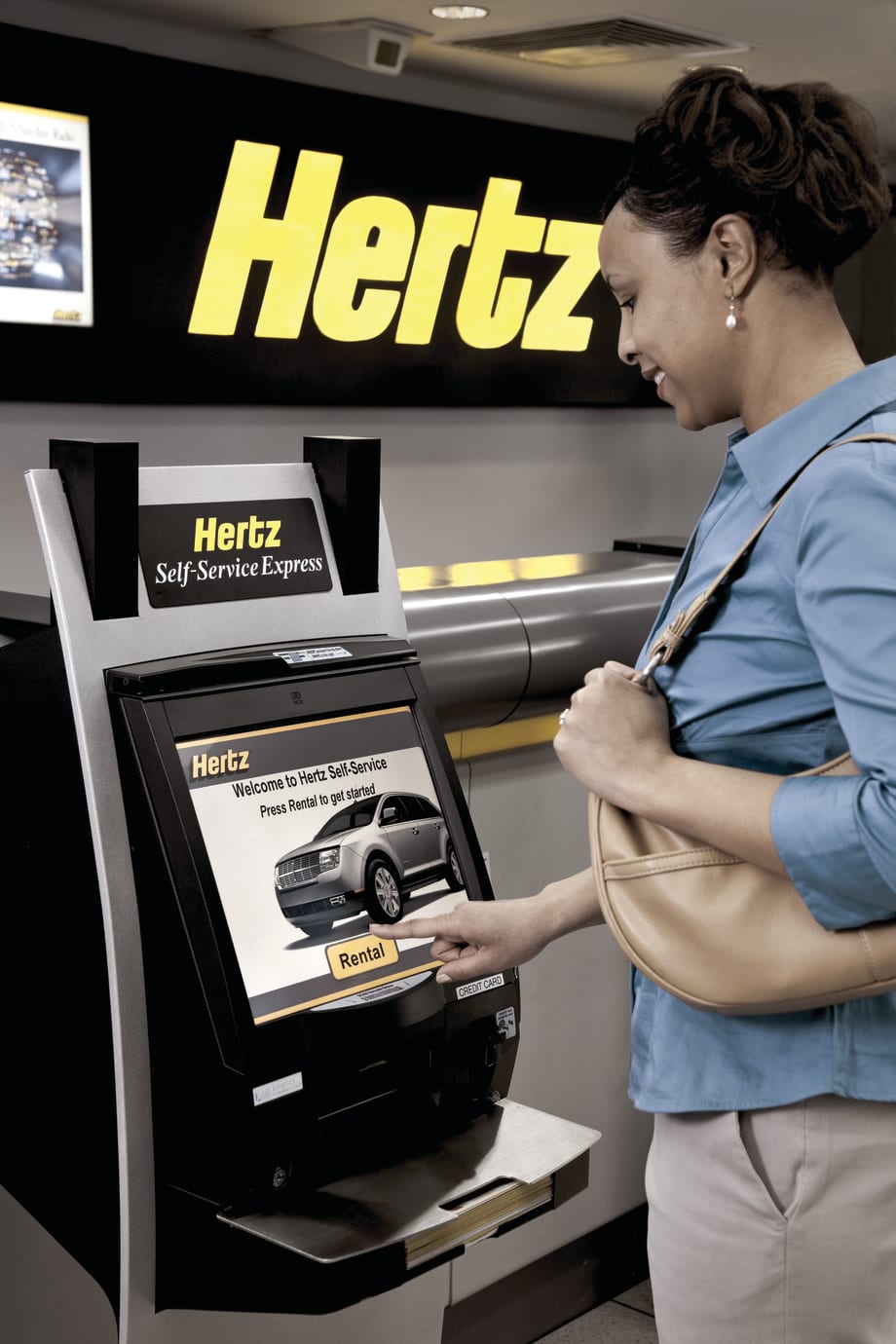
Hertz’s home-based agent program and ExpressRent kiosk initiatives are decentralizing the company’s workforce. Pictured is the first generation kiosk, though newer kiosks have a top screen to display the video agent.
Hertz’s home-based agent program and ExpressRent kiosk initiatives are decentralizing the company’s workforce. Pictured is the first generation kiosk, though newer kiosks have a top screen to display the video agent.
While technology overtakes the workplace, it is also affording mobility options to some companies’ customers and employees. For the Hertz Corp., this mobility means transitioning traditional brick-and-mortar call centers into the home — the agent’s home.
Hertz’s home-based agent program, now operating for more than three years, has call center agents working from the comfort of their own chairs and desks to answer calls for many of Hertz’s programs. Hertz Chief Information Officer Joe Eckroth says the many limitations of traditional call centers — and the benefits of a decentralized workplace — motivated implementation of the program.
“Bricks and mortar is an expensive way to go and it can also limit the geography in which you can source talent,” Eckroth says, adding that consolidating operations under one roof increases risk when it comes to natural disasters, a power outage or other service disruptions. “I now have immediate capacity and redundancy because I have my workforce spread out geographically and on many different circuits,” he says.
An ‘Employee-Friendly’ Program
Through the home-based agent program, Eckroth says he has been able to tap into an expanded workforce around the company’s call centers in Oklahoma City and in Mobile, Ala., where it is not uncommon for workers to have one- or two-hour commutes. And with gas prices rising, “Working from home is like getting a raise,” Eckroth says, adding that it gives the employees flexibility to meld the job into their lifestyles.
Compared to employees working in a call center, Eckroth reports that employee satisfaction scores are often the same if not better, and are consistently higher every year.
Since the start of the program, the call agent attrition rate has improved by 40% with no difference in customer files per hour. “The metrics speak for themselves,” he says.
Finding the Talent
Employees who are appropriate for the home-based agent program require a different set of aptitudes than those in the tightly supervised atmosphere of a call center. Eckroth looks for employees that are self-motivated, self-healing and can fix their own technical issues. While Hertz gives the at-home agents special training, “You do have to be a bit more industrious,” he says.
In narrowing in on home-based agents, Hertz tests these qualities by putting the agent in an “incubator,” where the company can observe the agent and see if the employee can set up the equipment without trouble, for example. And it’s always the employee’s choice to take the at-home position or remain in the call center.
Currently, home-based agents account for 58% of Hertz’s U.S. reservation sales specialists — a majority of whom work out of the Mobile, Ala. office.
Difficulties in Decentralizing
Eckroth has learned that each home-based employee must still feel like a part of the company. This inclusion means that home-based agents can’t be located too far from a main office, where training and meetings can take place, though Eckroth says that this is most often done virtually.
“It’s a cultural change,” he says. “Decentralizing can be immensely scary. It starts to be a little nerve-racking because you’re taking what was tightly controlled and putting it out to hundreds of locations.”
He says that besides finding the right employees who will thrive at home, he makes every effort to make them feel a part of “something bigger” than just their home offices. “The last thing you want is people who are touching our customers every day not to be included in the culture,” he says, adding that he is constantly thinking of creative ways to include the at-home agents.
Leveraging the Decentralized Workforce
The Mobile, Ala. office is located adjacent to one of Hertz’s off-airport locations and is used as the hub for face-to-face communications with agents in the surrounding area. Hertz is looking at opening other regional training centers, Eckroth says.
Hertz is also looking at using the regional centers, or call center hubs, as a base for video agents for the company’s ExpressRent video kiosks.
“It’s a progressive strategy around a different way to attract, retain and get the best and brightest people in these jobs,” Eckroth says, adding that with so many call center-like jobs in the country, by having the option to be a video agent or one that works from home, “You’re really giving them the opportunity to work the way they want,” he says.
And one more benefit of home-based agents and the ExpressRent kiosks is “the whole sustainability thing,” Eckroth says. Through the home-based agent program, Hertz says it saved more than 8 million pounds of carbon emissions in 2011.
Hertz’s next step is to take both programs overseas. As of this writing, 29 video kiosks will be installed in London’s Heathrow Airport by June or July, Eckroth says, and starting a home-based agent program is also on Hertz’s radar for its Dublin call center.
See other articles here from our July/August 2012 issue.
More Rental Operations

What Does It Take to Succeed in B2B Rentals?
The fundamentals may be familiar to daily car rental operators, but project-based truck rentals put different demands on the fleet and the business.
Read More →
NPR Builds on International Partnerships to Grow Rental Bookings
With Ana Laborde supporting broker development, NPR Auto Group is tailoring distribution strategies, rate packages, and partnerships to grow international reservations across its three brands.
Read More →
Advantage, Sixt Place Among Top Five in Annual Satisfaction Study
While Enterprise and National retain the top spots in JD Power’s 2026 rankings, the latest customer satisfaction results suggest renters can find competitive service beyond the biggest car rental names.
Read More →
The $100,000 Insurance Trap in Exotic Car Rentals
Exotic rental agencies often rely on customers’ personal auto policies to protect six-figure vehicles. But policy language can dramatically change the coverage for vehicles over $100,000 MSRP.
Read More →
The Booking Is Confirmed, But Is Your Customer Ready to Drive?
For international renters, a confirmed reservation doesn’t always mean they’re eligible to drive. Earlier checks can help operators catch documentation and payment issues before the customer reaches the counter.
Read More →
ICRS 2027 Opens Call for Papers
The International Car Rental Show seeks session proposals on the business, operational, and technology issues facing car rental operators. Submissions are due Jan. 15.
Read More →
Turo to Launch Vehicle Delivery Service
Turo Delivered will let travelers search for vehicles that hosts can deliver directly to hotels, homes, airports, train stations, and other locations.
Read More →
Palm Beach Airport Code Change Creates Car Rental Distribution Gap
A test of rental searches under the old PBI and new DJT airport codes returned largely different sets of brands and vehicles, highlighting a potential distribution problem for rental operators.
Read More →
U-Save Continues Dominican Republic Expansion with Launch in Punta Cana
The new franchise location builds on U-Save’s existing Santo Domingo operation and will begin taking reservations for October 2026.
Read More →
When AI Books the Rental Car, Who Controls the Sale?
As AI moves from comparing rental rates to completing transactions, operators need to understand how travelers find, interpret, rank, and ultimately see their offers. (Part 2 of 2.)
Read More →