




Car Rental Demand in Brazil, Russia, India and China Expected to Rise
In a 2012 report, BRICData says that an increase in each country’s GDP, personal disposable income, increasing volumes of both domestic and inbound tourists, and increasing levels of economic activity are key forces behind the increases in car rental demand.
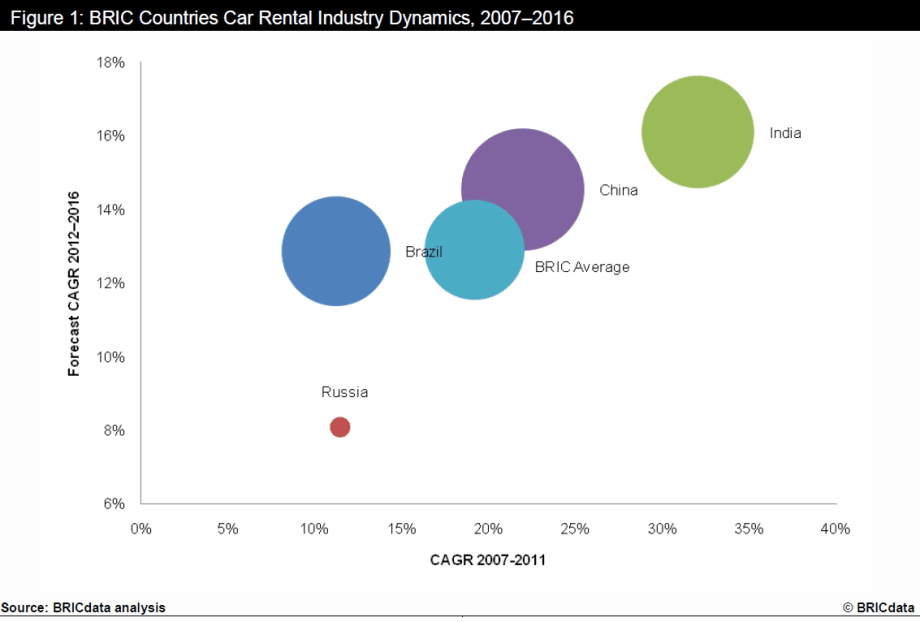
During the review period, the leisure tourist car rental market in China registered the highest growth with a CAGR of 31.94%, followed by India with a CAGR of 21.83%. Brazil and Russia recorded CAGRs of 10.24% and 11.52% respectively. Over the forecast period, the leisure care rental markets in India, Russia and Brazil are expected to grow more quickly than China's.
During the review period, the leisure tourist car rental market in China registered the highest growth with a CAGR of 31.94%, followed by India with a CAGR of 21.83%. Brazil and Russia recorded CAGRs of 10.24% and 11.52% respectively. Over the forecast period, the leisure care rental markets in India, Russia and Brazil are expected to grow more quickly than China's.
A BRICData, which studies Brazil, Russia, India and China (BRIC), released a 2012 study looking at the four regions focusing on “Market Entry Strategies and Emerging Opportunities in the Car Rental Industry in BRIC,” as the study was titled. According to the report, the four countries make up slightly less than half of the world’s total population.
At a total compound annual growth rate (CAGR) of 20% over the past five years, the four countries are expected by BRICData to continue to grow at a CAGR from 2012-2016 of 13.7% — reaching $17.04 billion in 2016. The market size of BRIC hit $8.9 billion in 2011, according to the report. “Increasing GDP levels, high levels of personal disposable income, increasing volumes of both domestic and inbound tourists, and increasing levels of economic activity are the key driving forces behind the increased demand for the car rental industry in the BRIC nations,” the report states.
Brazil
• The car rental market in Brazil is expected to grow in value from BRL5.83 billion in 2012 to BRL7.96 billion in 2016, attaining a CAGR of 8.09% over the forecast period.
• Growth is expected to be driven by the hosting of international sports events such as the 2014 FIFA World Cup and the 2016 Olympic Games, increasing volumes of both leisure and business tourists.
• The industry is highly fragmented with more than 1,000 companies operating in the economy.
Russia
• The Russian car rental industry has recorded considerable growth over the last few years, as the market size reached RUB2.57 billion in 2011, an increase of 12.7% from 2010. The market is expected to grow at a CAGR of 16.45% during the forecast period to reach RUB4.73 billion by 2016.
• Demand for rented cars in Russia comes primarily from international tourists, visiting the country either for leisure or business purposes. Demand is expected to increase significantly in line with tourist volumes.
• The Russian car rental industry is expected to remain highly competitive and fragmented, with large numbers of both local and international operators offering a variety of services at competitive rates.
India
• India’s car rental industry grew at a CAGR of 21.95% over the review period. The market is primarily driven by increasing volumes of local and international tourists, and considerable investments in road infrastructure.
• The Indian car rental industry is primarily driven by the unorganized market; the organized car rental industry contributes just 3% of the overall rental fleet size.
• With the presence of a large number of small companies, the market is expected to consolidate as larger operators look to acquire smaller companies to improve their geographical reach.
• Demand for rented cars in India is driven by both domestic and international tourists. Business customers are the primary target market, with a total market size of INR81.59 billion in 2011.
China
• China’s car rental industry is one of the fastest-growing markets in all the BRIC nations, recording a CAGR of 32.03% during 2007–2011. The market is expected to grow at a CAGR of 16.10% during 2012–2016 to reach CNY54.09 billion in 2016.
• The market’s growth will be driven by increased spending on travel by domestic tourists, urbanization rates, the high costs of owning and driving a car, and new government policies curbing private car usage.
• The Chinese car rental industry is highly fragmented, with more than 40,000 car rental companies operating across the country. The market is mainly unorganized as only 6,000 of these companies are officially registered, and 75% operate five cars or less.
• With the entry of foreign competitors, the sector is expected to register high levels of consolidation.
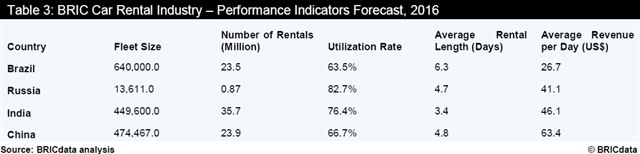
China is expected to lead the field in terms of future growth, while India is poised for significant growth with the highest rental volume and second-highest utilization rate. Brazil is expected to be a promising market for car rental companies, with forthcoming global sporting events which are likely to drive demand for rented cars.
For the full report or for sample pages, click on the URL: http://bricdata.com/research/report/TT0005MR/
More Rental Operations

Advantage, Sixt Place Among Top Five in Annual Satisfaction Study
While Enterprise and National retain the top spots in JD Power’s 2026 rankings, the latest customer satisfaction results suggest renters can find competitive service beyond the biggest car rental names.
Read More →
The $100,000 Insurance Trap in Exotic Car Rentals
Exotic rental agencies often rely on customers’ personal auto policies to protect six-figure vehicles. But policy language can dramatically change the coverage for vehicles over $100,000 MSRP.
Read More →
The Booking Is Confirmed, But Is Your Customer Ready to Drive?
For international renters, a confirmed reservation doesn’t always mean they’re eligible to drive. Earlier checks can help operators catch documentation and payment issues before the customer reaches the counter.
Read More →
ICRS 2027 Opens Call for Papers
The International Car Rental Show seeks session proposals on the business, operational, and technology issues facing car rental operators. Submissions are due Jan. 15.
Read More →
Turo to Launch Vehicle Delivery Service
Turo Delivered will let travelers search for vehicles that hosts can deliver directly to hotels, homes, airports, train stations, and other locations.
Read More →
Palm Beach Airport Code Change Creates Car Rental Distribution Gap
A test of rental searches under the old PBI and new DJT airport codes returned largely different sets of brands and vehicles, highlighting a potential distribution problem for rental operators.
Read More →
U-Save Continues Dominican Republic Expansion with Launch in Punta Cana
The new franchise location builds on U-Save’s existing Santo Domingo operation and will begin taking reservations for October 2026.
Read More →
When AI Books the Rental Car, Who Controls the Sale?
As AI moves from comparing rental rates to completing transactions, operators need to understand how travelers find, interpret, rank, and ultimately see their offers. (Part 2 of 2.)
Read More →
European Booked Car Rental Rates Fell 5%, Results Varied by Country
Ireland, Cyprus, and the United Kingdom saw steep declines, while booked rates rose in Poland and Hungary.
Read More →
Is It Time to Rethink Rental Categories?
As traditional economy and compact cars disappear from the market, longtime rental operator Mike DeLorenzo asks whether the industry’s familiar vehicle categories still make sense — and what operators need to rethink along with them.
Read More →