



Business Travel Continues Moderate but Steady Growth
Updated: Spending on group business trips in 2011 was up 7.2% over 2010. GBTA projects group travel spending will slow to 3.3% in 2012 as uncertainty in Europe and higher energy prices continue to impact the overall economy.
Business travel is showing signs of moderate but stable growth for the coming year, according to the latest Business Travel Quarterly Outlook – United States, released April 10, from the Global Business Travel Association (GBTA) and sponsored by Visa. The report shows that the business travel market has stabilized, but the outlook for international outbound travel is troubling due to the ongoing uncertainty of the European debt crisis and rising oil prices.
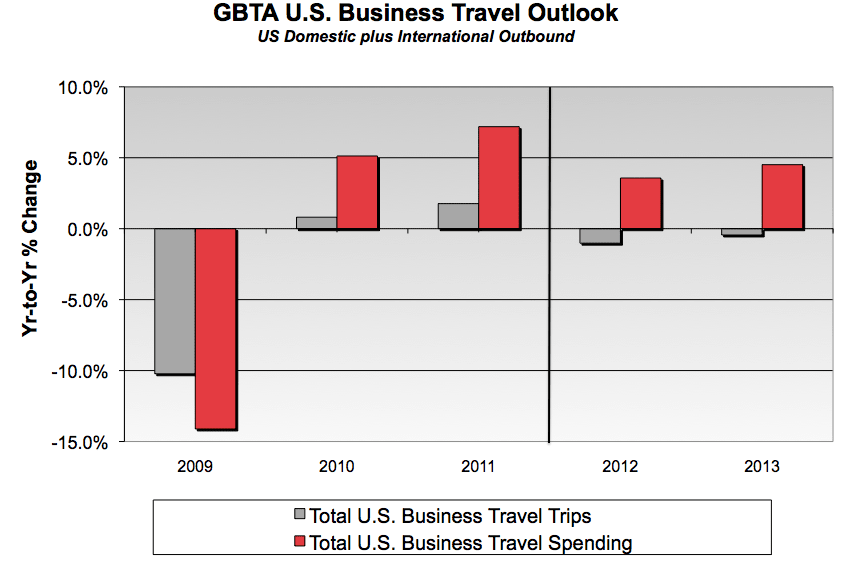
GBTA continues to believe business travel will reach its pre-recession levels by the middle of 2012, with measured growth throughout the year as economic headwinds persist. GBTA forecasts that business travel spend will increase by 4.6% in 2012 on a slight (0.8%) decline in person-trips. As an economic indicator, the steady growth of business travel spend has continued to track accurately against job growth in the U.S. over the last 12 months.
“It seems like we can start to breathe a sigh of relief about business travel,” said Michael W. McCormick, GBTA executive director and COO.
GBTA research demonstrates that 2011 was a year of growth for business travel. Total spending on U.S.-initiated business travel hit $251 billion in 2011 – up from $234 billion in 2010. This included $111.7 billion spent on transient business travel, $107.7 billion spent on group business travel and $31.6 billion spent on international outbound travel.
Total Person-Trip volume reached 445 million in 2011, up from 437 million in 2010. This figure will fall slightly to 440.4 million Person-Trips in 2012.
A Decade of Fewer Trips, Greater Spend
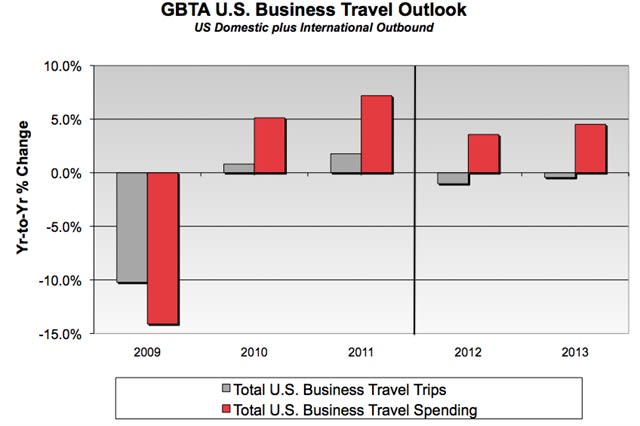
GBTA research demonstrates that since 2000, the number of business trips taken has declined, while the amount spent on business travel has increased — and not due solely to price inflation. In 2000, 576.06 million trips were taken with a spend of $242.9 billion. 2011 saw the number of trips decrease to 445.0 million (decrease of 22.7%) and spend increase 3.3% to $251.0 billion. In 2012, the trend will continue, as the number of trips dips 1% while spend increases 3.6%.
In fact, GBTA research shows that the average spend on a trip in 2000 was $422 and in 2011 it has grown by 33.6% to $564. While inflation alone accounts for 64% of the increase in average spend, the real increases in spending account for 36% of the total increase.
McCormick explained: “Aside from the boost in 2010 and 2011 when we were starting to get back on track after the worst of the recession, this trend makes perfect sense. We’re seeing road warriors taking fewer trips, but making the most of them, making more stops and spending more on the road. The productivity explosion is a huge factor and it’s being brought on by better travel management, better technology and making the most of their time on their road. In the past, a road warrior may make two trips rather than just spending an extra night, or three travelers would go out on a trip together, where now it’s fewer. This is a remarkable trend that we don’t see ceasing.”[PAGEBREAK]
GBTA Business Travel Index —
En Route to Pre-Recession Highs
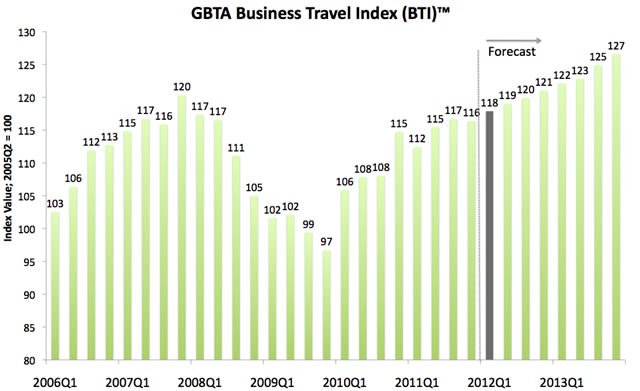
The GBTA Business Travel Index (BTI) for Q4 2011 came in at 116 — two points lower than the projected value in GBTA’s last outlook. The BTI is expected to see stable growth over the forecast horizon, reaching its pre-recession high of 120 in 2012 Q3. The index is expected to grow roughly one point per quarter through 2012 before picking up pace in the second half of 2013.
This slightly lower index value has been driven by continued uncertainty in the Eurozone, higher global energy prices and continued slow growth in the domestic economy. Business travel had a relatively good 2011, but Q4 GBTA BTI finishes just one point above 2010 Q4’s 115, as international economic risks and slow domestic growth have challenged robust recovery.
International Travel –
'The Outlook is Troubling'
After growing 8.5% in 2011, international outbound travel spend is expected to slow to only 3% growth in 2012. Weaker demand in Europe and Asia has led to the slowdown. The number of total U.S.-initiated international business trips hit 6.78 million in 2011, 3.1% growth over 2010. GBTA expects growth in the number of trips to slow to 1.2% in 2012, followed by more a robust advance of 4.8% in 2013.
“International travel has been a major driver for business travel during the recovery, but the outlook is troubling,” McCormick said. “The Eurozone crisis is creating too much uncertainty for many businesses and causing many to rethink where they send their travelers. We don’t expect anyone to make drastic changes, because they won’t want to give up the advantage of the face-to-face meeting, but we do think those trips will become less frequent.”
Group Travel Spend –
Modest Growth Continues
Transient business travel spend finished 2011 very strongly — ending the year up 6.7%, after falling -0.4% in 2010. But this rate won’t continue as GBTA expects growth to be far more modest in 2012 and 2013 (3.7% and 3.9% respectfully), staying in line with the slow-growth pattern of the economic recovery.
Group travel will keep pace with transient growth as long as no significant economic shocks take place. Economic shocks disproportionately impacts group travel compared to transient travel. Spending on group business trips in 2011 was up 7.2% over 2010. GBTA projects group travel spending will slow to 3.3% in 2012 as uncertainty in Europe and higher energy prices continue to impact the overall economy.
Report's Key Metrics
The Business Travel Quarterly Outlook – United States is free of charge to all GBTA Members (gbta.org/foundation/resourcelibrary). Non-members may purchase the report through the GBTA Foundation at research@gbta.org.
The Business Travel Quarterly Outlook – United States projects aggregate business travel trends over the next eight quarters. The report includes key buy-side metrics such as total business travel volume and spending, plus supply-side projections of changes in costs, across both transient and meetings travel.
This article was updated on April 13 to include the two charts.
More Rental Operations

Palm Beach Airport Code Change Creates Car Rental Distribution Gap
A test of rental searches under the old PBI and new DJT airport codes returned largely different sets of brands and vehicles, highlighting a potential distribution problem for rental operators.
Read More →
U-Save Continues Dominican Republic Expansion with Launch in Punta Cana
The new franchise location builds on U-Save’s existing Santo Domingo operation and will begin taking reservations for October 2026.
Read More →
When AI Books the Rental Car, Who Controls the Sale?
As AI moves from comparing rental rates to completing transactions, operators need to understand how travelers find, interpret, rank, and ultimately see their offers. (Part 2 of 2.)
Read More →
European Booked Car Rental Rates Fell 5%, Results Varied by Country
Ireland, Cyprus, and the United Kingdom saw steep declines, while booked rates rose in Poland and Hungary.
Read More →
Is It Time to Rethink Rental Categories?
As traditional economy and compact cars disappear from the market, longtime rental operator Mike DeLorenzo asks whether the industry’s familiar vehicle categories still make sense — and what operators need to rethink along with them.
Read More →
Who Owns the Rate? AI Is Creating a New Distribution Problem for Car Rental
Generative Engine Optimization asks whether AI can find a rental company, but operators also need to know whether the agent inspected enough of the market, compared equivalent offers, and presented a rate the traveler can actually book. (Part 1 of 2)
Read More →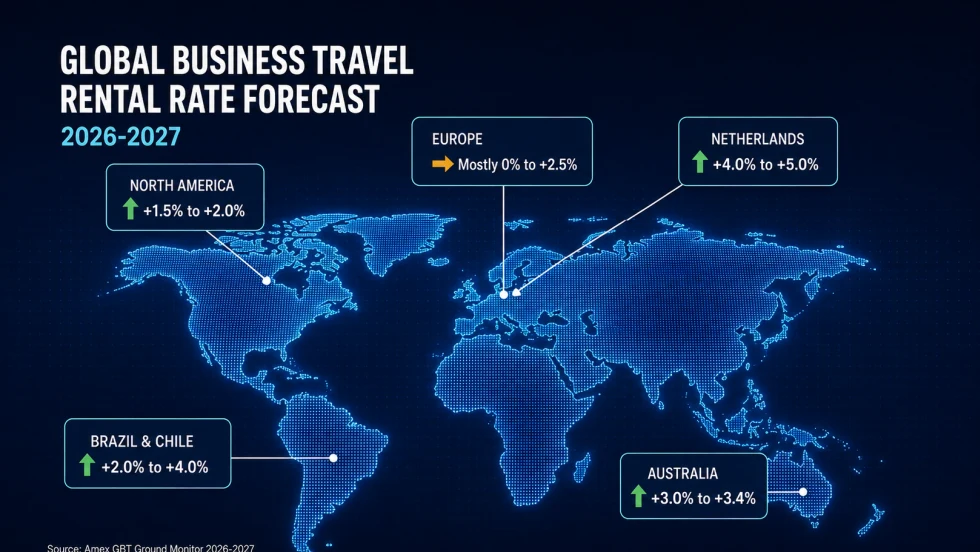
U.S. Business Travel Car Rental Rates Forecast to Rise Up to 2%
Improved fleet supply should limit pricing gains in 2026-27, while insurance, repair costs, and softer residual values continue to pressure rental operations, according to Amex GBT.
Read More →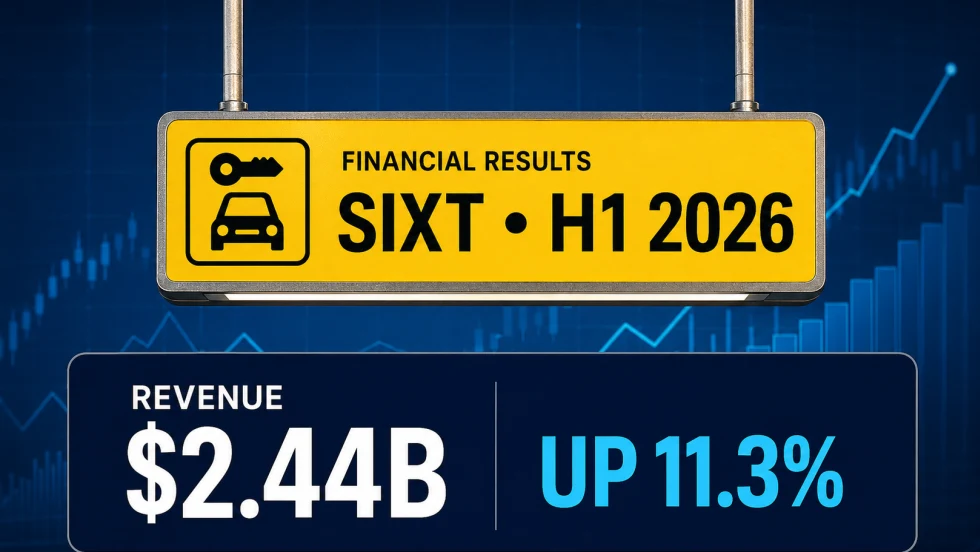
Sixt Revenue Tops $2.4 Billion in First Half of 2026
Sixt’s first-half revenue surpassed $2.4 billion for the first time as demand outpaced fleet growth, lifting utilization and earnings despite weaker consumer sentiment in North America.
Read More →
In Memoriam: Bobby Klyce, Avis Licensee Legend
The longtime Birmingham Avis operator and 2018 Auto Rental News Impact Award recipient was remembered as an advocate for independent licensees and the broader car rental industry.
Read More →
How to Build Custom Fleet Tools With AI and Vibe Coding [Webinar]
A new Automotive Fleet webinar explores how fleet managers are using AI and vibe coding to automate routine work and create simple operational tools without traditional programming skills.
Read More →