


Understanding E-Signature Pads and the Electronic Rental Agreement
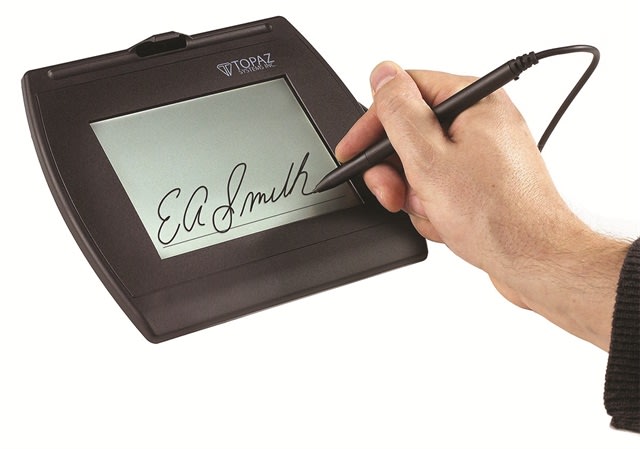
A pending class action case regarding rental contracts on electronic signature pads marks a good time to present the key points of electronic signature law and establish general best practices regarding their use and disclosure.
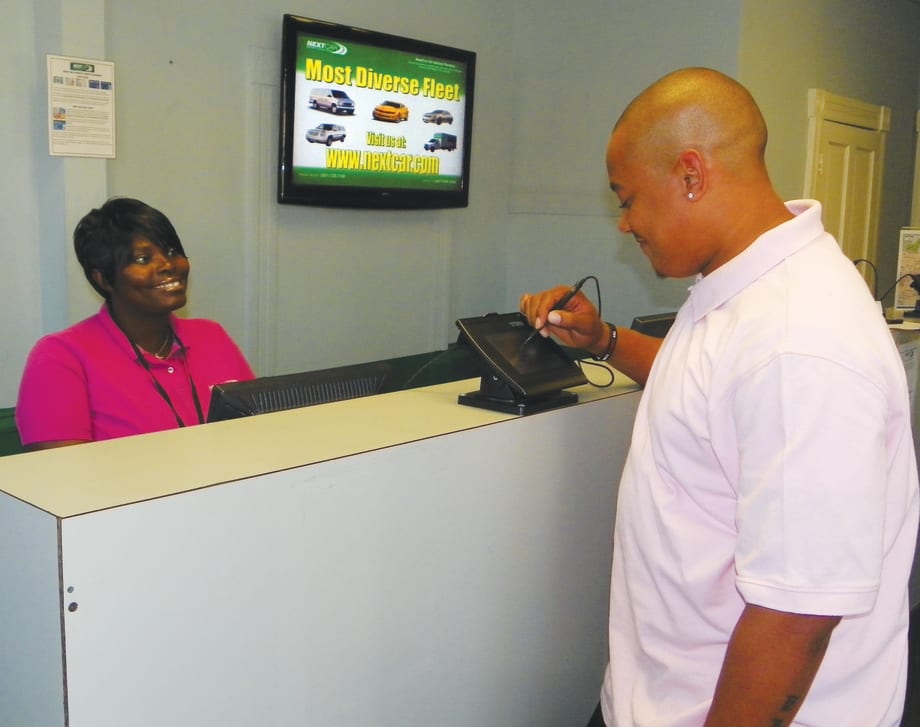
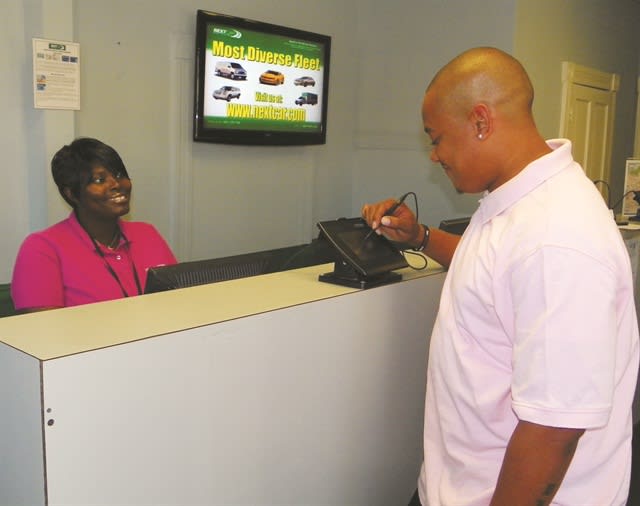
A NextCar customer uses the e-signature pad to review and approve his rental agreement. Photo credit: NextCar
NextCar
It’s easy to understand the trend toward electronic agreements signed using electronic signature pads — they provide benefits to both the customer and the rental company, including administrative savings, shorter processing times and a reduction in paper files.
The electronic rental agreement is simply a version of the manual rental agreement in electronic form. Nonetheless, this added layer of technology can add new wrinkles to the age-old customer argument of “I didn’t agree to that,” as this recent class-action lawsuit brought against Dollar Thrifty Automotive Group (DTAG) attests.
FACING CLASS-ACTION CLAIMS
Accused of adding extra charges onto rental car contracts and violating consumer protection statutes, DTAG (acquired by Hertz in late 2012) is facing class-action claims from customers that could advance to trial. According to the McKinnon and Tool v. Dollar Thrifty Automotive Group case filed on Aug. 24, 2012, Sandra McKinnon and Kirsten Tool are suing for allegedly defrauding them and other customers in California and Oklahoma.
“Plaintiffs suggest that defendants rely on the hustle and rush of airports to send their customers away without having reviewed their rental charges, thereby giving defendants a basis for claiming that their customers routinely agree to the add-on charges,” according to the opinion written by U.S. District Judge Samuel Conti.
After allegedly orally declining additional services such as damage waivers and insurance, the plaintiffs claim that Dollar employees misled them into checking boxes on the electronic signature pad that actually added the extra services.
Because the rental agent allegedly didn’t verbally discuss the total amount charged at pickup with McKinnon, the complaint claims that McKinnon was charged $359.65 in addition to her original online reservation rate when she returned the car, according to the McKinnon opinion.
On July 3, the U.S. District Court for the Northern District of California refused to dismiss all the class-action claims against DTAG.
“Based on plaintiffs’ reasonably specific pleadings, defendants have a national scheme involving providing low reservation rates and then tricking customers into paying more once they pick up their cars,” according to Conti’s opinion. “… Defendants’ conduct is more than mere endemic dishonesty — it is actionable under the unfair competition law as an unfair and fraudulent business practice.”
In addition, Conti found that DTAG’s online reservation confirmation should be viewed as a contract: “Defendants’ refusal to honor the confirmation price in anyway, and in fact to convince plaintiffs of the price’s validity and then alter it secretly, was a breach.”
[PAGEBREAK]
It is important to note that this is a preliminary decision. The judge’s refusal to dismiss the charges simply means that the plaintiffs — as well as Dollar Thrifty — will get their day in court.
At this stage, it is currently a “he-said, she-said” case. In Dollar’s motion to dismiss, the company states that each plaintiff received information about the charges associated with the loss damage waiver and each agreed to pay those charges through acceptance and signature on the signature capture pad.
With the trend toward e-signature pads growing, it is time to present the key points of electronic signature law and establish general best practices regarding their use and disclosure — many of which apply to traditional manual rental agreements as well.
RENTAL AGREEMENT BEST PRACTICES
Computime
According to Leslie Pujo, attorney/owner at LaPlaca Pujo, PC, counter agents should be instructed to verbally disclose to renters that CDW, SLI, PAI, PEC, Roadside Assistance and other products are optional, and that CDW and optional insurance products may duplicate a renter’s other coverage.
Pujo recommends making available a paper copy of terms and conditions and other pre-printed forms for renters to review before they sign a rental agreement on paper or by e-signature pad.
She also recommends that at the end of the transaction counter agents identify and review all parts of the rental agreement with the renter and communicate total charges and optional product selections.
Careful attention to these procedures and policies is even more important when using electronic signature pads, Pujo says.
To help renters clearly see what options they are accepting or declining, especially on the electric signature pads, it is important for the verbiage to stand out. For example, the words “accept” and “decline” could be uppercased and/or bolded, says Angela Margolit, president of Bluebird Auto Rental Systems.
[PAGEBREAK]
SUCCESS WITH ELECTRONIC SIGNATURE PADS
Chris Barber, director of information technology for NextCar and Rent-A-Wreck, says that NextCar has had fewer customer inquiries and complaints since switching its rental agreement to electronic signature pads a year and a half ago.
NextCar’s electronic rental agreement is broken into separate sections, including estimated charges, return date, additional renters and sections for each type of coverage, says Barber.
While going through the e-signature pad process, customers select “agree” or “decline” and initial for all the key portions of the rental agreement. For example, customers have to initial whether they are accepting or declining the Rent A Toll product, says Barber. When they click “confirm,” it takes them to the next screen, and the final screen requires their signature.
“Customers have to not only initial but also click ‘confirm,’ so they are driving the speed of the process,” says Barber, adding that this instills a comfort level and sense of ownership with the customer. “It kind of slows down the process so there is good dialogue between our agent and the customer, alleviating any possible confusion.”
In addition, the e-signature pad process helps keep NextCar’s agents on task, says Barber. Using Bluebird’s RentWorks program, agents initiate the signature process and set up the rental agreement. The agent’s computer screen displays a mimicked version of what the customer sees on the e-signature pad.
Throughout the process, the agents know the customers’ exact location on the contract and can help address any questions on each page.
“We are having the same conversations [as we did with a printed contract] but at the customer’s pace,” says Barber. “And the customer has a better visual aid for each portion of the contract.”
Customers leave with their own initialed and signed paper copy. That contract becomes a permanent record but can be amended if they come in to make a change, in which they initial and sign again.
More Rental Operations
Direct, Broker or Hybrid? How Travel Retailers Source Rental Cars
As travel retailers weigh direct supplier relationships against third-party distribution, rental operators need to understand how those decisions affect their business.
Read More →
How Did This Independent Rental Operator Grow to 170 Vehicles in 4 Years?
With 170 vehicles across three Kentucky locations, Joel Price relies on an overseas team to handle reservations, payments, and after-hours customer service. It's one part of an unconventional approach to growing an independent rental operation.
Read More →
What Does It Take to Succeed in B2B Rentals?
The fundamentals may be familiar to daily car rental operators, but project-based truck rentals put different demands on the fleet and the business.
Read More →
NPR Builds on International Partnerships to Grow Rental Bookings
With Ana Laborde supporting broker development, NPR Auto Group is tailoring distribution strategies, rate packages, and partnerships to grow international reservations across its three brands.
Read More →
Advantage, Sixt Place Among Top Five in Annual Satisfaction Study
While Enterprise and National retain the top spots in JD Power’s 2026 rankings, the latest customer satisfaction results suggest renters can find competitive service beyond the biggest car rental names.
Read More →
The $100,000 Insurance Trap in Exotic Car Rentals
Exotic rental agencies often rely on customers’ personal auto policies to protect six-figure vehicles. But policy language can dramatically change the coverage for vehicles over $100,000 MSRP.
Read More →
The Booking Is Confirmed, But Is Your Customer Ready to Drive?
For international renters, a confirmed reservation doesn’t always mean they’re eligible to drive. Earlier checks can help operators catch documentation and payment issues before the customer reaches the counter.
Read More →
ICRS 2027 Opens Call for Papers
The International Car Rental Show seeks session proposals on the business, operational, and technology issues facing car rental operators. Submissions are due Jan. 15.
Read More →
Turo to Launch Vehicle Delivery Service
Turo Delivered will let travelers search for vehicles that hosts can deliver directly to hotels, homes, airports, train stations, and other locations.
Read More →
Palm Beach Airport Code Change Creates Car Rental Distribution Gap
A test of rental searches under the old PBI and new DJT airport codes returned largely different sets of brands and vehicles, highlighting a potential distribution problem for rental operators.
Read More →