




3 Key Trends Driving the EV Charging Market
IDTechEx research has identified three key trends shaping the EV charging market as demand for access among electric vehicle users skyrockets.
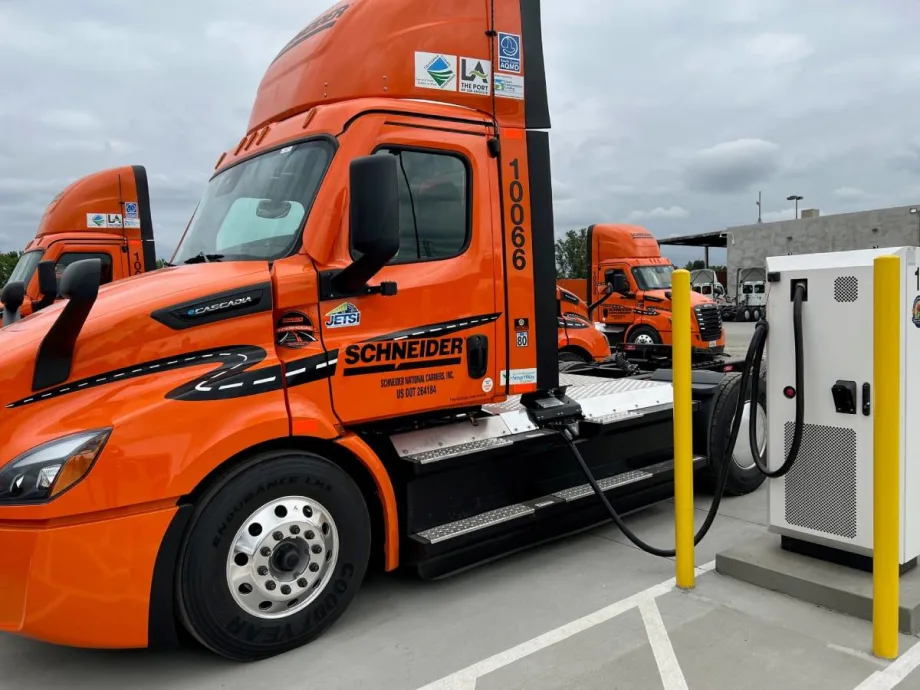
The transition towards higher voltage charging infrastructure promises enhanced performance and reduced charging times alongside regulatory initiatives that support the deployment of fast chargers.
Photo: Martin Romjue / Bobit
The world is witnessing an electrifying revolution in the automotive industry, as electric vehicles (EVs) emerge as a compelling solution to combat climate change and reduce our carbon footprint.
As more individuals and businesses shift towards electric mobility, the demand for efficient and accessible EV charging infrastructure has skyrocketed. In this fast-evolving landscape, staying ahead of the curve is vital for stakeholders across the EV ecosystem.
IDTechEx research dives into the heart of the matter, uncovering three key trends shaping the EV charging market.
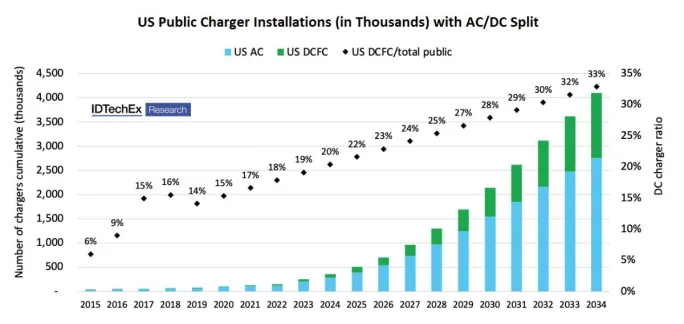
DC fast chargers will grow to take 33% public charger market share in the US by 2034.
Graphic: IDTechEx
NO. 1: 800V Batteries and Traction-Integrated Onboard Chargers (iOBCs)
Many EVs have relied on 400V battery architecture, but the future is 800V and beyond. Twice the voltage means far faster charging times for EVs.
A relatively simple innovation in next-generation vehicle platforms is using the traction high-powered electronics of the EV to double up as a high-power onboard DC charger while the vehicle is stationary.
By using the traction power electronics as part of the charging circuit, each vehicle is automatically rated at the maximum C rate of the battery, meaning faster possible charging times can be unlocked.
Some commercial vehicles operating on a higher platform voltage (BYD, ABB/Hitachi) have already demonstrated using the onboard traction inverter as part of the charging circuit. The passenger EV industry has already started to see a mass transition to 800V platforms and traction iOBCs, with many models already available (Hyundai, Lucid) or announced.
By 2026, IDTechEx speculates that a lot of mass-market OEMs will have moved to third generation platforms. Since the drive unit and charging station comprise of similar or identical components, most of the equipment inside the charging station can be made redundant, eliminating unnecessary cost, weight, and public space.
The next generation of charging infrastructure will be able to eliminate all of the unnecessary component duplications found in an EV charger and create new infrastructure optimized around DC, including onsite generation and storage. The next generation of EV charging infrastructure will start to look increasingly like a decentralized network of bidirectional DC micro-grids.
The latest report from IDTechEx finds EVSE manufacturers launching DC wallboxes in the 20-30 kW range and benchmarks them by power, voltage, current, and weight metrics.
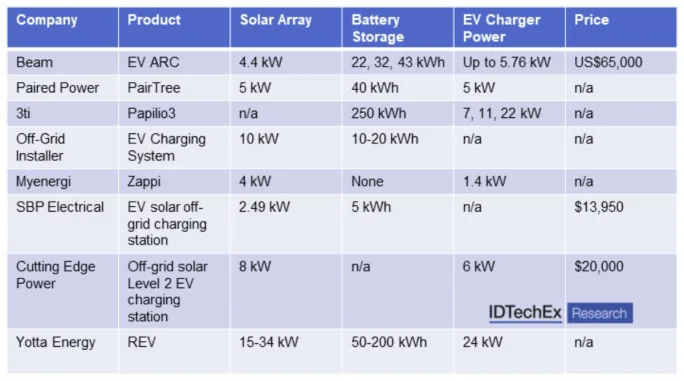
Examples of EV solar-charging infrastructure available on the market from manufacturers.
Graphic: IDTechEx
NO. 2: Off-Grid Solar Charging Infrastructure
EV charging in certain environments does not permit any digging — brownfield sites, nuclear waste sites, airports, etc. Off-grid solar charging EV infrastructure can be deployed without digging for foundations or trenching, which means it is an ideal solution for these types of environments.
Lack of spare capacity on the grid or waiting for infrastructure to be grid-tied can be serious bottlenecks in deploying standard EV chargers, creating a demand for off-grid solutions. IDTechEx Research finds off-grid solar charging companies coupling their sun-tracking solar canopies with onsite battery storage to offer a portable solution.
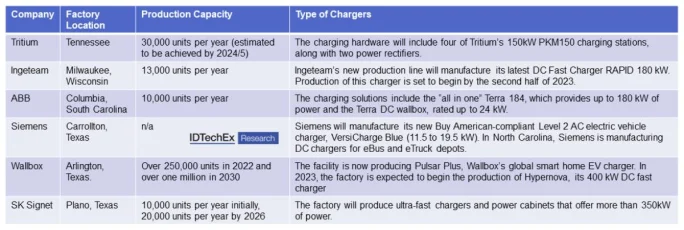
US building up domestic manufacturing base for EV chargers.
Graphic: IDTechEx
NO. 3: National Electric Vehicle Infrastructure (NEVI) Formula Program
On Feb. 15, 2023, the Federal Highway Administration (FHWA) and the Biden Administration announced standards for chargers purchased and installed with NEVI funding.
This includes predictable charging (consistent plug types, power levels), reliability requirements (97% uptime minimum), accessibility, and plug and charge capability. In addition, chargers must also meet Buy America standards with local manufacturing of most of the components initially with tighter control over time.
NEVI is accelerating EV charging infrastructure rollout in the U.S., but the market is heading into a rapid growth curve. Many states are starting NEVI programs, and most won’t be ready to install chargers until later in 2023. IDTechEx predicts that NEVI chargers will deploy en masse in 2024.
IDTechEx finds multiple EVSE manufacturers setting up domestic U.S. manufacturing facilities to comply with the Buy America standard and reduce time to market as the US public charging market expands.
DC fast charger (in the 24-350 kW range) installation is outpacing the growth of level 1 and 2 AC charger installations in the U.S. The number of EVSE ports with a power output between 250 and 349 kW grew by the largest percentage in 2022 overall.
This growth can be attributed to the addition of new Tesla Supercharger installations with a power output of 250 kW. The growth in higher power level fast charging infrastructure (>349 kW) is primarily attributable to new Electrify America, EVgo, and Rivian Adventure Network installations.
AC chargers still dominate public charger installations in the U.S., but the share of DC chargers is forecasted to rise gradually to serve the needs of interstate travelers.
Future of Electric Mobility
In conclusion, these trends in the EV charging market are paving the way for a transformative future of electric mobility. Witness the rise of faster and more efficient charging solutions, unlocking new possibilities for electric vehicle adoption on a global scale.
The transition towards higher voltage architectures promises enhanced performance and reduced charging times alongside regulatory initiatives that support the deployment of fast chargers. The IDTechEx report on the EV charging market, “Charging Infrastructure for Electric Vehicles and Fleets 2024-2034”, includes 10-year granular forecasts by technology (AC/DC split), power class, and key regions.
Information about this IDTechEx report, including downloadable sample pages: www.IDTechEx.com/EVCharge.
Full portfolio of IDTechEx research on electric vehicles: www.IDTechEx.com/Research/EV.
Shazan Siddiqi is a senior technology analyst at IDTechEx, a London, U.K.-based company that provides research and consultancy products.
Originally posted on Charged Fleet
More Green Fleet

Fleet Forward Conference Introduces One-Day Passes for 2026
New one-day registration gives fleet professionals the flexibility to attend Tuesday, Wednesday, or Thursday, with passes available for $199 through Sept. 18.
Read More →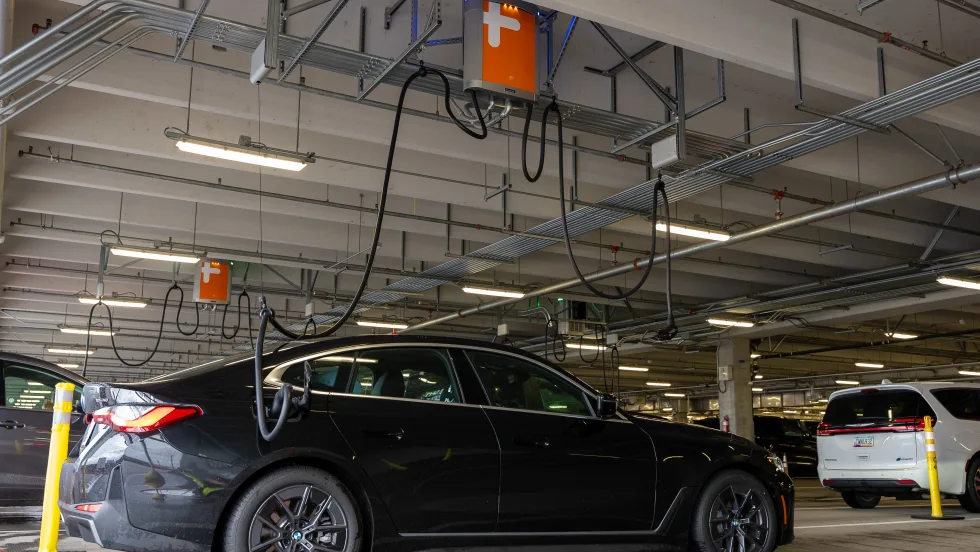
Portland Airport Adds Overhead EV Charging for Rental Fleets
The design is intended to address challenges associated with installing chargers in busy rental-car facilities.
Read More →
Running A Profitable Electric Rental Fleet
How do you successfully operate an all-electric rental car fleet? Whether you manage a rental fleet or another commercial fleet, this conversation offers practical lessons on deploying, operating, and scaling electric vehicles.
Read More →
Green Motion Expands Into Japan With Master Franchise Agreement
Japan's tourism industry, business travel market, and demand for vehicle rental services are reasons the country represents an important market for the company.
Read More →
Green Motion Expands Its African Presence with Mozambique Launch
This new rental car outlet reflects the growing demand for reliable transportation and the emphasis on sustainable travel across the continent.
Read More →
Survey: New Tech Tools, Sharper Pricing Plans, and Focused Service Can Improve Rental Car Industry
ICRS 2025: What are key trends, challenges, and opportunities confronting rental car operators this year?
Read More →
Green Motion Adds South Korea to Its Asian Service Region
The first Green Motion locations in South Korea are scheduled to open in key travel hubs during the coming months, including Seoul, Jeju, and Busan International Airports.
Read More →
Federal Highway Administration Halts EV Charger Funding, Delaying National Expansion Plans
The FHWA has rescinded funding for the NEVI Formula Program, delaying nationwide EV expansion as policies undergo federal review.
Read More →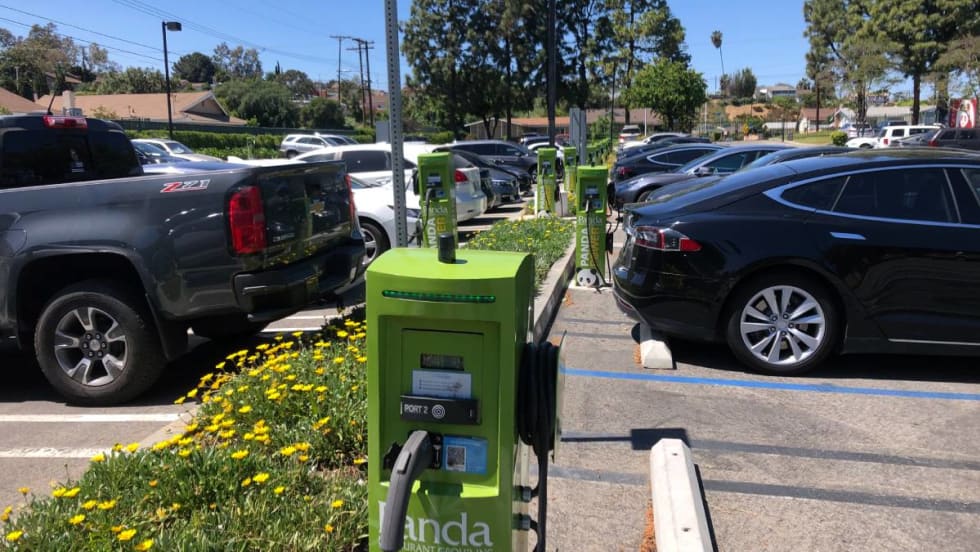
Operator Outlook: EVs Slow to Charm Rental Car Industry
2025 ARN Fact Book: Electric vehicles still must prove their reliability and worth in a fleet sector that puts rolling metal on the ground 24/7 for a demanding customer base.
Read More →
Green Motion Opens Franchise in Germany’s Most Populous State
The rental car outlet brings its hybrid and electric vehicles and sustainable approach to business to one of Europe’s most economically powerful regions.
Read More →