




Dollar Thrifty Cuts 25 Percent of Management Positions in Tulsa
Gary Paxton: "We are absorbing higher vehicle financing costs as a result of lower credit ratings in the auto industry. While raising rental rates is the key to offset these vehicle related cost increases, we are also taking steps to further reduce operating costs.”
Dollar Thrifty Automotive Group, Inc. today announced a reorganization, including the flattening of the management structure, staff reductions, and the assignment of new responsibilities to key executives at its Tulsa-based headquarters, the company reports.
"Vehicle manufacturers have been reducing the number of vehicles sold to the rental car industry and increasing our fleet costs," said Gary L. Paxton, President and Chief Executive Officer. "We are also absorbing higher vehicle financing costs as a result of lower credit ratings in the auto industry. While raising rental rates is the key to offset these vehicle related cost increases, we are also taking steps to further reduce operating costs throughout the organization in an effort to reinforce our objective to be the low cost provider in the rental car industry. The Company's action today is designed to respond to these auto industry changes by reducing operating costs and flattening the organization to make it even more efficient and more capable of a rapid response to the changing environment," said Paxton.
The personnel changes, effective immediately, eliminate approximately 25 percent of management positions at the Company's headquarters in Tulsa, Oklahoma, as well as other support staff. This is in addition to the 10 percent reduction in executive management positions the Company made last year at this time. The financial impact of these actions will be disclosed with the Company's earnings release on August 7, 2007.
During the past year, Dollar Thrifty has implemented many cost savings and efficiency initiatives, including:
-- Outsourcing its IT services to EDS
-- Outsourcing certain call center operations
-- Introducing productivity improvements in all field locations utilizing lean management techniques
The Company completed a significant financing transaction in the second quarter, which provides more flexibility to finance non-program vehicles and vehicles purchased from non-investment grade manufacturers. This included $250 million in corporate debt that was used to pay down asset backed vehicle financing.
"We were aggressive in dealing with the potential credit rating downgrade of our key vehicle supplier as a result of its pending sale, which allowed us to put this financing in place during very favorable market conditions," Paxton said.
"We also have several revenue growth initiatives in the pipeline right now that are quite encouraging, including increasing efforts to target both the domestic corporate segment and international inbound segment and expanding our sales team in the U.S. and around the world," Paxton said. "We're also continuing our aggressive franchise acquisition strategy with the purchase of ten Thrifty franchises and one Dollar franchise already this year."
As part of this reorganization, R. Scott Anderson, Senior Executive Vice President of Global Marketing and Franchise Operations will take over responsibilities for corporate operations, fleet and revenue management. John J. Foley, Senior Executive Vice President of Corporate Operations will take over responsibilities for global marketing and franchise operations. "Having these two key executives switch roles will provide them with broader business experience while bringing a fresh perspective on key areas of our business," Paxton said.
"We expect the organizational changes made today will further improve our focus on the customer while also maintaining a sharp focus on continuous improvement," said Paxton.
More Rental Operations

ICRS 2027 Opens Call for Papers
The International Car Rental Show seeks session proposals on the business, operational, and technology issues facing car rental operators. Submissions are due Jan. 15.
Read More →
Turo to Launch Vehicle Delivery Service
Turo Delivered will let travelers search for vehicles that hosts can deliver directly to hotels, homes, airports, train stations, and other locations.
Read More →
Palm Beach Airport Code Change Creates Car Rental Distribution Gap
A test of rental searches under the old PBI and new DJT airport codes returned largely different sets of brands and vehicles, highlighting a potential distribution problem for rental operators.
Read More →
U-Save Continues Dominican Republic Expansion with Launch in Punta Cana
The new franchise location builds on U-Save’s existing Santo Domingo operation and will begin taking reservations for October 2026.
Read More →
When AI Books the Rental Car, Who Controls the Sale?
As AI moves from comparing rental rates to completing transactions, operators need to understand how travelers find, interpret, rank, and ultimately see their offers. (Part 2 of 2.)
Read More →
European Booked Car Rental Rates Fell 5%, Results Varied by Country
Ireland, Cyprus, and the United Kingdom saw steep declines, while booked rates rose in Poland and Hungary.
Read More →
Is It Time to Rethink Rental Categories?
As traditional economy and compact cars disappear from the market, longtime rental operator Mike DeLorenzo asks whether the industry’s familiar vehicle categories still make sense — and what operators need to rethink along with them.
Read More →
Who Owns the Rate? AI Is Creating a New Distribution Problem for Car Rental
Generative Engine Optimization asks whether AI can find a rental company, but operators also need to know whether the agent inspected enough of the market, compared equivalent offers, and presented a rate the traveler can actually book. (Part 1 of 2)
Read More →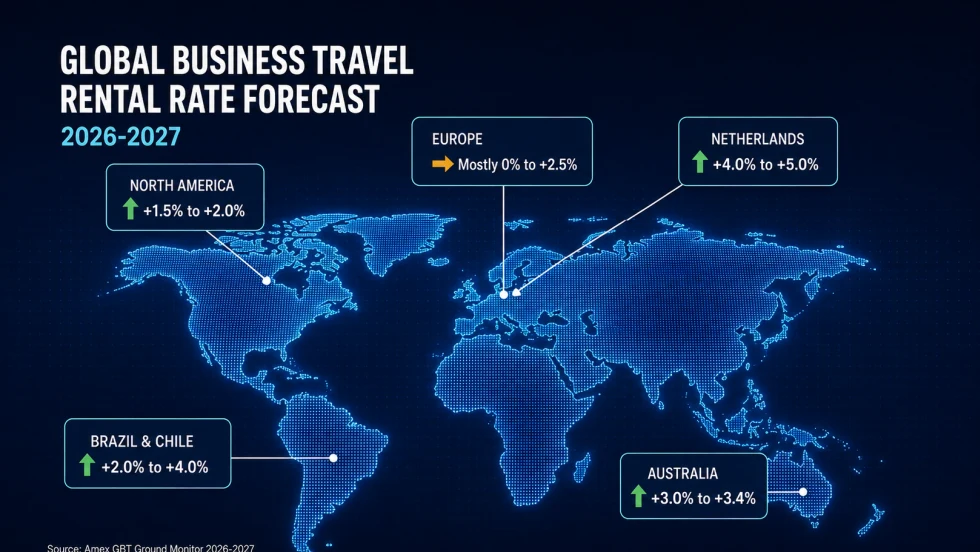
U.S. Business Travel Car Rental Rates Forecast to Rise Up to 2%
Improved fleet supply should limit pricing gains in 2026-27, while insurance, repair costs, and softer residual values continue to pressure rental operations, according to Amex GBT.
Read More →
Sixt Revenue Tops $2.4 Billion in First Half of 2026
Sixt’s first-half revenue surpassed $2.4 billion for the first time as demand outpaced fleet growth, lifting utilization and earnings despite weaker consumer sentiment in North America.
Read More →