




Making Connections: More Options Diversify Travel Plans
World Cup Travel Data Shows Longer Car Rentals and More One-Ways
A recent analysis of FIFA bookings found varied demand patterns that influenced rental car pricing.
by Hannes Poldvee, Car Rental Gateway
June 23, 2026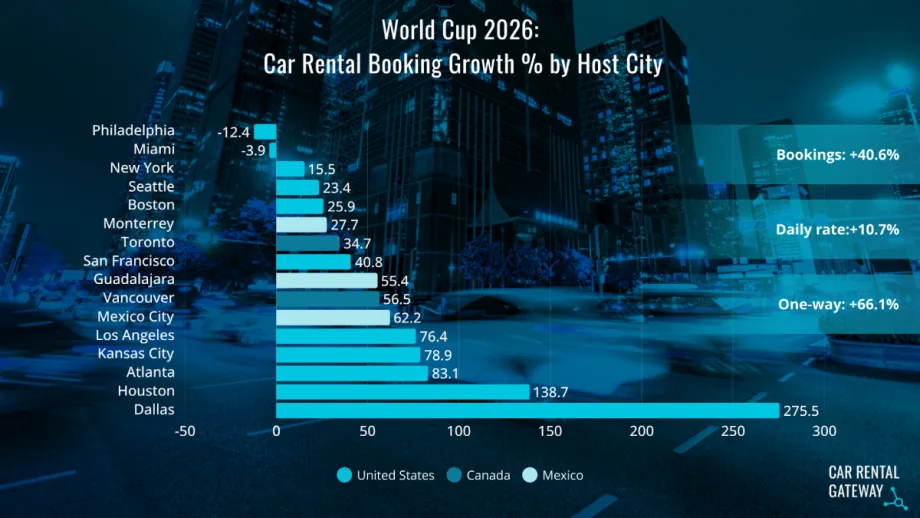
The U.S. picture on FIFA World Cup-related bookings was more mixed, with Dallas the runaway winner among cities.
Credit:
Car Rental Gateway
3 min to read
- Travelers may choose longer car rentals to ensure reliable transportation over the duration of the tournament and to visit multiple locations.
- One-way car rentals allow a vehicle to be picked up in one location and dropped off in another
*Summarized by AI
The FIFA World Cup 2026 is already starting to appear in car rental booking data.
At Car Rental Gateway, we recently analyzed thousands of bookings across the 16 FIFA World Cup 2026 group-stage host cities. The analysis compared rental pickup dates around each city’s first hosted match with the same weekdays one year earlier.
Across those host cities, car rental pickups were up 40.6% around match day. That headline number matters, but it is not the whole story.
For rental operators, brokers and mobility platforms, the more useful insight may be how differently the impact appears from city to city, and how customers seem to be shaping their trips around the tournament.
Canada was one of the more interesting regional signals. Vancouver saw pickups increase 56.5%, while Toronto was up 34.7%.
Those increases are not the largest in the dataset, but they are still useful because of the timing.
Canada’s first host-city matches came in mid-June, before the strongest July and August tourism period. That makes the lift easier to see against the seasonal baseline and suggests the tournament is already visible in rental pickup behavior.
Mexico also showed clear growth. Mexico City was up 62.2%, Guadalajara was up 55.4%, and Monterrey was up 27.7%.
The U.S. picture was more mixed. Dallas was one of the strongest movers, with bookings up 275.5%. That percentage should be read with some care because the prior-year base was smaller than in the largest U.S. hubs. Still, the increase is notable, especially when viewed alongside Dallas’ strong early group-stage fixture mix, including matches involving the Netherlands, England, and Argentina.
Fixture strength appears to matter. New York (NY NJ Stadium) opened with Brazil vs Morocco and saw pickups rise 15.5%. Philadelphia opened with Côte d’Ivoire vs Ecuador and was down 12.4% in the data.
That does not mean the team draw explains the full difference between the two locations, but it does suggest that the teams, fanbases, and host-city profile can shape how strongly a major event appears in rental demand.
One of the most interesting findings was not simply that more people rented cars. It was how they used them.
Across the 16 host cities, average rental duration rose 18.9%, while one-way bookings increased 66.1%.
That points to a different type of tournament travel. Some customers may not be flying into one city, watching one match, and returning from the same location. They may be picking up a car in one location, following the tournament, visiting other destinations, and returning the vehicle somewhere else.
For rental operators, that has practical implications:
- Major events can affect fleet demand before, during, and after match day.
- One-way bookings can create vehicle imbalance between locations.
- Longer rentals can reduce vehicle availability during peak windows.
- Demand can also vary widely depending on the teams playing, the size of the fanbase, local transport options and the existing tourism season.
Price growth was more moderate than pickup growth. Across the host cities, the average daily rate rose 10.7%. Some markets saw larger increases, but because vehicle mix can influence average daily rates, the change should not be viewed solely as demand pressure.
The main takeaway is that large sports events do not create one clean demand pattern across every host city. The World Cup appears to be shaping rental behavior in different ways by market.
Tickets, hotels, and flights often dominate major-event planning. Car rental data adds another perspective by showing how travelers move after they arrive.
More Rental Operations

How Did This Independent Rental Operator Grow to 170 Vehicles in 4 Years?
With 170 vehicles across three Kentucky locations, Joel Price relies on an overseas team to handle reservations, payments, and after-hours customer service. It's one part of an unconventional approach to growing an independent rental operation.
Read More →
What Does It Take to Succeed in B2B Rentals?
The fundamentals may be familiar to daily car rental operators, but project-based truck rentals put different demands on the fleet and the business.
Read More →
NPR Builds on International Partnerships to Grow Rental Bookings
With Ana Laborde supporting broker development, NPR Auto Group is tailoring distribution strategies, rate packages, and partnerships to grow international reservations across its three brands.
Read More →
Advantage, Sixt Place Among Top Five in Annual Satisfaction Study
While Enterprise and National retain the top spots in JD Power’s 2026 rankings, the latest customer satisfaction results suggest renters can find competitive service beyond the biggest car rental names.
Read More →
The $100,000 Insurance Trap in Exotic Car Rentals
Exotic rental agencies often rely on customers’ personal auto policies to protect six-figure vehicles. But policy language can dramatically change the coverage for vehicles over $100,000 MSRP.
Read More →
The Booking Is Confirmed, But Is Your Customer Ready to Drive?
For international renters, a confirmed reservation doesn’t always mean they’re eligible to drive. Earlier checks can help operators catch documentation and payment issues before the customer reaches the counter.
Read More →
ICRS 2027 Opens Call for Papers
The International Car Rental Show seeks session proposals on the business, operational, and technology issues facing car rental operators. Submissions are due Jan. 15.
Read More →
Turo to Launch Vehicle Delivery Service
Turo Delivered will let travelers search for vehicles that hosts can deliver directly to hotels, homes, airports, train stations, and other locations.
Read More →
Palm Beach Airport Code Change Creates Car Rental Distribution Gap
A test of rental searches under the old PBI and new DJT airport codes returned largely different sets of brands and vehicles, highlighting a potential distribution problem for rental operators.
Read More →
U-Save Continues Dominican Republic Expansion with Launch in Punta Cana
The new franchise location builds on U-Save’s existing Santo Domingo operation and will begin taking reservations for October 2026.
Read More →