


L.A. Port to Adjust Budget for Alt-Fuel Trucks, Equipment
SAN PEDRO, Calif -- Port of Los Angeles harbor commissioners this month were briefed on a new plan to repurpose two of the Port's major air quality improvement initiatives in order to buy road haul trucks and in-port cargo handling equipment that run on alternative fuels.
SAN PEDRO, Calif -- Port of Los Angeles harbor commissioners this month were briefed on a new plan to repurpose two of the Port's major air quality improvement initiatives in order to buy road haul trucks and in-port cargo handling equipment that run on alternative fuels. These fuels include liquefied natural gas (LNG), compressed natural gas (CNG), electric power and such sources as hydrogen fuel cells and bio fuels.
Bruce E. Seaton, interim executive director at the Port of Los Angeles, announced the Port's plans to pay the full price of new CNG or LNG trucks, as well as comparable electric vehicles if they become available. These purchases depend on a specified annual budget approved by the Harbor Commission. The Port has approximately $20 million in its current fiscal-year budget to initiate the change in its clean air strategy.
"This groundbreaking shift away from diesel-powered trucks and yard equipment in and around the Port of Los Angeles is what I mean by clean growth," said Harbor Commission President S. David Freeman. "We have some funds to move forward in this new direction, but we are also looking forward to partnering with the Air Resources Board and the South Coast Air Quality Management District for both technical and financial support."
Seaton added: "We're clearly responding to a commission that wants to set a higher benchmark for achieving cleaner air as soon as possible here at the Port of Los Angeles. There are a lot of details to be worked out, but this is an effort that we are committed to making succeed, and the technology is out there to tap and develop."
The primarily LNG-focused truck modernization program would target truck owner-operators that have the oldest, dirtiest diesel rigs and make the highest frequency of calls to Los Angeles container terminals. Those owner-operators would turn in their old rigs for disposal, in exchange for new trucks with alternative fueled engines.
The Port will do the same for CNG, LNG and electric cargo handling equipment used by its tenants as part of a redirection of its 2005-2006 Near-Term Air Quality Measures, which include modernizing yard tractor and cargo handling equipment used in terminals throughout the Port.
The Port will explore the development of one or more LNG and CNG fueling stations within the Port, as well as a delivery system for a sustaining supply of such fuels. Seaton also confirmed that the Port would explore other alternative fuels for powering road haul trucks and yard equipment, such as hydrogen fuel cells and the use of biofuels.
More Rental Operations

Palm Beach Airport Code Change Creates Car Rental Distribution Gap
A test of rental searches under the old PBI and new DJT airport codes returned largely different sets of brands and vehicles, highlighting a potential distribution problem for rental operators.
Read More →
U-Save Continues Dominican Republic Expansion with Launch in Punta Cana
The new franchise location builds on U-Save’s existing Santo Domingo operation and will begin taking reservations for October 2026.
Read More →
When AI Books the Rental Car, Who Controls the Sale?
As AI moves from comparing rental rates to completing transactions, operators need to understand how travelers find, interpret, rank, and ultimately see their offers. (Part 2 of 2.)
Read More →
European Booked Car Rental Rates Fell 5%, Results Varied by Country
Ireland, Cyprus, and the United Kingdom saw steep declines, while booked rates rose in Poland and Hungary.
Read More →
Is It Time to Rethink Rental Categories?
As traditional economy and compact cars disappear from the market, longtime rental operator Mike DeLorenzo asks whether the industry’s familiar vehicle categories still make sense — and what operators need to rethink along with them.
Read More →
Who Owns the Rate? AI Is Creating a New Distribution Problem for Car Rental
Generative Engine Optimization asks whether AI can find a rental company, but operators also need to know whether the agent inspected enough of the market, compared equivalent offers, and presented a rate the traveler can actually book. (Part 1 of 2)
Read More →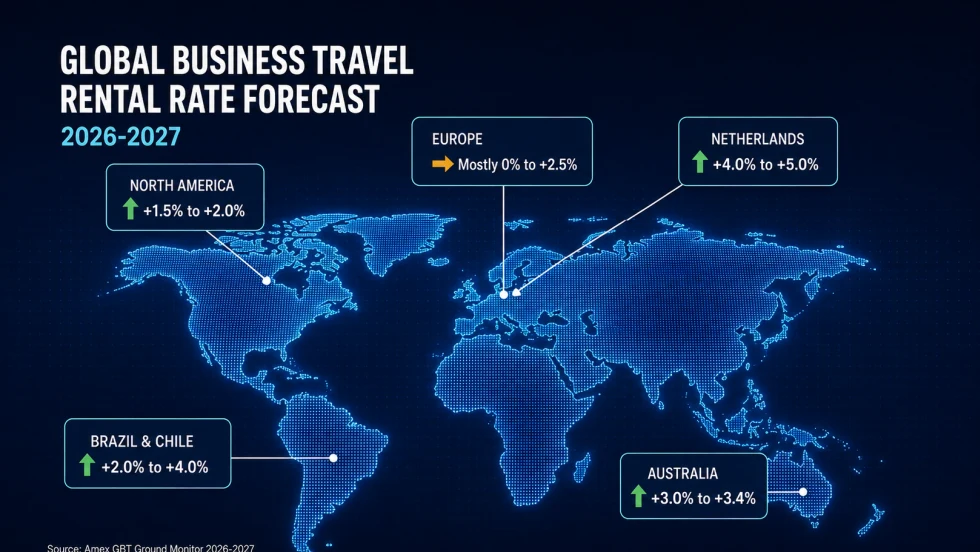
U.S. Business Travel Car Rental Rates Forecast to Rise Up to 2%
Improved fleet supply should limit pricing gains in 2026-27, while insurance, repair costs, and softer residual values continue to pressure rental operations, according to Amex GBT.
Read More →
Sixt Revenue Tops $2.4 Billion in First Half of 2026
Sixt’s first-half revenue surpassed $2.4 billion for the first time as demand outpaced fleet growth, lifting utilization and earnings despite weaker consumer sentiment in North America.
Read More →
In Memoriam: Bobby Klyce, Avis Licensee Legend
The longtime Birmingham Avis operator and 2018 Auto Rental News Impact Award recipient was remembered as an advocate for independent licensees and the broader car rental industry.
Read More →
How to Build Custom Fleet Tools With AI and Vibe Coding [Webinar]
A new Automotive Fleet webinar explores how fleet managers are using AI and vibe coding to automate routine work and create simple operational tools without traditional programming skills.
Read More →