



The Road to Growth for Auto Rental in China
Emerging car rental businesses could become ‘the best propellant for the entire [auto] industry.’
Corporate analysts and industry insiders say the auto rental market could become China's next big hope, with one leasing company executive saying the prospects for car rental businesses are "enormous," according to China Daily.
Emerging car rental businesses will become "the best propellant for the entire [auto] industry," said Zhang Xiaolin, chairman of Haina International Auto Leasing, a Sino-Japanese joint venture.
By 2015, China's car rental market is expected to hit 400,000 vehicles and produce $2.8 billion in annual revenue, according to the China Taxicab and Livery Association. Consulting firm Roland Berger goes even further, estimating annual revenue at $5.9 billion.
China was once known as the bicycle kingdom, but now it is one of the world's largest automobile consumers. Civilian automobiles went from 31.6 million in 2005 to 91 million last year, and that number is expected to hit 200 million by 2020.
News for China's auto market is not all positive, however. Xinhua News Agency stated that problems of the car market include gridlock, pollution and energy shortages.
A 2009 government work report by Premier Wen Jiabao stated that the administration would "facilitate the development" of the car rental market.
In a sector where companies are fighting for market control, one of the winners is China Auto Rental, the industry's No. 2 company behind eHi until last summer. But China Auto Rental is now operating in 58 cities, with a fleet of 22,000, and is looking to almost double that figure by the end of the year.
In July, China Auto Rental opened a 24-hour store in Shanghai.
China's auto rental companies flourished in 2006 and 2007 when Hertz International and Avis failed to adapt their stores to the Chinese business environment. As a result, those two companies mostly suspended their business in the country.
Frozen credit markets, recessions and US automaker bankruptcies since 2008 coincided with a boom in China's own car rental sector. And as market conditions improved, foreign capital started to return to China.
But the promises of growth are accompanied by various problems. At the end of last year, about 80 percent of China's 5,000 registered auto rental companies each had fewer than 50 cars.
More Rental Operations

Palm Beach Airport Code Change Creates Car Rental Distribution Gap
A test of rental searches under the old PBI and new DJT airport codes returned largely different sets of brands and vehicles, highlighting a potential distribution problem for rental operators.
Read More →
U-Save Continues Dominican Republic Expansion with Launch in Punta Cana
The new franchise location builds on U-Save’s existing Santo Domingo operation and will begin taking reservations for October 2026.
Read More →
When AI Books the Rental Car, Who Controls the Sale?
As AI moves from comparing rental rates to completing transactions, operators need to understand how travelers find, interpret, rank, and ultimately see their offers. (Part 2 of 2.)
Read More →
European Booked Car Rental Rates Fell 5%, Results Varied by Country
Ireland, Cyprus, and the United Kingdom saw steep declines, while booked rates rose in Poland and Hungary.
Read More →
Is It Time to Rethink Rental Categories?
As traditional economy and compact cars disappear from the market, longtime rental operator Mike DeLorenzo asks whether the industry’s familiar vehicle categories still make sense — and what operators need to rethink along with them.
Read More →
Who Owns the Rate? AI Is Creating a New Distribution Problem for Car Rental
Generative Engine Optimization asks whether AI can find a rental company, but operators also need to know whether the agent inspected enough of the market, compared equivalent offers, and presented a rate the traveler can actually book. (Part 1 of 2)
Read More →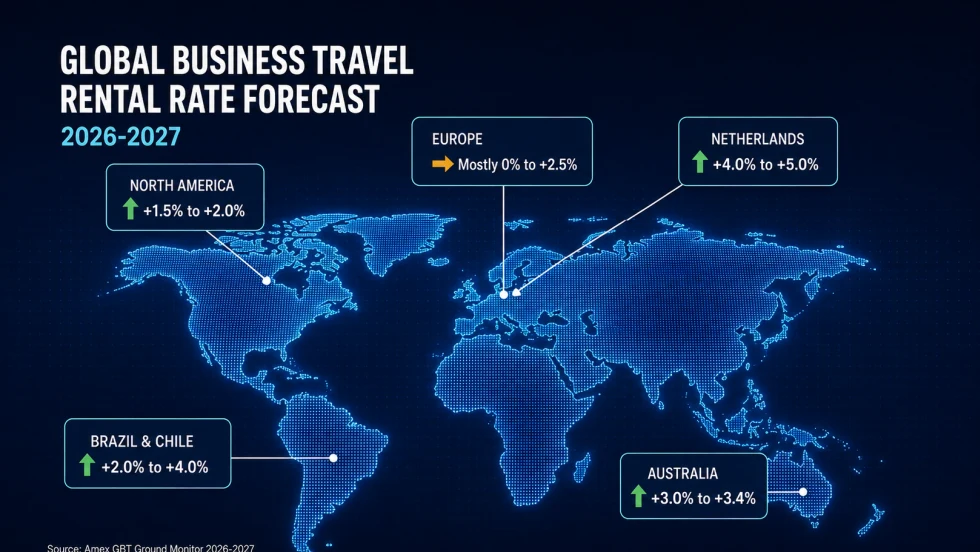
U.S. Business Travel Car Rental Rates Forecast to Rise Up to 2%
Improved fleet supply should limit pricing gains in 2026-27, while insurance, repair costs, and softer residual values continue to pressure rental operations, according to Amex GBT.
Read More →
Sixt Revenue Tops $2.4 Billion in First Half of 2026
Sixt’s first-half revenue surpassed $2.4 billion for the first time as demand outpaced fleet growth, lifting utilization and earnings despite weaker consumer sentiment in North America.
Read More →
In Memoriam: Bobby Klyce, Avis Licensee Legend
The longtime Birmingham Avis operator and 2018 Auto Rental News Impact Award recipient was remembered as an advocate for independent licensees and the broader car rental industry.
Read More →
How to Build Custom Fleet Tools With AI and Vibe Coding [Webinar]
A new Automotive Fleet webinar explores how fleet managers are using AI and vibe coding to automate routine work and create simple operational tools without traditional programming skills.
Read More →