





Related News: New Vehicle Prices Hit Record While Supply Falls
Worst of Vehicle Supply Shortage Might Be Over
New-vehicle inventory levels are still 63% lower than a year ago while the average transaction price hit another record.
November 22, 2021
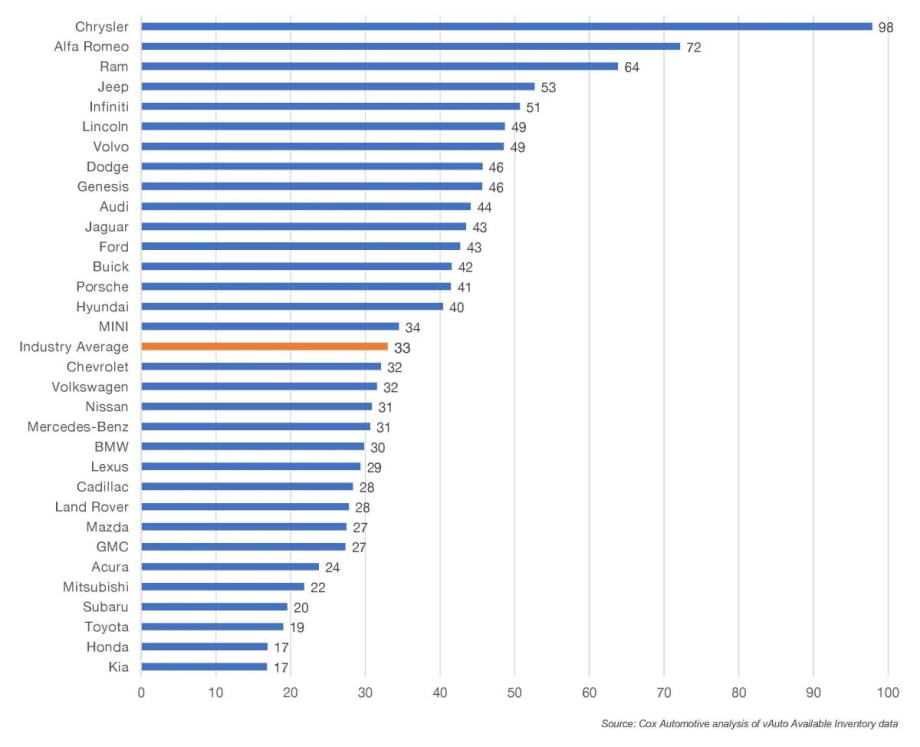
National Days' Supply By Brand, October 2021
Chart: Cox Automotive
4 min to read
Still low by historical standards, new-vehicle supply closed higher at the end of October than a month earlier, while the average listing price hit another record high, closing in on $45,000, according to a recent Cox Automotive analysis of vAuto Available Inventory data.
“The higher inventory suggests the worst of the inventory shortage caused production cuts due to the global computer chip crisis may be over, or, at the very least, not worsening,” said Cox Automotive senior economist Charlie Chesbrough, in a recent news release about the data release.
The total U.S. supply of available unsold new vehicles remained below one million at 969,464 vehicles at the end of October, but that was up from the 885,7731 vehicles at the end of September. Of those, non-luxury vehicle supply was 830,181 vehicles; luxury was 137,107 vehicles. New-vehicle inventory levels are 63% lower than a year ago.
The days’ supply of unsold new vehicles was 33 as November opened, up from 31 at the start of October. Days’ supply of non-luxury vehicles was 32 and luxury stood at 35. The total days’ supply has hovered in the range of 29 to 33 since mid-July. Still, the days’ supply in October was 50% below a year ago.
New-vehicle inventory in October 2020 was nearly 2.6 million units for a 65 days’ supply. In pre-pandemic October 2019, supply was nearly 3.5 million vehicles for an 86 days’ supply, according to Cox Automotive data.
The Cox Automotive days’ supply is based on the daily sales rate for the most recent 30-day period. New-vehicle sales had lost momentum since June, but the October sales pace picked up. The seasonally adjusted annual rate (SAAR) rose to 13 million from the year’s low point of 12.2 million in September. Still, with October sales still down 23% from a year ago, the SAAR was far lower than October 2020’s 16.4 million and October 2019’s 16.7 million.
Average Price Nearing $45,000
The average listing price – or asking price – for new vehicles set another record and is approaching $45,000. The average listing price of $44,680 heading into November was up from $43,425 at the start of October. By comparison, at the end of October 2020, the average listing price was $39,314. In October 2019, it was $37,457.
Average transaction prices – the price buyers actually paid – also set a record, surpassing $46,000 for the first time, according to a Kelley Blue Book report. October marked the seventh straight month of ATP increases.
In addition to the economics law of high demand and low supply, prices are record-breaking because of the rich mix of vehicles. Price gains are being driven by luxury vehicles, large SUVs and pickup trucks. In addition, no inventory of leftover models, typically deeply discounted at this time of year, are part of the mix. Further, incentives remain at a 20-year low.
The average listing price for luxury vehicles was $63,726 in October. The non-luxury average list price was $41,700, according to Cox Automotive data. The lowest days’ supply are in the price categories below $40,000.
“We expect prices to remain high until the inventory pipeline is refilled, which may take another year to return to more normal levels,” said Chesbrough.
Asian Brands Had Lowest Supply
Asian brands took the bottom half-dozen spots for the lowest days’ supply. Kia and Honda were at the very bottom with a scant 17 days of supply. Kia’s popular Carnival minivan tied with the Chevrolet Corvette for lowest inventory with 10 days’ supply. Its Telluride SUV wasn’t much better at 14. Kia’s sibling brand, Hyundai, however, had much improved inventories in October, ranking above average for supply.
Honda has extremely low inventories of the three models that make up the bulk of the brand’s sales – Accord, Civic and CR-V. All had days’ supplies in the teens. Acura fell to the lowest supply among luxury brands, a spot that had been held by Toyota’s Lexus for months. The race for the U.S. luxury crown may depend on which brands have inventories. Lexus and its rivals, BMW and Mercedes-Benz, are running neck and neck in that regard.
Toyota brand inventory was third from bottom at 19 days’ supply. Its popular models – Corolla, Highlander, Prius, RAV 4 and trucks Tundra and Tacoma – had supplies under 20 days. However, it appears Toyota prioritized Lexus production since luxury vehicles do well in the year’s last quarter. Lexus supply climbed throughout October as did its volume-leading RX SUV. Toyota said all plants will return to normal production and even begin making up lost production in December.
Because Asian brands dominate traditional car categories, the inventory for compact, subcompact and midsize cars as well as hybrids were at the low end. Supplies of pickup trucks are increasing. The categories of SUVs and crossovers are mixed.
GM brands GMC, Cadillac and Chevrolet improved inventory levels, but they still were below average as the automaker cut production in recent months. GM said all North American plants will be running in December. Ford and Lincoln inventory picked up. Stellantis’ brands had the highest days’ supply.
Originally posted on Vehicle Remarketing
More Remarketing
Rental Fleet Sales Skating Just Above 2025 Levels
The U.S. economy's continued growth and positive business investment are creating a favorable environment for fleet vehicle demand.
Read More →
Cross-Pressures, Evolving Trends Drive 2026 Rental Car Industry
A combination of cautious economic behavior, shifts in the rental vehicle market, and technological influences are shaping car rental operator decisions.
Read More →
Wholesale Used Vehicle Prices Slightly Up In April
The Iranian conflict and rising gas prices inject much uncertainty into the future wholesale used vehicle markets, as higher gas prices soak up spendable income from vehicle buyers.
Read More →
Surprice Opens Two Rental Branches In Japan
The launch highlights the global car rental operation’s growing presence in Asia.
Read More →
Wholesale Used Vehicle Prices Up In February
Solid demand at Manheim auctions with higher sales conversion rates indicate an appetite from dealers to buy.
Read More →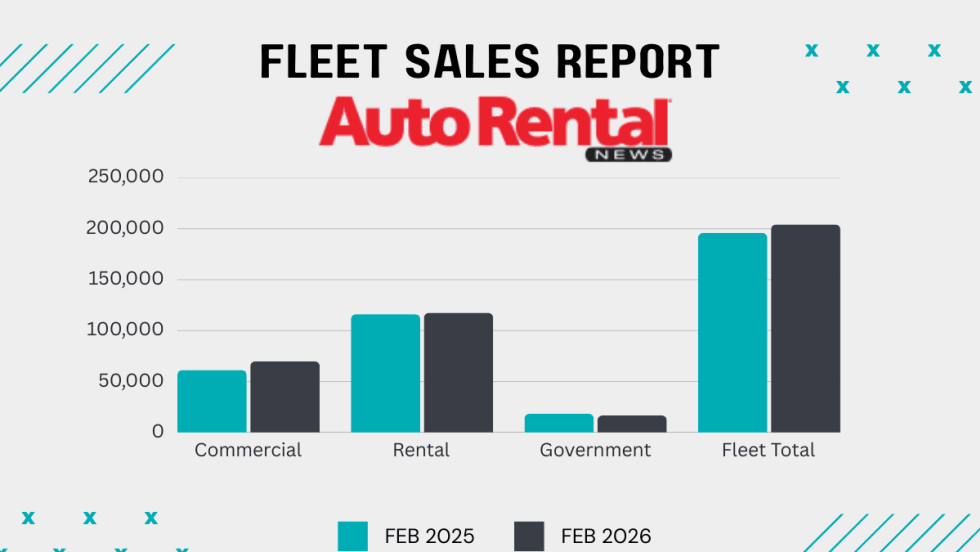
Rental Fleet Sales Slow In February Ending A Strong Streak
Commercial fleets posted the most gains, sustaining increases in monthly and year-to-date fleet sales
Read More →
Avis Budget Group Reports Near $1 Billion Loss Tied To 2025 EV Fleet Write-Down
Following Hertz, the company is the second global car rental conglomerate to sustain sizable losses due to lower customer demand and usage of electric rental cars.
Read More →
2025 Rental Vehicle Remarketing Summary And Outlook
The year brought modest and flatter results across wholesale values, total off-rental supply, and rental risk units.
Read More →
Auctions Record Highest Vehicle Sales Since 2019
2025 figures show a steady recovery in wholesale vehicle activity this decade.
Read More →
DriveItAway Holdings, Free2move Launch Operations In Nine Cities
The co-branded program with Stellantis’ mobility division scales up leasing and financing options nationwide with more cities to come online in 2026.
Read More →