


About the Author
Alex Aryafar is Rent Centric’s chief technology officer. Rent Centric is a provider of car rental management systems, including a self-service carsharing platform. For more technology information, visit www.rentcentric.com.
 MENU
MENU SEARCH
This carsharing trend in condo complexes reduces parking spaces to increase buildable units, while on-demand self-service technology makes operating a private carsharing business more cost-effective for the building owner.
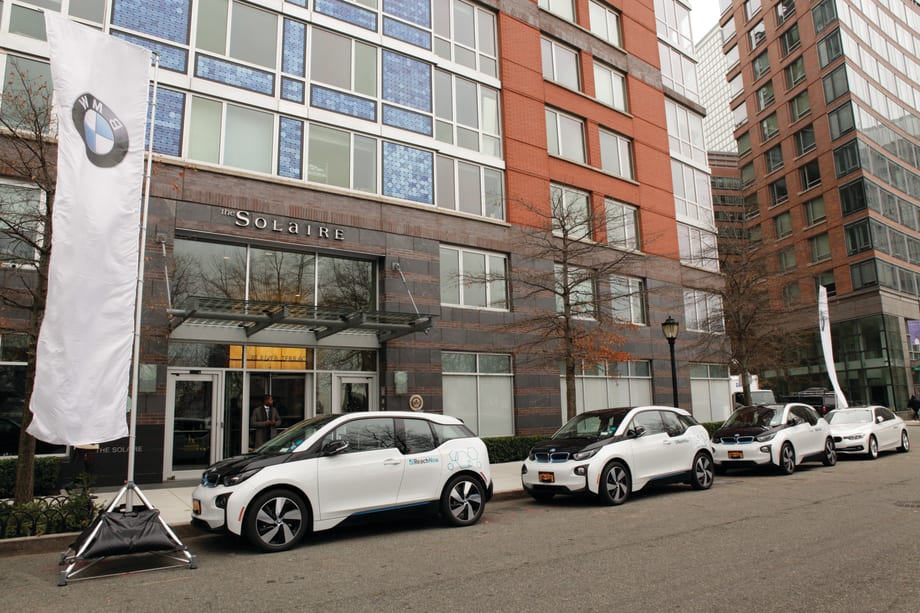
ReachNow, BMW Group’s carsharing service, has served the 700 residents of the Solaire, a residential tower in Battery Park City, N.Y., since December 2016. BMW Group says it plans to expand the ReachNow program to residential and business complexes across the U.S. Photo courtesy of BMW Group.
ReachNow, BMW Group’s carsharing service, has served the 700 residents of the Solaire, a residential tower in Battery Park City, N.Y., since December 2016. BMW Group says it plans to expand the ReachNow program to residential and business complexes across the U.S. Photo courtesy of BMW Group.
Real estate developers are finding new opportunities to capitalize on their condo development projects, building more units on less land, by incorporating carsharing into their building amenities.
City planners are making it even easier, changing the laws for carsharing services to grow in this space. In the city of New Rochelle, N.Y., for example, real estate developers can now ditch three conventional car spaces for every carshare space due to a new provision in their city bylaws.
Carsharing also reduces the need for new transit, thus opening up “edge” developments in underserved parts of cities, according to Paul Lipson of Barretto Bay Strategies, an urban policy consulting firm.
From a building management perspective, the leveraging of carsharing in condominium communities reduces the need for parking spaces in the building, while allowing tenants more cost-effective access to mobility compared to traditional car ownership and monthly parking space fees. Condo amenities may now include 24/7 access to shared vehicles for its owners; something that many are admitting is a big selling point for these condo buyers.
Condominiums considering carsharing operations will find starting a service is no longer prohibitive and doesn’t require the involvement of mega corporations. Now it is cost-effective for developers and condo boards to successfully own and operate their own private carsharing businesses (or to partner with smaller independent operators), exclusively for their condo owners. That is because on-demand, self-service technology is readily available and designed to empower managers to start a carsharing service easier than previous offerings.
The idea of carsharing has been floating around for over a decade. Brands like Zipcar have helped bring carsharing into cities and the mainstream — lobbying for new by-laws and placing their vehicles in high-density urban spaces.
Carsharing services are especially popular among the under-30 crowd in dense urban centers where space is at a premium. Many in this group consider car ownership to be a luxury or a hassle rather than a necessity, especially when they are centrally located. They are also more likely to rent a vehicle rather than own one and to purchase a condominium as their first property. This means that a growing number of condo owners are open and interested in the proposition of carsharing, especially if it is convenient and economical.
David McComb, president of Edenshaw, a downtown Toronto condominium with four carsharing vehicles, says that his residents are happy to say “no” to car ownership. “They don’t want the burden or the operating costs of a permanent vehicle,” he says.
Condo developers have found themselves with an opportunity to provide a growing demographic, which has moved away from vehicle ownership, with a cost-effective mobility solution. This trend in condo development reduces the number of parking spaces by using carsharing, which also provides added value for condo owners as well as higher revenue and an increase in the number of buildable units for condo developers.
The opportunity is ripe for condo complexes to own or manage a fleet of carsharing vehicles with rental automation technology. The building owner can acquire carsharing technology and management automation software, complete with custom mobile apps for their customers. Then the building can operate a carsharing fleet uniquely for residents.

The fundamentals may be familiar to daily car rental operators, but project-based truck rentals put different demands on the fleet and the business.
Read More →
With Ana Laborde supporting broker development, NPR Auto Group is tailoring distribution strategies, rate packages, and partnerships to grow international reservations across its three brands.
Read More →
While Enterprise and National retain the top spots in JD Power’s 2026 rankings, the latest customer satisfaction results suggest renters can find competitive service beyond the biggest car rental names.
Read More →
Exotic rental agencies often rely on customers’ personal auto policies to protect six-figure vehicles. But policy language can dramatically change the coverage for vehicles over $100,000 MSRP.
Read More →
For international renters, a confirmed reservation doesn’t always mean they’re eligible to drive. Earlier checks can help operators catch documentation and payment issues before the customer reaches the counter.
Read More →
The International Car Rental Show seeks session proposals on the business, operational, and technology issues facing car rental operators. Submissions are due Jan. 15.
Read More →
Turo Delivered will let travelers search for vehicles that hosts can deliver directly to hotels, homes, airports, train stations, and other locations.
Read More →
A test of rental searches under the old PBI and new DJT airport codes returned largely different sets of brands and vehicles, highlighting a potential distribution problem for rental operators.
Read More →
The new franchise location builds on U-Save’s existing Santo Domingo operation and will begin taking reservations for October 2026.
Read More →
As AI moves from comparing rental rates to completing transactions, operators need to understand how travelers find, interpret, rank, and ultimately see their offers. (Part 2 of 2.)
Read More →