




Discount: Our Plan to Grow Self-Service Rentals
Steven Lazaroff of Discount Car and Truck Rentals shares the company's strategy for implementation of its new hourly truck and van rental service.

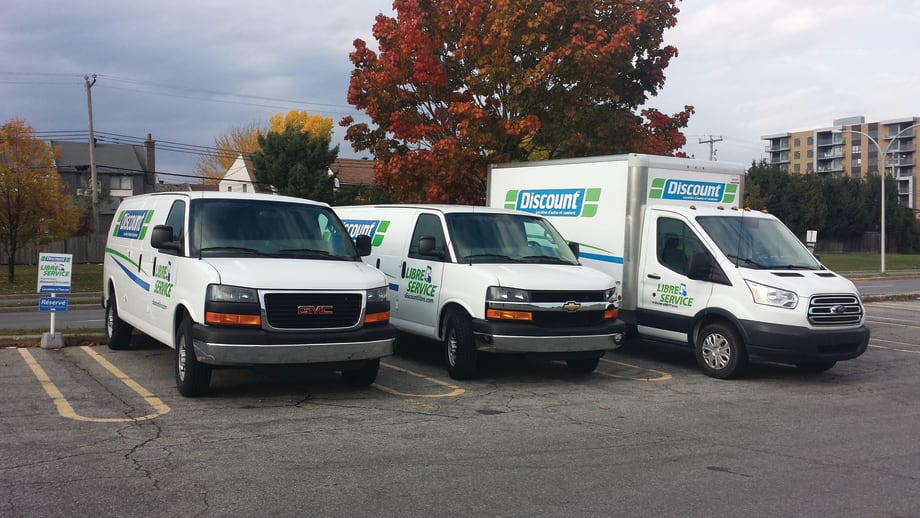
Discount Self-Service's trucks and vans are parked in dense commercial and residential neighborhoods in Quebec City and Montreal. Photo courtesy of Discount Car and Truck Rentals.
Discount Self-Service's trucks and vans are parked in dense commercial and residential neighborhoods in Quebec City and Montreal. Photo courtesy of Discount Car and Truck Rentals.
Discount Car and Truck Rentals in Quebec has launched an hourly truck and van rental service called Discount Self-Service. The program began operations in May and rents from about 25 parking spots at present in Montreal and Quebec City, with the goal to expand.
Discount Self-Service runs on Rent Centric’s self-service carsharing platform, which includes telematics technology, a web application, and integration with its management system.
“We’re the largest car rental operator in Quebec by geographic coverage,” says Steven Lazaroff, director of Discount’s retail sales division. “We want to complement that by giving the customer accessibility to a vehicle down the street.”
To initiate the Discount Self-Service program, users register online, access the web app on their smartphones, and then use it to find and reserve the closest cargo van or cutaway box truck at any time. Upon arrival at the vehicle, the smartphone initiates the rental process and unlocks the doors, and then the renter records a visual inspection of the vehicle with the smartphone.
Upon completion, the renter returns the vehicle to the same parking lot, makes another smartphone inspection, and locks the vehicle with the smartphone to terminate rental. Users’ credit cards are billed based on kilometers driven and the amount of rental time. There is no membership or registration fee.
For issues with anything from the registration process to the technology or the rental, users can access Discount’s call center to speak to a live agent. The call center can complete the transaction for users without smartphones.
A New Model
Lazaroff says that the self-service offering will be kept separate from the company’s brick-and-mortar locations and is not meant to compete with them. The plan is to leave daily rentals to the store locations, and focus the hourly rental service where customers have last-minute needs for trucks and vans.
“We want [potential renters] who aren’t coming to us because of accessibility reasons such as operating hours or geographical distance,” he says. “If we can get our trucks closer to the customer’s house, there is a better chance of getting that extra rental.”
The vehicles are placed opportunistically in dense commercial and residential neighborhoods. Discount has inked a partnership to place vehicles with Canadian hardware retailer Rona, Inc. and will announce other retail partnerships soon.
One opportunity is to catch potential customers at stores that end up with an impromptu purchase of a larger item. “Using shipping provided by the store has inherent disadvantages,” Lazaroff says. “[With Self-Service], consumers now have an immediate solution.”
While the industry progresses toward service that melds car rental and carsharing, transitioning auto rental outside the confines of the traditional rental counter comes with challenges and takes considerable planning — though not insurmountable, as the Discount initiative attests.
Discount is marketing the self-service concept through a blend of traditional means such as membership drives and non-traditional platforms such as social media. Users are also exposed to the service where the vehicles are parked, Lazaroff says.
Lazaroff advises that those looking to implement a self-service program should not focus on profits from day one. “It takes some time to generate awareness of the platform and the technology,” he says.
Maintaining optimal utilization and a high daily dollar average means analyzing transactions by location. If a vehicle is underperforming in one location, it will be moved to another, Lazaroff says. With hourly rentals, operators need to concentrate on generating multiple transactions in a day. “We are giving the customer the flexibility to pay by the hour,” he says. “In exchange, we are hoping that they will bring back the truck within a few hours so we can rent it out again the same day.”
Ironically, the success of the program could drive the transformation of the entire company. “This decentralizes the rental fleet and puts it where the need is,” Lazaroff says. “As we grow self-service and expand our base of users, we’re offering our customers new and innovative ways to satisfy their transportation needs.”
More Rental Operations

The $100,000 Insurance Trap in Exotic Car Rentals
Exotic rental agencies often rely on customers’ personal auto policies to protect six-figure vehicles. But policy language can dramatically change the coverage for vehicles over $100,000 MSRP.
Read More →
The Booking Is Confirmed, But Is Your Customer Ready to Drive?
For international renters, a confirmed reservation doesn’t always mean they’re eligible to drive. Earlier checks can help operators catch documentation and payment issues before the customer reaches the counter.
Read More →
ICRS 2027 Opens Call for Papers
The International Car Rental Show seeks session proposals on the business, operational, and technology issues facing car rental operators. Submissions are due Jan. 15.
Read More →
Turo to Launch Vehicle Delivery Service
Turo Delivered will let travelers search for vehicles that hosts can deliver directly to hotels, homes, airports, train stations, and other locations.
Read More →
Palm Beach Airport Code Change Creates Car Rental Distribution Gap
A test of rental searches under the old PBI and new DJT airport codes returned largely different sets of brands and vehicles, highlighting a potential distribution problem for rental operators.
Read More →
U-Save Continues Dominican Republic Expansion with Launch in Punta Cana
The new franchise location builds on U-Save’s existing Santo Domingo operation and will begin taking reservations for October 2026.
Read More →
When AI Books the Rental Car, Who Controls the Sale?
As AI moves from comparing rental rates to completing transactions, operators need to understand how travelers find, interpret, rank, and ultimately see their offers. (Part 2 of 2.)
Read More →
European Booked Car Rental Rates Fell 5%, Results Varied by Country
Ireland, Cyprus, and the United Kingdom saw steep declines, while booked rates rose in Poland and Hungary.
Read More →
Is It Time to Rethink Rental Categories?
As traditional economy and compact cars disappear from the market, longtime rental operator Mike DeLorenzo asks whether the industry’s familiar vehicle categories still make sense — and what operators need to rethink along with them.
Read More →
Who Owns the Rate? AI Is Creating a New Distribution Problem for Car Rental
Generative Engine Optimization asks whether AI can find a rental company, but operators also need to know whether the agent inspected enough of the market, compared equivalent offers, and presented a rate the traveler can actually book. (Part 1 of 2)
Read More →