Keys to Managing High Rates, Declining Satisfaction
While overall car rental customer satisfaction is declining along with vehicle supply, car rental operators find themselves caught between a rock and a hard place. How can they respond?
by Michael Taylor and David Paris, J.D. Power
March 14, 2022
While conditions don't look like they will improve soon, in the meantime, rental companies should optimize communication and manage customer engagement to stay relevant, says J.D. Power.
A lack of vehicle supply paired with the uptick in demand during the past year has upended the traditional economics of the rental car market. Staffing shortages have further complicated the rental landscape, creating gaps in service that have resulted in a significant decline in the customer experience.
Overall customer satisfaction with North American airport-based rental car companies declined significantly in 2021 as a global shortage of new vehicles caused prices to increase 58%, according to the J.D. Power 2021 North America Rental Car Satisfaction Study. The study found that the average customer-cited price-per-day rental fees rose to $90.40 by the summer of 2021. In August 2020, more than half of the consumers surveyed by J.D. Power said they paid $40 a day or less for a rental, with only 21% spending more than $70. By August 2021, those categories were inverted, with more than half paying more than $70 a day for a rental.
Ad Loading...
Given the economic trends underpinning the car rental market, the outlook for customer satisfaction does not look like it will improve anytime soon. The combination of high prices, long wait times and poor service have caused renters to feel like they are not getting a good value for their money. Satisfaction with rental-related costs and fees plummeted from 815 (on a 1,000-point scale) in December 2020 to 763 in August 2021, a significant 52-point reduction.
A Rock and a Hard Place
While these drastic price increases undoubtedly diminish brand image and long-standing customer relationships, rental companies find themselves caught between a rock and a hard place. The cost of replenishing inventory rises as automotive supply constraints continuously manifest themselves. Making new-vehicle purchases will have to come out of a lower sales volume, leaving margins as the only source to secure the vehicles necessary to ensure availability in the future.
The most significant effect of these market dynamics is fundamentally altering the connection points between rental companies and renters. Where once there was a nuanced relationship between renters — especially business travelers — and the major brands that offered choices on luxury vehicles and the opportunity to skip the check-in lines to pick their rides, the events of the past two years have further commoditized the market.
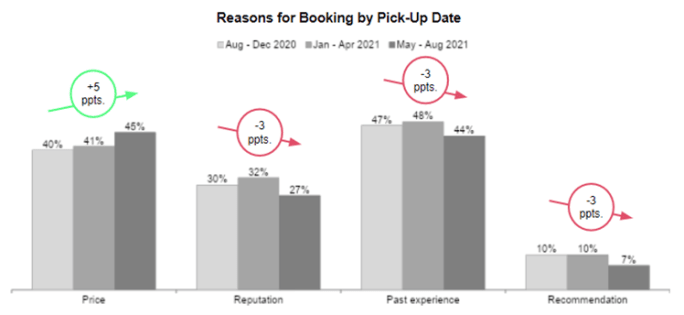
Currently, the price of rentals is the driving metric that matters most to travelers across the renting spectrum. As a deciding factor, price is rising in importance as reputation, past experience and recommendations have become less important.
According to J.D. Power metrics, prices rose 58% in 2021, while satisfaction dropped by 52 points.
Source: J.D. Power
Commoditization is the enemy of differentiation. As a result, executives in the rental fleet are exploring what actions they can take to make it through the next few supply- and labor-constrained years to re-establish relationships that rekindle loyalty.
Ad Loading...
Three Things to Consider
Selective pricing segmentation. If avoiding commoditization is a strategic imperative for rental brands, then hard choices will have to be made around rationalizing pricing. In this context, it will be important to take an even harder look at different customer dispositions with an eye on future behavior. The industry has already made the distinction between leisure and business travelers. It may make sense to further analyze and segment markets with an eye toward pricing strategies that will sow the seeds of future loyalty.
Optimize supply chain. Every dollar counts when it comes to building a war chest to replenish the vehicular supply. It is the undisputed key to more effectively serving tomorrow’s market. Executives may want to explore now how to invest in end-to-end digital supply-chain engagement with both new and used suppliers to expand margins. This may help to offset price reductions for preferred customers who are looking for reasons to remain loyal to accustomed brands.
Transparency matters. That is why effective digital engagement on the demand side of the equation is poised to separate leaders from the rest of the pack. If rental companies cannot provide the inventory and selection that travelers want, they can at least provide an accurate picture of what is available to introduce a higher level of certainty to a frustrated traveling public. Investments in digital engagement strategies that connect used vehicle Inventory to customer relationship management will enable a truth in pricing and availability that is sorely lacking today.
Global pandemics and unprecedented geopolitical disruptions will continue to introduce uncertainty in new- and used-vehicle supply for the foreseeable future. While organizations may find it increasingly difficult to anticipate and plan for supply, they can at least optimize communication and customer engagement. Rental companies that win the expectation management game by introducing even small levels of consumer control will likely fare better than those who don’t when it comes to protecting brand reputation. Reputation, after all, has a finite shelf life.
About the Authors
Michael Taylor is director of travel, hospitality and retail at J.D. Power. Taylor has worked more than 30 airports worldwide, nearly all major North American air carriers and all U.S.-based rental car companies to measure and manage customer satisfaction and loyalty. Taylor founded and led the travel practice at J.D. Power from 1998 to 2004 and rejoined J.D. Power in 2017.
David Paris is the senior manager of market insights at J.D. Power Valuation Services. Since starting with J.D. Power in 2007, Paris has served in various capacities for the editorial and market intelligence teams within Valuation Services. He also serves as one of Valuation Services primary media spokespeople on issues affecting the automotive industry and its consumers.
This article was authored and edited according to ARN editorial standards and style. Opinions expressed may not necessarily reflect that of ARN.
A consistent approach to vehicle cleaning helps rental operators reduce turnaround delays and return vehicles to service without compromising cleanliness.
A suspicious $45,000 Lamborghini booking reveals the strengths and limitations of renter verification, from forged insurance documents to coverage gaps and unauthorized drivers. (Part 2 of 3)
The partnership brings Tesla's Full Self-Driving (Supervised) technology into the rental experience, offering a glimpse of how increasingly automated vehicles could change car rental.
As regulators scrutinize the use of customer data in pricing, rental operators need to know whether they can explain why one renter pays more than another.
As travel retailers weigh direct supplier relationships against third-party distribution, rental operators need to understand how those decisions affect their business.
With 170 vehicles across three Kentucky locations, Joel Price relies on an overseas team to handle reservations, payments, and after-hours customer service. It's one part of an unconventional approach to growing an independent rental operation.
With Ana Laborde supporting broker development, NPR Auto Group is tailoring distribution strategies, rate packages, and partnerships to grow international reservations across its three brands.
While Enterprise and National retain the top spots in JD Power’s 2026 rankings, the latest customer satisfaction results suggest renters can find competitive service beyond the biggest car rental names.
Exotic rental agencies often rely on customers’ personal auto policies to protect six-figure vehicles. But policy language can dramatically change the coverage for vehicles over $100,000 MSRP.