



Nail Your Financials
This revenue and expense ratio system makes it easier to interpret financial data so you can work on improving specific areas of your business. Which metric is most important?

In the general business world, GAAP (Generally Accepted Accounting Principles) determine how companies’ financial statements are presented. While this is a standard format across many industries, it’s not very useful in analyzing the particulars of the vehicle rental business, says Jim Tennant of the Tennant Group.
During a pre-conference Roundtable at this year’s Car Rental Show, Tennant presented an alternative financial analysis, a “standard chart of accounts” that groups expenses in a logical manner for auto rental operations. This method was developed by Fred Mudgett of the Mudgett Group, from which the Tennant Group evolved.
“This way to group your expenses makes it easier for you to interpret the metrics and work on improving specific areas of your business,” says Tennant. “It can also help to make your financials more transparent to your lender.”
The method is used in all Tennant Group Roundtables and has been adopted by Dollar Thrifty licensees. Tennant says bankers and lenders have found this system to be the most useful way they’ve seen to interpret car rental financials.
Divide and Conquer
The system divides revenues and expenses into these groups:
Revenue: time and mileage (minus discounts), collision damage waiver, personal accident insurance, personal effects coverage, supplemental liability, prepaid fuel sales, baby seat, additional driver, underage driver and other incremental sales revenue
Unit Expense (the cost of having the vehicle in the fleet): rental vehicle depreciation, rental vehicle interest, rental vehicle lease expense, rental vehicle tags, taxes and inspection, gain or loss on rental vehicle sales, vehicle sales expense (minus fleet rebates)
Direct Operating (the cost of running the vehicle): parts, tires, outside mechanical repairs, towing (minus vehicle warranty), damage repairs, salvage and stolen write-offs (minus subrogation and customer collection), vehicle insurance expense
Indirect Operating (other variable expenses): gas expense (minus gas collections, except prepaid) oil and antifreeze, car wash supplies, shuttling expense, shop equipment expenses, bus depreciation, repairs and maintenance expenses, busing, depreciation or lease on service vehicles, repairs and maintenance on service vehicles, non-rental vehicle tags and license, etc.
Advertising and Sales Expense: advertising fees, national advertising and sales promotion, local Yellow Pages depreciation, signs, reservation expense, system fees, amortization franchise purchase, travel agent commissions and credit card commissions
[PAGEBREAK]
Personnel Expense: salaries (exempt and non-exempt), bonuses, overtime, contract labor, payroll taxes, workers’ compensation insurance, group medical, other benefit programs, training, etc.
Occupancy Expense: facility rent and other facility expenses, concession fees, real estate taxes, utilities, etc.
General and Administrative: office supplies, postage and shipping, bank charges, business permits, office equipment expenses, telephone and computer communications, meals and entertainment, etc.
Use Groupings for Projections
Grouping expenses and revenues in this manner allows for clearer projections in any area. “If you group your financials in this way, you can come up with ‘what if’ scenarios more easily,” says Tennant.
Certain relationships emerge in the analysis:
Unit expense varies with fleet size.
Direct operating costs vary with fleet size and revenue.
Indirect operating costs vary with revenue and number of transactions.
Marketing is partially fixed and varies with revenue.
Personnel is partially fixed and partially dependent on fleet size/transactions as well as revenue.
Occupancy is fixed in the short term, though it may vary with revenue.
G&A is generally fixed in the short term.
In 2004, the Tennant Group used this system to analyze financial results from 40 different companies over three years for a total of 85 financials. The results were presented at the Car Rental Show that year.
[PAGEBREAK]
The metrics analyzed were:
Size of operation (total revenue and fleet size)
Length of rental
Non-rental activity revenue (e.g. parking)
Revenue per day (T&M, incremental and total per day)
Utilization
Revenue per vehicle
Fleet expense per vehicle and as a % of revenue
Personnel expense per vehicle and as a % of revenue
Direct operating per vehicle and as a % of revenue
All other expenses (indirect operating, marketing, occupancy and G&A) per vehicle and as a % of revenue
Which Metric Is Most Important?
Tennant used a mathematical formula to determine which of the 10 metrics represented the best predictor of profitability. In the case of some expenses, Tennant used dollar per vehicle as well as percentage of revenue, for a total of 17 measurements.
The chart lists the metrics in order of correlation to profits. To see the correlations expressed as a percentage, square the figure in the correlation column. Therefore, “fleet expense % of revenue” has a 24.3 percent correlation to profitability using this formula.
Your Results Will Vary
No two car rental operations are alike. Thus individual results will vary, depending on factors such as location, personnel and type of RAC (independent, franchise or corporate).
As such, operations with a maintenance staff may create higher personnel costs, but lower direct operating costs.
RACs in the local market with a local sales staff could cause higher personnel costs but less advertising expense, higher rates and better utilization in slow periods.
[PAGEBREAK]
Franchise operators will incur system and ad fees but could achieve better rates and more volume. Airport operators are open more hours and would have higher costs all around.
The High Profit Correlation
Tennant cautions that one cannot draw a direct cause and effect using this analysis, as these numbers are only a predictor of profitability. However, high profit operations have certain metrics in common that low profit operations don’t have, says Tennant.
Fleet expense measured as a percentage of revenue and as cost per vehicle have the highest correlation to profitability — by far — in this analysis. Lenders would reinforce the importance of these metrics, as expense to revenue ratio is used to determine creditworthiness.
An expense to revenue ratio near 50 percent is likely not profitable, says Tennant, while a good target is 40 percent, though “that’s not easy to get to.”
In other observations of the rankings, total revenue has only a 3 percent correlation to profitability. The total percentage of all the metrics below total revenue equals less than 6 percent. The last three metrics on the list only register in fractions of a percent.
“You don’t necessarily boost profitability by scrimping on personnel,” Tennant says, regarding the low rankings of personnel metrics.
T&M, RPU and RPD are all important and are tied to utilization. However, “utilization is not as important as people think,” notes Tennant, as some companies run high utilization with small and midsize cars, while others with luxury vehicles and trucks don’t need to run as high.
While incremental sales rank low, they are important, Tennant says. If you train your team to increase incremental sales, you’ll increase profits. Still, they are not a clear predictor of profitability. Tennant cautions that a push for more incremental sales should not cause your team to lose focus on fleet.
In terms of length of rental, the more profitable companies rent their vehicles a half day longer than the least profitable ones. That leads to lower transaction costs and lower miles on the fleet, as longer rentals tend to gain fewer miles.
Overall, Tennant says that this analysis shows how important fleet is, and the significance of relating fleet expense to revenue.
“Car rental is a complicated business,” says Tennant. “There is no one thing that is a secret to success, that if you get it right you’ll be sure to make good money. You have to do almost everything right.”
[PAGEBREAK]
More Rental Operations

Palm Beach Airport Code Change Creates Car Rental Distribution Gap
A test of rental searches under the old PBI and new DJT airport codes returned largely different sets of brands and vehicles, highlighting a potential distribution problem for rental operators.
Read More →
U-Save Continues Dominican Republic Expansion with Launch in Punta Cana
The new franchise location builds on U-Save’s existing Santo Domingo operation and will begin taking reservations for October 2026.
Read More →
When AI Books the Rental Car, Who Controls the Sale?
As AI moves from comparing rental rates to completing transactions, operators need to understand how travelers find, interpret, rank, and ultimately see their offers. (Part 2 of 2.)
Read More →
European Booked Car Rental Rates Fell 5%, Results Varied by Country
Ireland, Cyprus, and the United Kingdom saw steep declines, while booked rates rose in Poland and Hungary.
Read More →
Is It Time to Rethink Rental Categories?
As traditional economy and compact cars disappear from the market, longtime rental operator Mike DeLorenzo asks whether the industry’s familiar vehicle categories still make sense — and what operators need to rethink along with them.
Read More →
Who Owns the Rate? AI Is Creating a New Distribution Problem for Car Rental
Generative Engine Optimization asks whether AI can find a rental company, but operators also need to know whether the agent inspected enough of the market, compared equivalent offers, and presented a rate the traveler can actually book. (Part 1 of 2)
Read More →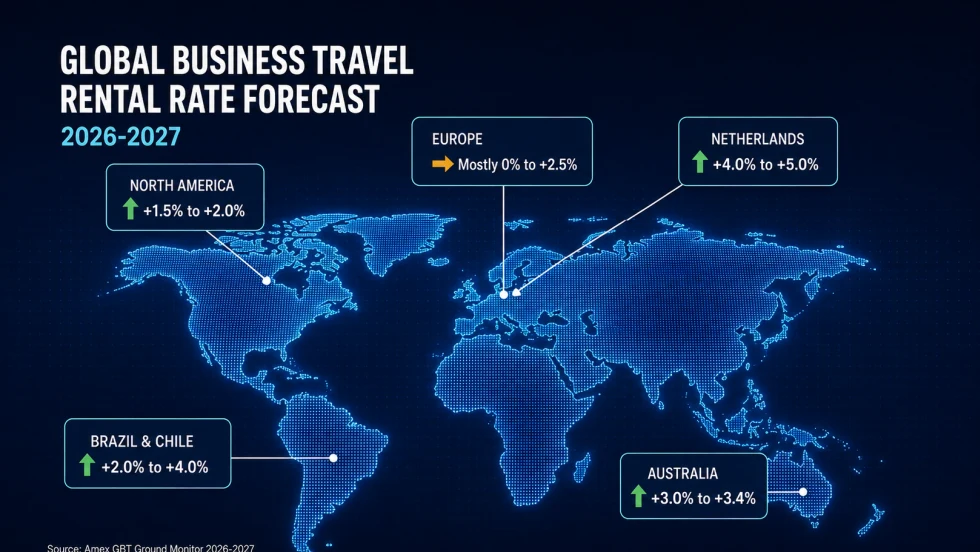
U.S. Business Travel Car Rental Rates Forecast to Rise Up to 2%
Improved fleet supply should limit pricing gains in 2026-27, while insurance, repair costs, and softer residual values continue to pressure rental operations, according to Amex GBT.
Read More →
Sixt Revenue Tops $2.4 Billion in First Half of 2026
Sixt’s first-half revenue surpassed $2.4 billion for the first time as demand outpaced fleet growth, lifting utilization and earnings despite weaker consumer sentiment in North America.
Read More →
In Memoriam: Bobby Klyce, Avis Licensee Legend
The longtime Birmingham Avis operator and 2018 Auto Rental News Impact Award recipient was remembered as an advocate for independent licensees and the broader car rental industry.
Read More →
How to Build Custom Fleet Tools With AI and Vibe Coding [Webinar]
A new Automotive Fleet webinar explores how fleet managers are using AI and vibe coding to automate routine work and create simple operational tools without traditional programming skills.
Read More →