




This article originally appeared in our inaugural Auto Rental News International digital edition, covering the European rental market. To access our current International edition covering Latin America, click here.
Russian Car Rental's Rocky Road
Driven by "festivity rentals" yet hampered by bureaucracy and an uncertain economy, the tiny Russian car rental market struggles to grow.
by Vladislav Vorotnikov
December 21, 2015
The "festivity car rental segment" — which uses luxury cars, limousines and most often comes with drivers — makes up close to a third of the Russian car rental market.
6 min to read

The "festivity car rental segment" — which uses luxury cars, limousines and most often comes with drivers — makes up close to a third of the Russian car rental market.
The Russian car rental market is the youngest and probably the smallest among European countries. Its total size in 2014 was estimated at only US$70 million per year, according to statistics from the Russian Business Consulting Agency, yet it has grown from US$40 million in 2010.
Why is the market so small? Ordinary Russian citizens don’t rent cars: During the Soviet Union era, car rental didn’t exist, thus a culture of car rental never developed. For average citizens, car rental is still too expensive. This culture is slowly changing, though rental agencies — even in the large cities in the European part of Russia — are hard to find.
Nonetheless, growth is expected to continue in the coming years, despite an economic crisis and a decrease of tourist inflow last year. At the same time, according to the representatives of the Russian consulting agency SMCC, it is clear that the Russian car rental market has little chance to grow to the level of the United States or even the countries in Western Europe, at least in the foreseeable future.
Market Stats
From 2010 to 2014, Russia’s total rental fleet jumped from 13,000 to 27,000 units. About 90% of this fleet total encompasses Moscow, Saint Petersburg and holiday resort area of Krasnodar Krai.
According to estimates from Abarus Market Research, in 2010 the economy segment accounted for about 80% of the Russian rental fleet, while 65% to 70% were cars of Russian brands. Today, the situation has changed — 43% of the overall fleet falls in the business and premium class segments, while the share of foreign auto brands reached about 47%.
The average rental period in Russia varies greatly depending on the region and season. In Moscow, the average is three to five days; in St. Petersburg, it’s five to eight days. In the central region of the country, the average rental period is 10 to 12 days. In general, tourists usually take the car for seven to nine days.
Client profiles vary by region, as well. In the Black Sea resort town of Sochi, 70% of clients are Russian tourists, while in Moscow a significant share of renters are local residents, according to Arina Bochkovaya, head of marketing and sales for Group Ryden, operating in Russia as the general licensee of Dollar Thrifty Rent-e Ka.
According to Bochkovaya, the share of foreign tourists in the overall market is only 7% to 10%. Foreign specialists working for Russian companies make up another 5% to 7%.
The average price of a daily rental — for new foreign cars in the economy class — in Moscow varied from 1.5 thousand to 2 thousand rubles (US$50 to 70). Last year it jumped from 2.5 to 3 thousand rubles (US$83 to $105), based on exchange rates from the beginning of 2014.
The cost of car rental in Saint Petersburg is about the same, while in Krasnodar Krai rates are usually lower by 5%. Rates in other Russian provinces are 10% to 15% lower than that. Prices usually rise at the Russian Black Sea resorts during the height of the season by 30% to 40%. Some companies more than doubled rates, particularly during last year’s Olympic Games in Sochi.
According to estimates from Moscow-based Elex-Polyus, the revenue from one car in Russia is estimated at US$9,000 per year. That may seem low by Western standards, but to put in context, average monthly salaries in Russia in 2015 are 30,620 rubles (US$578) or less than $7,000 a year, according to official state data — making $9,000 per car per year quite profitable. In Moscow and St. Petersburg, salaries are 1.5 to 2 times higher than the rest of the country.
Nonetheless, this revenue is threatened by the devaluation of the Russian ruble — which collapsed twice against the dollar last year. The market also faces a decrease in inbound tourism. According to estimates from the Russian Tourism Association, tourism declined 10% in 2014, and it may fall by another 10% to 15% in 2015 compared to last year, even excluding visitors to the Olympic Games.
Market Trends
A category of the Russian market not found in other markets is “festivity car rental,” occurring for weddings, celebrations and other milestone events. Found in larger cities, festivity car rental usually comes with a driver and additional services. The rental period is usually for one or two days, while the daily rate ranges from 10 thousand to 20 thousand rubles (US$200 to $400). Luxury vehicles such as the Hummer H2 and Chrysler 300C are popular in this segment, as are limousines.
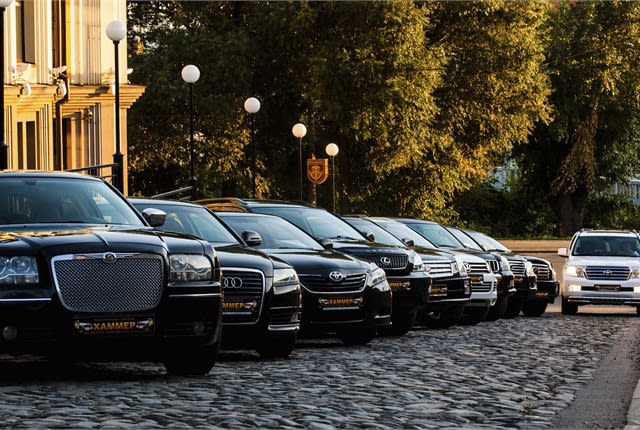
The fleet of the car rental company Hammer Tomsk serves visitors to the historic city of Tomsk in Siberia.
Forecasters say one of the most important trends in the coming years could be the domestic expansion of international rental companies. Today, they occupy 12% to 14% of the market and do not have branches in Russian provinces, nor are they engaged in festivity rentals. It is expected that foreign companies will open branches in cities with more than one million people, such as Kazan, Samara, Volgograd and Voronezh. In 2018, the FIFA World Cup should give impetus to the further development of car rental in those smaller cities.
Nonetheless, foreign companies will face growing competition from the rapidly growing number of domestic rental companies. In 2011, 364 car rental companies were officially registered for business, yet by 2014 this figure jumped 28% to 465. Still, analysts say that the number of market players is growing slower than demand, as more than 60% of these companies are working in the festivity rental segment only.
Growth Barriers
According to representatives of Russian company Rolf-Rental, market growth had been paralyzed by the country’s crime situation. However, in 2009 rental companies received permission to check customers on the database of the Ministry of the Interior, and the number of thefts and serious accidents with rental cars dropped by 50%.
In 2009, the Russian Association of Car Rental Companies was formed. The association is dealing with car thefts by sharing information on bad rentals and conducting joint advertising campaigns. All in all, these changes will bring better margins to the industry, Rolf-Rental says.
According to the analytical agency Folio Research Group, changes such as an ease in rental requirements and the opening of international brands such as Europcar and Hertz — and with it a Western business culture — have stimulated the Russian market.
This growth will be tempered by continuing business impedances particular to Russia, says Alexei Zakharov of the Russian analytical agency Finam. These complications include the bureaucratic procedures surrounding accidents, long repair periods due to a lack of spare parts and a general high level of fraud in the country. High auto insurance also affects profits, particularly for the small companies.
“In Russia, almost half of car rental clients are businesses rather than individuals, and the proportion of ‘car rental for weddings’ is too big,” says Zakharov, who does not see a boom coming for car rental by individuals. “We should consider the Russian market as underdeveloped.”
Subscribe to Our Newsletter
More Rental Operations

Direct, Broker or Hybrid? How Travel Retailers Source Rental Cars
As travel retailers weigh direct supplier relationships against third-party distribution, rental operators need to understand how those decisions affect their business.
Read More →
How Did This Independent Rental Operator Grow to 170 Vehicles in 4 Years?
With 170 vehicles across three Kentucky locations, Joel Price relies on an overseas team to handle reservations, payments, and after-hours customer service. It's one part of an unconventional approach to growing an independent rental operation.
Read More →
What Does It Take to Succeed in B2B Rentals?
The fundamentals may be familiar to daily car rental operators, but project-based truck rentals put different demands on the fleet and the business.
Read More →
NPR Builds on International Partnerships to Grow Rental Bookings
With Ana Laborde supporting broker development, NPR Auto Group is tailoring distribution strategies, rate packages, and partnerships to grow international reservations across its three brands.
Read More →
Advantage, Sixt Place Among Top Five in Annual Satisfaction Study
While Enterprise and National retain the top spots in JD Power’s 2026 rankings, the latest customer satisfaction results suggest renters can find competitive service beyond the biggest car rental names.
Read More →
The $100,000 Insurance Trap in Exotic Car Rentals
Exotic rental agencies often rely on customers’ personal auto policies to protect six-figure vehicles. But policy language can dramatically change the coverage for vehicles over $100,000 MSRP.
Read More →
The Booking Is Confirmed, But Is Your Customer Ready to Drive?
For international renters, a confirmed reservation doesn’t always mean they’re eligible to drive. Earlier checks can help operators catch documentation and payment issues before the customer reaches the counter.
Read More →
ICRS 2027 Opens Call for Papers
The International Car Rental Show seeks session proposals on the business, operational, and technology issues facing car rental operators. Submissions are due Jan. 15.
Read More →
Turo to Launch Vehicle Delivery Service
Turo Delivered will let travelers search for vehicles that hosts can deliver directly to hotels, homes, airports, train stations, and other locations.
Read More →
Palm Beach Airport Code Change Creates Car Rental Distribution Gap
A test of rental searches under the old PBI and new DJT airport codes returned largely different sets of brands and vehicles, highlighting a potential distribution problem for rental operators.
Read More →