




The Booking Is Confirmed, But Is Your Customer Ready to Drive?
For international renters, a confirmed reservation doesn’t always mean they’re eligible to drive. Earlier checks can help operators catch documentation and payment issues before the customer reaches the counter.

Where do international rentals break down between booking and vehicle collection? Driving documentation is only one potential point of failure.
Auto Rental News
An international customer books a rental car weeks before traveling. The reservation is confirmed, flights are booked, and the vehicle is waiting.
Then they arrive at the counter, and the rental can't proceed.
That experience prompted us to look more closely at a simple question: Where do international rentals break down between booking and vehicle collection?
Italy provides a useful example. Drivers with licenses issued outside the EU or EEA generally need to carry their valid national driver's license together with an International Driving Permit (IDP) or an official Italian translation. A traveler who arrives without the required documentation may therefore find that having a confirmed reservation isn't enough.
Booked, Confirmed, But Not Eligible to Drive
But driving documentation is only one potential point of failure.
Depending on the destination and rental company's policies, problems can arise when the customer's license has not been held for the required period, identification or passport documentation is missing, the payment card isn't in the renter's name, the customer doesn't meet age requirements, or the available credit isn't sufficient for the required security deposit.
For an operator accepting international bookings, the challenge isn't simply making these requirements available somewhere in the terms and conditions. It's making sure the right customer receives the right information at the right time.
Move the Eligibility Check Forward
Instead of discovering a problem at the counter, rental operators can build simple checkpoints into the reservation journey.
At booking, ask the renter's country of residence and country of license issuance and use this information to flag destination-specific requirements.
The booking confirmation should clearly show the essential collection requirements: license, ID or passport, payment card, deposit and any additional driving documentation rather than relying solely on lengthy terms and conditions.
A second pre-arrival communication, sent several days before collection, provides another opportunity to remind the renter what they need to bring and highlight any requirements specific to international drivers.
Where possible, operators can also introduce a simple pre-arrival eligibility checklist:
· Valid driver's license
· Required IDP or translation
· Passport/identification
· Correct payment card
· Deposit requirement understood
· Age and license-duration requirements met
The goal isn't to add more friction to the booking process. It's to remove friction from the rental counter.
International distribution gives independent rental companies the opportunity to reach customers worldwide. But as that reach grows, so does the importance of making sure customers understand the local requirements before they travel.
A reservation shouldn't only confirm that a vehicle is available.
It should also confirm that the customer can drive it.
More Rental Operations

ICRS 2027 Opens Call for Papers
The International Car Rental Show seeks session proposals on the business, operational, and technology issues facing car rental operators. Submissions are due Jan. 15.
Read More →
Turo to Launch Vehicle Delivery Service
Turo Delivered will let travelers search for vehicles that hosts can deliver directly to hotels, homes, airports, train stations, and other locations.
Read More →
Palm Beach Airport Code Change Creates Car Rental Distribution Gap
A test of rental searches under the old PBI and new DJT airport codes returned largely different sets of brands and vehicles, highlighting a potential distribution problem for rental operators.
Read More →
U-Save Continues Dominican Republic Expansion with Launch in Punta Cana
The new franchise location builds on U-Save’s existing Santo Domingo operation and will begin taking reservations for October 2026.
Read More →
When AI Books the Rental Car, Who Controls the Sale?
As AI moves from comparing rental rates to completing transactions, operators need to understand how travelers find, interpret, rank, and ultimately see their offers. (Part 2 of 2.)
Read More →
European Booked Car Rental Rates Fell 5%, Results Varied by Country
Ireland, Cyprus, and the United Kingdom saw steep declines, while booked rates rose in Poland and Hungary.
Read More →
Is It Time to Rethink Rental Categories?
As traditional economy and compact cars disappear from the market, longtime rental operator Mike DeLorenzo asks whether the industry’s familiar vehicle categories still make sense — and what operators need to rethink along with them.
Read More →
Who Owns the Rate? AI Is Creating a New Distribution Problem for Car Rental
Generative Engine Optimization asks whether AI can find a rental company, but operators also need to know whether the agent inspected enough of the market, compared equivalent offers, and presented a rate the traveler can actually book. (Part 1 of 2)
Read More →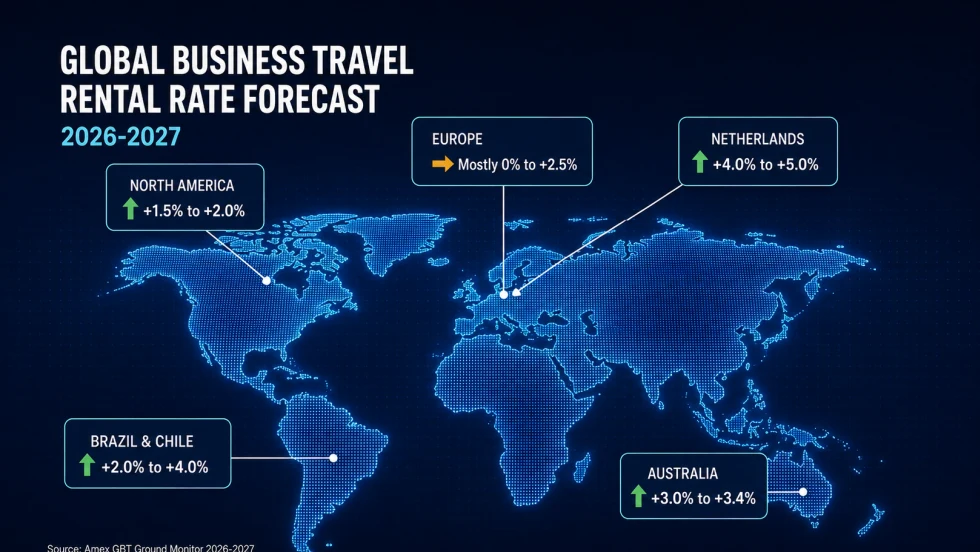
U.S. Business Travel Car Rental Rates Forecast to Rise Up to 2%
Improved fleet supply should limit pricing gains in 2026-27, while insurance, repair costs, and softer residual values continue to pressure rental operations, according to Amex GBT.
Read More →
Sixt Revenue Tops $2.4 Billion in First Half of 2026
Sixt’s first-half revenue surpassed $2.4 billion for the first time as demand outpaced fleet growth, lifting utilization and earnings despite weaker consumer sentiment in North America.
Read More →