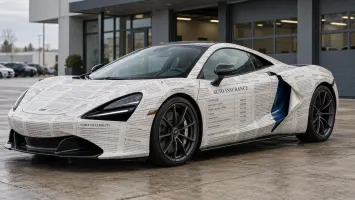
Exotic rental agencies often rely on customers’ personal auto policies to protect six-figure vehicles. But policy language can dramatically change the coverage for vehicles over $100,000 MSRP.
Ken Van Vorhis
An insurance policy can appear to cover an exotic rental while leaving substantial financial exposure beneath the surface. Coverage depends on the policy’s terms, limits, and endorsements.
Credit:
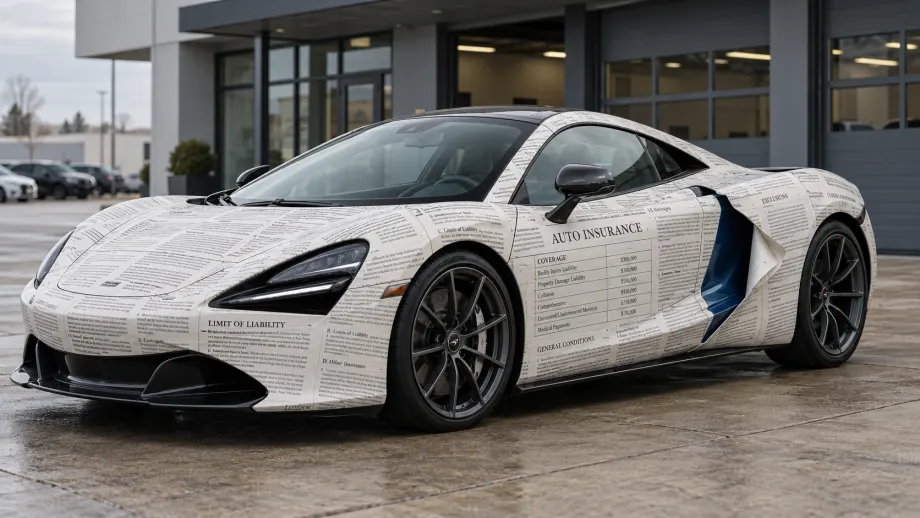
Auto Rental News. AI-generated image. Refer to our Terms of Use.
13 min to read
Eleven years ago this publication ran a special report called "The Problem with Renting Fast Cars." Carlos Dolabella of First Class Rent A Car explained that 20 to 30 percent of exotic rental transactions in South Florida were brokered through individuals who owned no cars and carried no commercial auto insurance. Tony DeBoor at Zurich framed the importance of insurance in one line. "When you're dealing with $200,000 cars, insurance is everything."
Since that article was released, the issue has not been resolved. It's grown.
Ad Loading...
If you run a rental operation and you are looking into the exotic side of the industry, the first thing to understand is that it doesn't work the way your business does. I'm not talking about the price point; I'm talking about the business model. Two things are different, and until you have both of them in your head, none of the insurance makes sense.
Everything below is based on the California market. I have read California contracts, and I am not going to pretend the answer travels. If you operate elsewhere, the business model generally stays the same, but the numbers may not.
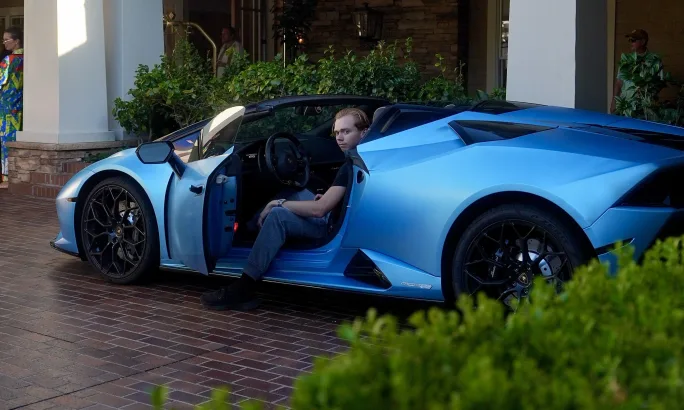
Author Ken Van Vorhis exits a Lamborghini Huracan, one of his rentals.
Credit:
Ken Van Vorhis
Difference One: We Do Not Own the Cars
In a conventional rental operation, you own or lease your fleet. It sits on your books, is registered to your company, depreciates on your balance sheet, and every car on your lot is yours to rent.
Most exotic operations do not work that way. They run an agency model.
The cars are sourced from private owners in the area who put them into service instead of leaving them parked. Once a car is placed with an agency it enters the local market under the agency's brand. My own fleet is past 100 vehicles and almost none of them were purchased. Somebody else holds title to nearly every car I rent.
The appeal is obvious and it is real. Supply is no longer a limiting growth factor. With a couple connections and a few phone calls you could add $1M worth of inventory to your fleet in a single day. In an industry where inventory cost is the wall that stops most operators from scaling, sourced inventory changes everything.
The consequence is less obvious. The party carrying the most risk on any given rental is usually a private individual who is not in the room when the booking happens. They are not on the phone with the renter. They do not see the driver's license. They find out how the weekend went on Monday from the agency they trusted their car with.
The second difference is one nobody outside the exotic rental car industry seems to know exists.
Exotic agencies rent to each other constantly. If a client wants a Lamborghini Urus this weekend and every Urus in my fleet is booked, I do not lose the booking. I source one from another agency's fleet. Next weekend that same agency might have a client for a car in my fleet, and they call me.
That is the wholesale side of this market, and it is not an edge case. Based on my experience with my own fleet, other agencies I work with, and my own observations, I estimate that more than 60% of bookings in the market are wholesale. That is also why a small operator can present a deep fleet on day one, and why a 100-car list in this segment rarely means 100 cars are sitting in one warehouse.
Understand that, and you understand the supply side of exotic rentals. Cars move between agencies the way rooms move between a hotel and a wholesaler. A retail customer books a car. Behind that booking is a wholesale deal the customer never sees.
One Booking, Two Transactions
Here is the part that matters operationally, and it is where most people get lost.
When two agencies are involved, a single booking is really two separate transactions.
Agency A holds the car. Agency B sourced the client. Both bring their halves of the deal to the table. Agency B signs a rental agreement with their customer for their listed retail rate. That is transaction one, the retail side of the deal. Agency A supplies the car to Agency B at a wholesale rate, under its own terms. That is transaction two. One car, one weekend, two contracts, two different sets of parties.
Agency B white-labels the car as if it's their own, and the renter never knows Agency A was involved.
Now add the thing that makes this hard to reason about. Your role changes from booking to booking. On Tuesday you hold the retail side of the deal. You sourced the client, you signed the rental agreement, the customer is yours. On Wednesday you hold the wholesale side. You supplied a car to another agency, and the person driving it is somebody you have never spoken to. Plenty of agencies play both roles with the same counterparty in the same month.
So the question of "whose insurance covers the vehicle" is not a clean one. It depends on which role you were playing in that booking.
Three Policies, And Two of Them Are Already Dead
Start by counting what insurance policies are in play when a car goes out.
Three policies are involved in any rental in this industry. The vehicle owner's, the agency's, and the renter's. Most people assume some combination of the three is working. Count them honestly, and you are usually down to one.
The car owner's policy is gone the moment somebody pays to drive that car. This is not a gray area. GEICO's California contract excludes coverage "for any owned auto while it is leased or rented to others or given in exchange for any compensation, including while operated, maintained or used as part of personal vehicle sharing facilitated by a personal vehicle sharing program." That same sentence appears three separate times in the same document. Once in liability, once in medical payments, once in physical damage. It is the same answer given three ways, and GEICO isn't the only one. Nearly every single insurance carrier on the market carries a similar exclusion. The car owner's policy provides no coverage for exotic rentals.
The agency's policy is the second one. Many agencies carry nothing at all, which is the plain truth of this market, but even the ones that do carry a commercial policy run into an issue. The entity that signs the rental agreement with the client has to be a named insured on the policy. On a wholesale deal, a different agency signed that agreement. Your policy is not covering their exposure, and their policy (if it exists) may not cover your vehicle. How this industry ended up structured that way deserves its own article.
Which leaves the renter's personal auto policy. On most rentals in this industry, it is the only policy that holds any weight in the booking. Everything protecting that car comes from a contract signed by a stranger, and their personal auto insurance policy issued by a carrier nobody in the chain has spoken to.
So it is worth knowing what that contract says.
The $100,000 Line
Progressive attaches an endorsement to California policies, numbered A340. It is one paragraph.
"If a non-owned auto, in operation while leased or rented for a fee, has a Manufacturer Suggested Retail Price above $100,000, the limit of liability for loss to the non-owned auto is the highest of the actual cash value of any covered auto shown on the declarations page."
Read that again with a car in mind. The renter has a paid-off sedan on his declarations page. He wrecks a $180,000 car. His coverage for that car is capped at the value of his sedan, not the car he wrecked.
Now, GEICO's California contract, form A30CA, under Limit of Liability, paragraph 4.
"If a non-owned auto, in operation while leased or rented for a fee, has a Manufacturer Suggested Retail Price above $100,000, the limit of liability for loss to the non-owned auto is the highest of the actual cash value of any owned auto shown in the Declarations Page."
Two words are different. Progressive says covered auto shown on the declarations page. GEICO says owned auto shown in the Declarations Page. Everything else, including the comma placement and the phrase "for a fee," is identical.
Two of the largest personal auto carriers in California drew the same line, at the same number, in nearly the same words. One put it in an endorsement. The other built it into the base contract.
Three things follow, and all three matter operationally.
It is a cliff, not a slope. Under $100,000 of MSRP, coverage covers the actual cash value of the rental like any other claim. A single dollar over $100,000 of MSRP, and you fall to whatever the renter's best car is worth. There is no proportional middle, and it was written that way intentionally to exclude the very class of vehicle we're renting. The sub-$100,000 tier is where a personal auto policy can actually cover the car a client is renting. Above it, at least on these two carriers, coverage doesn't exist.
It keys on MSRP, not current value. A car that stickered at $140,000 in 2016 is over the line even if it's valued at $60,000 today. Depreciation does not move you back under, and that catches a lot of what this segment actually rents.
The scary part to inexperienced operators is that it's invisible. You won't find this exclusion on an insurance card or on a declarations page. On a Progressive policy, it lives in a separate endorsement document most policyholders have never opened, including myself.
Although it's listed on my declarations page and visible in my account's documents tab, I couldn't view or read the endorsement. To get my hands on Form A340 I had to visit California's SERFF database and download the form directly. No renters know it exists, and no agencies know where to find it. If nobody in the chain has read it, nobody knows.
Why You Cannot Get a Straight Answer
This is the part that took me the longest to understand, and it is why the whole thing is so maddening in practice.
The industry standard is a recorded verification call. You get the renter on the phone with his carrier, you ask whether he has full coverage, you ask whether it extends to a rental, you get a yes, you keep the recording, you hand over the keys. Everyone involved is acting in good faith.
The problem is who is on the other end of the call. The insurance company's customer service representative has never read the policy contract or the endorsements attached to it. When you ask about non-owned auto physical damage limits, they type your question into a search bar in their company's help desk software and read back the first result, which is a product summary written for sales.
My carrier's own representative told me that all the endorsements on my policy were already included in the base contract. That is definitionally wrong. An endorsement exists to modify the base form. They are separately filed documents with their own form numbers and edition dates, and they exist to change what the contract says. That same conversation walked me through what my endorsements did and never mentioned the provision above. It was on my policy.
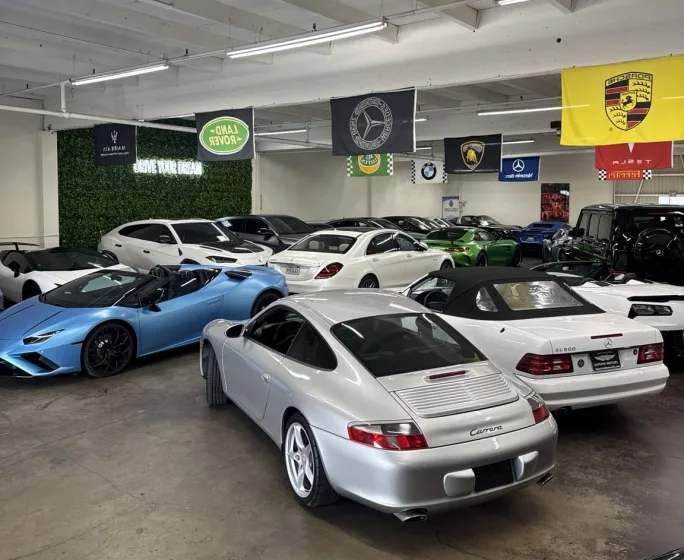
The rental warehouse of Prometheus Exotics.
Credit:
Ken Van Vorhis
That was not a bad employee. That was a person doing their job with the tools they were given.
So understand what the recorded call produces. It produces a recording of somebody without contract authority characterizing a document they have not read. The contract is still the contract.
The call is genuinely good for one thing. Whether a carrier will pay actual cash value on one specific high-value car in a total loss is a forward-looking statement about a specific vehicle, and only the carrier can make it. Ask that, record the answer, and stop treating the rest of the call as verification.
The rest lives in documents. An insurance card proves a policy exists and proves nothing else. The declarations page lists comprehensive and collision vehicle by vehicle, the limits, the deductibles, and every endorsement by form number and edition date. That last column is the one nobody looks at, and it is where the provisions that decide the claim actually live.
Other Provisions That End Coverage Quietly
The value cap is the loudest one. The others are worse, because nothing in the transaction signals them.
Duration. GEICO's contract defines a non-owned auto to exclude anything "rented or leased for more than 30 days," then closes the obvious workaround in the very next sentence.
"Two or more private passenger autos…consecutively rented or leased, one after the other, for more than 30 consecutive days will be considered as furnished for regular use."
Writing a fresh contract every 29 days does not reset the clock.
Repeat business. The same contract excludes coverage for "any vehicle, or series of vehicles, regularly rented by you or a relative on a daily, weekly or monthly basis" unless that vehicle is listed on their own declarations page. Read it twice. The best customer in the book, the one who rents every month, is progressively losing the coverage everybody is relying on by renting so frequently.
Excess, not primary. "Any insurance we provide for a vehicle you do not own shall be excess over any other valid and collectible insurance." Excess over what is the question that decides who pays. When nobody in the chain carries physical damage coverage, there is nothing for it to sit excess of, and the renter's policy carries the whole loss.
Diminished value. The same section says the coverage limit "will not include compensation for any diminution of value claimed to result from the loss." A repair on the CarFax of an exotic car is a real loss to whoever owns it, and that carrier won't reimburse it.
And one thing that cuts the other way. Not every carrier draws this line. I have read a California contract from another major insurance carrier with no coverage exclusions on non-owned physical damage at all, and watched a claim be paid in full on a $500,000 Ferrari without any issues. The point is not that the industry is uniformly bad, only that the answer to the question "does coverage exist" is different for every carrier and unknowable without reading the fine print of that specific contract and any relevant endorsements.
Which is why "full coverage" is not enough. Most of the exotic rental car industry is satisfied with a call recording of an insurance representative confirming coverage exists, and that call means nothing.
What To Do With This
If you are getting into this end of the business, the practical version is short.
Sort your inventory list by MSRP. Every car above $100,000 is one where a personal policy might not be sufficient to cover the vehicle. Price it, paper it, and deposit it accordingly.
Collect the declarations page and read the endorsement list, not the insurance card. Before you read anything, match the license state, the card state, and the declarations page address, because a resident holding an out-of-state policy is a garaging misrepresentation, and coverage will evaporate at claim time.
Build a per-carrier reference. Renters change every booking; carrier policy contracts and endorsement forms do not. Read a carrier's contract once, and you can confirm coverage for every renter who ever shows up with that carrier. That library is worth more than any individual verification call.
Treat long rentals and repeat renters as their own category, because the contracts do. If you want your car to be covered on a 30+ day rental, have your client add the vehicle to their declarations page.
Decide what your wholesale terms say. When you supply a car to another agency, their verification and their booking process become your exposure. Either you set a standard on what constitutes a "verification," or you inherit the consequences of whatever "verification" means to them.
None of this requires a lawyer. It requires reading documents that are already sitting in the transaction.
Ten years ago this magazine found operators who could not have answered any of it. The reason nothing changed is not that the answers are hard to find. It is that the industry kept asking the question out loud, on the phone, to somebody who did not have it, and took the answer.
Part 2 takes the operator's side. It covers what verification catches and what it misses, which documents get forged, why deposits and GPS keep getting treated as protection, and what the sequence looks like when a car comes back damaged.
About the Author: Ken Van Vorhis is the founder of Prometheus Exotics, an exotic and luxury car rental agency in Orange County, Calif. The agency runs a network of more than 100 vehicles sourced from private owners and other agencies rather than purchased.
Exotic rental agencies often rely on customers’ personal auto policies to protect six-figure vehicles. But policy language can dramatically change the coverage for vehicles over $100,000 MSRP.
In my return to writing about the day-to-day challenges of car rental, I have a few observations about shrinking vehicle mix, changing customer base, and the incessant hunt for new efficiencies.
A reservation captures demand. The operating test is whether the business can keep the customer, vehicle, commercial terms, and next action aligned until the rental is closed.
A recent precedent-setting court case points to the precautions and steps a rental fleet operation should take to minimize risk, reduce exposure, and avert legal consequences.
As a growing number of itineraries now feature segments with multiple transportation providers, car rental serves as a core mobility link in travel journeys.
This primer on how AI intersects with rental fleet pricing covers the technology, costs, and steps to ensure an accurate, 24/7 smart system that delivers more revenue to rental car providers.
Greater transparency, simplified digital access, and connected fleets will be the key factors in determining who comes out on top over the next 10 years.