


Surviving the Car Rental Climate Change
The economic storm of 2008-2009 is causing shifts in the auto rental industry both in front of and behind the rental counter. Can you adjust to new market conditions and take advantage of this opportunity, or will you simply try to weather the storm?
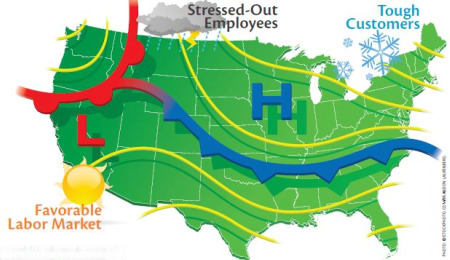
As this issue of Auto Rental News lands on your desk, most of you will be in the midst of your busy season. Hopefully this summer marks a period of heavier rental volumes, higher rates and a renewed sense that “things” are getting better. Having a clearer picture of the General Motors situation along with some recent slightly positive economic news may help your perception, your marketplace and the industry overall.
For some operators, the economic storm has passed; for some, the storm is still there; and for a very small portion of operators, the forecast was wrong—the storm did not hit.
Regardless of your position and outlook, the economic storm and its aftermath have created a convergence of factors that are changing our industry:
Welcome to the age of Car Rental Customer 2.0. Customers are leaner, hungrier for value, more vocal and frustrated.
Frontline associates and management are maxed out. They have endured reductions in workforce as well as upset customers, and they have evolved to multi-task at a higher level.
A weak U.S. job market—combined with industry layoffs and a strong pipeline of candidates—equals a buyer’s market for talent. The war for talent is over! Many operators are apprehensive about adding labor to their P&L in these uncertain times.
Evolution of “Car Rental Customers 2.0”
In the airline, hotel and car rental industries, the words customer experience and service represent urgency and focus. Yet, because of the car rental industry’s move to higher mileage units, lower frontline staffing levels and less management presence at the counters, to many customers, those words are evolving to represent settling for mediocrity and inconsistency.
Added pressures with corporate travel cutbacks, higher airline capacity and the traditional frustrations that go with travel have carried over to the customers’ perception of their experience at the rental counter. According to a JD Power study, all three travel-related industries posted declines in general customer satisfaction in the past two years, which hasn’t happened since 2001-2002.
Because of the current climate, many customers have evolved to adopt the following traits:
In their minds, service has been diluted and perks for loyalty have been cut, so price matters. As a result of these changes, they have been less loyal to specific brands.
With less management presence at the counters, customers rely on frontline associates to make critical decisions that impact their experience.
Smart phones and wireless technologies have allowed customers to become ultra informed about rate changes and availability.
Because of Internet booking portals, customers have become “price predatory” to find levels of new low rates.
Social networking and popular consumer sites such as Facebook, Twitter, Trip Advisor and YouTube have intensified the customer’s feedback.
Some have accepted longer line waits at hotel, airline and car rental counters as the status quo.
They have accepted higher mileage on rental vehicles. Implementing the following techniques with your team will help you improve the customer’s experience and their perception:
Implement a service-based sales training program for all team members. Support it with consistent coaching.
Empower your frontline associates to handle customer complaints with a “first contact resolution” policy. Adopting a “no one leaves unhappy” mindset only starts when your team is fully trained and has customer resolution techniques and dialogues.
Demonstrate to frontline associates the power of the Internet and the impact a negative report can have on travel or social sites. Ask yourself, “What happens when we Google our location about our service?” or “Do we have friends or foes on Facebook?”
Encourage loyal customers to share positive feedback about your location on their social networking Web site. Establish an online ambassadors’ discount program.
Coach frontline associates to acknowledge customers in line with a positive and appreciative method. Identify high volume hours that call for a management presence at the counter.
Coach your frontline never to begin their rental process with “How was your flight?” Why open up a can of worms?
Coach your service agents to spend additional time cleaning door jambs, cup holders, windshields and radio displays. Not only does a dirty car get driven harder, it appears older to the customer. The higher the mileage, the more attention it deserves.
[PAGEBREAK]
Finally, and most importantly, adopt the mindset that you can control the customers’ experience and perception. What happens during the first critical seconds of the rental can set the pace for the customer’s trip. A good frontline associate backed by a strong manager can help quell the tide of customers’ negative perceptions.
Frontline Sales and Management Teams Are Maxed Out
Have you heard any of the following statements of frustration from your management or frontline team? “It’s been crazy today,” or “It seems as if every rental has a different problem with it,” or “Our incentives have not been good,” or “We used to have someone help us with that but that task has fallen on my plate.”
Since the second quarter of 2008, the North American car rental industry has shed an estimated 4,000 jobs. Many of these cuts came in the areas of management personnel and frontline associates.
To many teams, a typical day “seems crazy” not because rental volume has increased but because the number of frontline team members has been cut. Every rental seems to be “problematic” because in many cases, frontline training has been cut and management support at the counters has been limited. Although frontline and management teams are working hard, in many cases, incentives have been lowered because of a downturn in rental volumes.
With less frontline staff and less administrative support, the new 50-hour week for your typical manager has become a 60-hour- plus work week. These realities have pushed managers and associates to a brink that many senior leaders have not seen before.
Implementing the following techniques and service-based sales tools while adopting a different general philosophy will help you improve your team’s level of engagement and your customers’ experience:
Implement performance-based scheduling. Place your top performers and best ambassadors at your peak hours. Better performers treat customers better.
Ask yourself if you really have that many problematic rentals, or are your problematic frontline associates incapable of handling unique situations? Then ask yourself if, with what you know now, would you hire this problematic person? Managers can feel maxed out when all three motivational drivers are, in fact, not maxed out. In a professional setting, three things motivate all people: recognition, money and accountability. If incentive payouts are slimmer, it is critical that senior leadership relies on recognition and accountability to drive performance.
Establish a face-time ratio for your managers and frontline. For every four conference call meetings with your team, dedicate one face-to-face visit. If travel cuts and budget concerns are an issue, utilize Skype or other free Web conferencing services to make the connection. Nothing drives results faster than strong relationships. Your ability to connect one-on-one will keep your frontline managers and leaders engaged.
Utilize a defined service-based sales process for the rental transaction. Chaos is the child of inconsistent behaviors. Provide your frontline team with a set guideline of what should happen with specific sales techniques and dialogues. Stress to them that within the five-minute rental transaction many things can go wrong with the customer’s experience if the frontline team is not mindful of the little things.
Remove all distracting literature and non-essential items from the counter. A cluttered desk is a cluttered mind. Having too many items on the counters distracts your customers, prolongs the rental process and draws curious, impatient customers who should be waiting in line to wander and explore the counter literature while your associates are renting. Too many people at the counter raises the stress level of your associates and jeopardizes your customer’s privacy.
[PAGEBREAK]
To ensure that some of these methods are being implemented, establish monthly result reviews for your management team. Schedule 90-minute sessions once a month, between the third and fifth of each month. Focus on previous months’ results, review operational targets and set goals for the upcoming month. Involve as many senior leaders in the meeting as possible. This practice will help your managers bring clarity to their work routine and provide a forum to be recognized.
The War for Talent Is Over!
Since early 2008, the U.S. economy has shed 6,000,000 jobs. Unemployment has reached 9.4 percent, and unfortunately, could get worse. If anything, these statistics should create the urgency that candidates are out there.
Americans want to work. If you were apprehensive in the past to make changes with underperforming team members because the candidate pool was limited, now is the time to act!
Throughout the current economic crisis and “talent opportunity,” the following realities of our industry play into our favor: The car rental industry is not going away. Our industry recognition and value to our customers is strong. Candidates understand the basics of what the industry is about, and the established brands are very recognizable. It is an easy draw for candidates looking for a new challenge.
The industry appeals to candidates of all walks of life, education level and experience level. After getting in the door, the candidate can move into many different roles.
The new 50-hour work week is now 60 hours. The new $50,000-per-year job is paying $35,000–$45,000. No one should exploit a candidate on their willingness to work or over-leverage the candidate because of candidate supply and demand, but look for candidates who are willing to take a lower fixed wage with a higher amount on performance-based incentives. Provide fair performance targets with supporting measurements to gauge their impact.
Implementing the following hiring techniques and performance management philosophies, while being mindful of potential pitfalls, will help you capitalize on this hiring opportunity:
Make your recruitment efforts known to everyone at your operation. Even if it is for one to two positions, let your team know you are actively recruiting top-shelf candidates. This activity is a reminder that for every one position open, there are 10 candidates hungry for the opportunity. This sends a clear message to frontline associates who are underperforming and representing your organization poorly. Note in some unionized environments or ones that have suffered recent reductions, this may not be applicable, or needs further review.
Define your “unique recruitment proposition.” Have your message of why your organization is a good choice and why the industry offers great professional opportunities. Practice the message with your recruiters and managers prior to it being delivered.
Years of service do not equal valuable experience or competence. Be wary of candidates with car rental experience in one operation or one role for more than five years. Many times the manager with 15 years’ experience really has 13 years’ experience of repeating years one or two. To provide a fair opportunity to these candidates, ask questions about how they developed professionally and what they learned from the changes they faced operationally. Ask candid questions about how they would change your location.
“Journeymen” sales associates who approach you for employment may bring more baggage and questionable sales techniques than value. Ask these candidates to role play the rental process, check for their dialogues and see if they have been through any professional service-based sales training.
Understanding these realities, evaluating your business in an objective fashion and responding to them accordingly will help you weather your existing economic storm and prepare for those to come.
Ken Stellon is a senior vice president for The Khoury Group. He is a frequent contributor to Auto Rental News and a presenter at the annual Car Rental Show. Contact Ken at 800-930-1214 or kstellon@khouryconsulting.com. Similar topics can be found at The Khoury Group’s performance blog www.frontlineprofitmachine.com.
More Rental Operations

Palm Beach Airport Code Change Creates Car Rental Distribution Gap
A test of rental searches under the old PBI and new DJT airport codes returned largely different sets of brands and vehicles, highlighting a potential distribution problem for rental operators.
Read More →
U-Save Continues Dominican Republic Expansion with Launch in Punta Cana
The new franchise location builds on U-Save’s existing Santo Domingo operation and will begin taking reservations for October 2026.
Read More →
When AI Books the Rental Car, Who Controls the Sale?
As AI moves from comparing rental rates to completing transactions, operators need to understand how travelers find, interpret, rank, and ultimately see their offers. (Part 2 of 2.)
Read More →
European Booked Car Rental Rates Fell 5%, Results Varied by Country
Ireland, Cyprus, and the United Kingdom saw steep declines, while booked rates rose in Poland and Hungary.
Read More →
Is It Time to Rethink Rental Categories?
As traditional economy and compact cars disappear from the market, longtime rental operator Mike DeLorenzo asks whether the industry’s familiar vehicle categories still make sense — and what operators need to rethink along with them.
Read More →
Who Owns the Rate? AI Is Creating a New Distribution Problem for Car Rental
Generative Engine Optimization asks whether AI can find a rental company, but operators also need to know whether the agent inspected enough of the market, compared equivalent offers, and presented a rate the traveler can actually book. (Part 1 of 2)
Read More →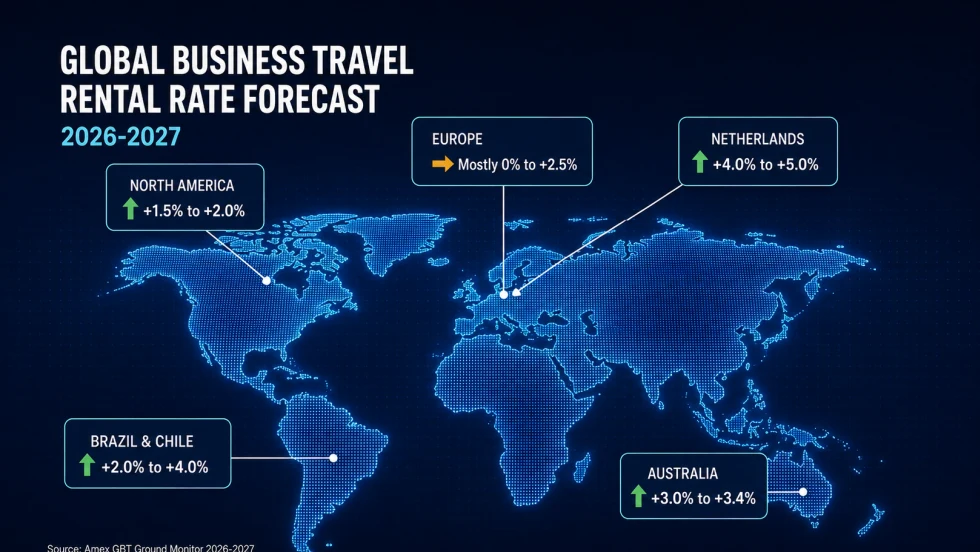
U.S. Business Travel Car Rental Rates Forecast to Rise Up to 2%
Improved fleet supply should limit pricing gains in 2026-27, while insurance, repair costs, and softer residual values continue to pressure rental operations, according to Amex GBT.
Read More →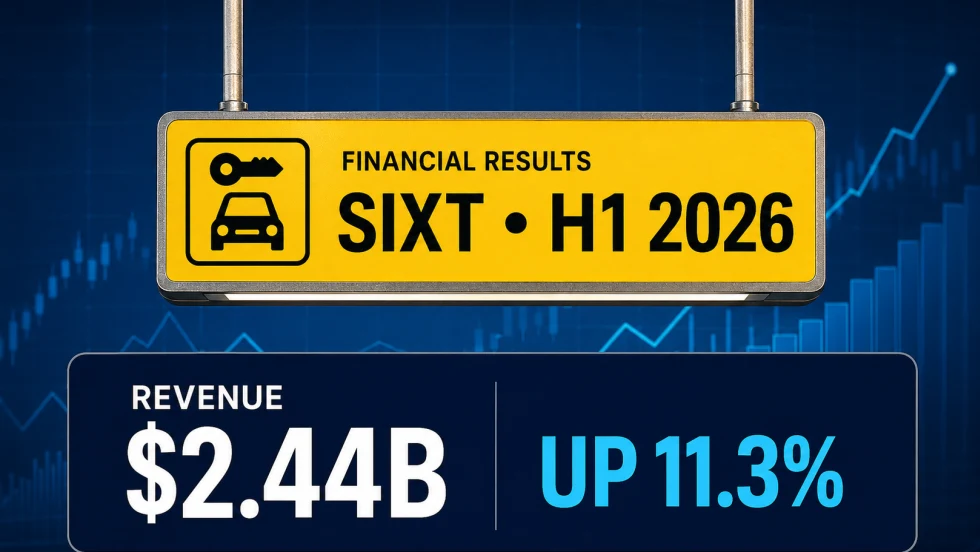
Sixt Revenue Tops $2.4 Billion in First Half of 2026
Sixt’s first-half revenue surpassed $2.4 billion for the first time as demand outpaced fleet growth, lifting utilization and earnings despite weaker consumer sentiment in North America.
Read More →
In Memoriam: Bobby Klyce, Avis Licensee Legend
The longtime Birmingham Avis operator and 2018 Auto Rental News Impact Award recipient was remembered as an advocate for independent licensees and the broader car rental industry.
Read More →
How to Build Custom Fleet Tools With AI and Vibe Coding [Webinar]
A new Automotive Fleet webinar explores how fleet managers are using AI and vibe coding to automate routine work and create simple operational tools without traditional programming skills.
Read More →