



Turning A Profit
At the 2011 Car Rental Show, four members of the Tennant Group Roundtable each presented a proven cost-reduction and profit-making idea that they have implemented in their car rental operations. Seminar attendees voted for the best idea. Can they work for you?

Here are four ideas you can use today to drive profits to your bottom line.
1. Base fleet purchases primarily on projected holding costs.
Mike Kulp
Kulp Car Rentals, Gilbertsville, Penn.
Kulp Car Rentals has instituted a policy of making all fleet purchases based primarily on projected holding costs of the vehicle. Our goal is to depreciate the rental fleet at the rate of one percent per month, and still sell the vehicles at a gain. In 2010 the actual monthly cost of depreciation on the 341 fleet vehicles we sold was .87 percent.
Before a vehicle is purchased for the fleet, we determine that vehicle's MMR (Manheim Market Report) value for one-, two- and three-year-old models. This is used to determine the estimated residual value of the vehicle. Based upon the current acquisition cost and estimated residual value, we will purchase the vehicle if it meets our 5-percent per-month budget.
In order to maintain this depreciation rate, we purchase based upon vehicle availability and market conditions. In Nov. and Dec. 2010 and Jan. 2011 we bought more than 200 vehicles because the cars were available at the right price, not because we thought we needed that many for rental.
Since the summer of 2008, we have also sold off all of our larger SUVs and bought only fuel-efficient fleet vehicles. We believe that gas prices will again climb to rates that will significantly impact the value of larger, less fuel-efficient vehicles. Although we could have rented these vehicles at a higher rate than our current fleet vehicles, we did not purchase them because of our estimate of their residual value.
In summary, the driving factor in fleet purchase decisions is not the vehicle's rental rate, or the type of vehicle to rent-it is whether the acquisition cost will allow us to keep the depreciation cost within our budget.
2. Get "free" money for training.
Jack Vercollone
Verc Car Rental, Southeastern Mass.
For the last 10 years, we have received more than $100,000 in training from three separate grants from our state's (Massachusetts) Workforce Training Fund. The training was for selling extras, computer training, supervision techniques, customer service and operations management.
Grant funds were matched, dollar for dollar, with company money, either cash or in kind.
Our match was met by paying employees while they trained. The company chose a different trainer for each type of training.
Training can be spread over two years, minimizing disruptions during busy season. The Training Fund comes from every company's unemployment tax contribution. If you are going to have to pay it, you might as well get something back!
Most states have the same or similar training grants available.[PAGEBREAK]
3. Track historical fleet data per model for better cost control.
David Wilson
Dollar Thrifty licensee, Nashville, Tenn.
Which model costs more in fleet, a Toyota Corolla or a Toyota Avalon? Is it really more cost effective to hold cars longer? By analyzing actual historical fleet data by model, we've found that the real-world numbers sometimes fly in the face of conventional wisdom.
We keep an Excel spreadsheet of our fleet that tracks each car's purchase price, sale price, months owned, miles per month, ending miles, monthly and total depreciation, cost per month and cost per mile. With this data, we aggregate car costs by car sizes, hold times and total miles. By analyzing cumulative data for a particular model, we can pinpoint the optimal time to sell that model.
We've found in some instances that it is more cost effective to sell our big cars-which accumulate miles quicker-within a shorter hold time than our small cars. This actual data guides our fleet purchases and sales to wring the most cost savings out of each unit.
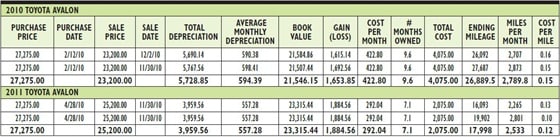
In the enclosed snapshot of Toyota Avalons, the 2010 models were held for 9.6 months and incurred an average cost of $423 per month. The 2011 models, however, were held for 7.1 months on average, yet incurred only $292 in cost per month. The 2011 Avalons' average holding cost is much less than for our Corollas, which were held for 14 months on average at an average cost per month of $352.
4. Winner! Use your screen saver to motivate employees.
Brenda Albright
Discount Car and Truck Rentals, Riverview, New Brunswick, Canada
Are you pulling your hair out over employees that forget to do simple tasks?
Why not take advantage of some simple technology that will cost you absolutely nothing? Use the "rolling marquee" feature on your screen saver to get a message across to your staff.
Set the marquee to come on after a minute of inactivity and they'll be aware of it all day long. When you think they've got the message, change it to something else.
Even the most forgetful employee can't use the "Oh, I forgot" excuse with this simple, easy-to-implement reminder and motivational tool. Best of all, it's cheaper than string on a finger!
Here are some of the messages we have used:
● Have you sent in a lead today?
● Use the proper source code.
● Vehicle Licensing Fee
● Remember the Fuel Purchase Option.
● Utilization
● Have you ASKED for the rental?
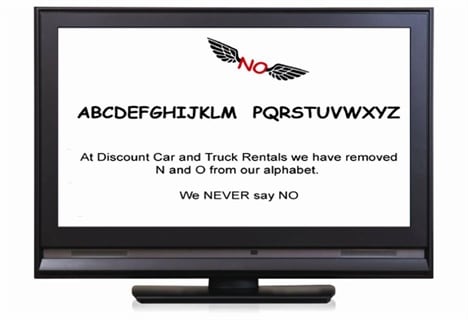
This screen saver has been our favorite by far. This was created by converting a Flash display to a screen saver using free software available from instantstorm.com in conjunction with the rolling marquee that is standard in Windows.
More Rental Operations
How Did This Independent Rental Operator Grow to 170 Vehicles in 4 Years?
With 170 vehicles across three Kentucky locations, Joel Price relies on an overseas team to handle reservations, payments, and after-hours customer service. It's one part of an unconventional approach to growing an independent rental operation.
Read More →
What Does It Take to Succeed in B2B Rentals?
The fundamentals may be familiar to daily car rental operators, but project-based truck rentals put different demands on the fleet and the business.
Read More →
NPR Builds on International Partnerships to Grow Rental Bookings
With Ana Laborde supporting broker development, NPR Auto Group is tailoring distribution strategies, rate packages, and partnerships to grow international reservations across its three brands.
Read More →
Advantage, Sixt Place Among Top Five in Annual Satisfaction Study
While Enterprise and National retain the top spots in JD Power’s 2026 rankings, the latest customer satisfaction results suggest renters can find competitive service beyond the biggest car rental names.
Read More →
The $100,000 Insurance Trap in Exotic Car Rentals
Exotic rental agencies often rely on customers’ personal auto policies to protect six-figure vehicles. But policy language can dramatically change the coverage for vehicles over $100,000 MSRP.
Read More →
The Booking Is Confirmed, But Is Your Customer Ready to Drive?
For international renters, a confirmed reservation doesn’t always mean they’re eligible to drive. Earlier checks can help operators catch documentation and payment issues before the customer reaches the counter.
Read More →
ICRS 2027 Opens Call for Papers
The International Car Rental Show seeks session proposals on the business, operational, and technology issues facing car rental operators. Submissions are due Jan. 15.
Read More →
Turo to Launch Vehicle Delivery Service
Turo Delivered will let travelers search for vehicles that hosts can deliver directly to hotels, homes, airports, train stations, and other locations.
Read More →
Palm Beach Airport Code Change Creates Car Rental Distribution Gap
A test of rental searches under the old PBI and new DJT airport codes returned largely different sets of brands and vehicles, highlighting a potential distribution problem for rental operators.
Read More →
U-Save Continues Dominican Republic Expansion with Launch in Punta Cana
The new franchise location builds on U-Save’s existing Santo Domingo operation and will begin taking reservations for October 2026.
Read More →