




Airport Rates Dip Amid Positive Trend
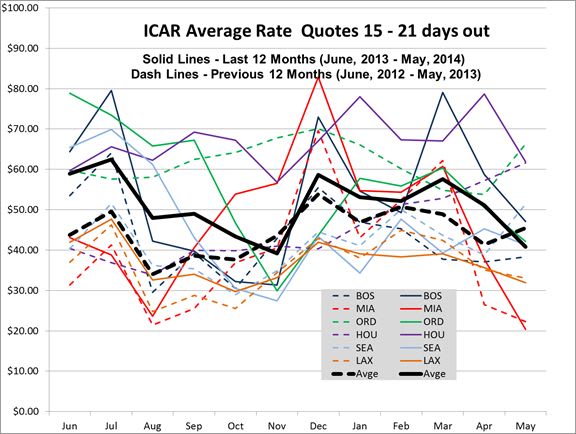
May rate quotes for the six cities dropped for only the second time in the last 19 months, according to Rate-Highway’s monthly rate survey. In May, the rates were down $4.70 from a year ago. Additionally, next month’s survey will also feature a 50-city rate survey.
With the help of Jim Tennant of The Tennant Group and Michael Meyer of Rate-Highway Inc., we are conducting rate surveys on a weekly basis and providing analysis and comments where appropriate. We publish this monthly recap in our electronic edition and more comprehensive looks in the print editions.
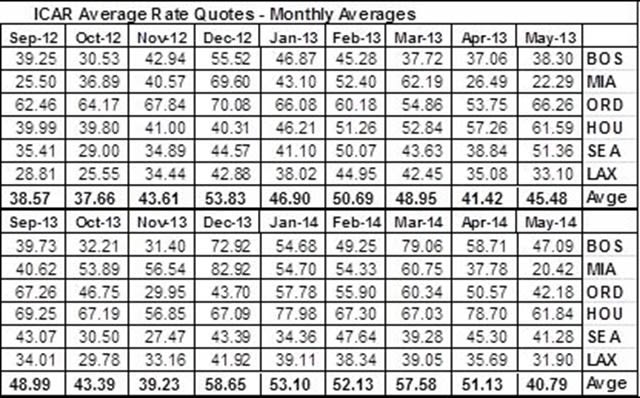
For only the second time since November 2012 — a period of 19 months — rates in May were down from the same month last year. Recently, we have been seeing significant year-over-year increases, but increases of this magnitude could not continue indefinitely.
We still believe that the summer will be strong, since there is no indication that the industry is over-fleeted or travel will be down. But double digit increases are not looking likely.
When it comes to specific cities, Chicago and Seattle are both down significantly, Boston is recovering from low rates last year and Miami is showing normal shoulder season weakness.
Comparison of Six-City to 50-City Average Quotes
As we have previously discussed, we have been collecting rate quotes for the top 50 U.S. airports since mid-May 2013. The intention is to switch from the current six-city survey to the 50-city survey when we have 13 full months, allowing us to do a year-over-year comparison.
This comparison will occur with the upcoming June survey; therefore, May is the last time we will be using the six-city results exclusively. In June, along with our regular look at rates, we will show the six-city results compared to the 50-city results for the last year. This will help understand the significance of the new results after the transition.
The chart below compares the weekly average rate quotes for the six cities that we have been surveying for three years with the average of the 50 largest U. S. airports’ rate quotes.
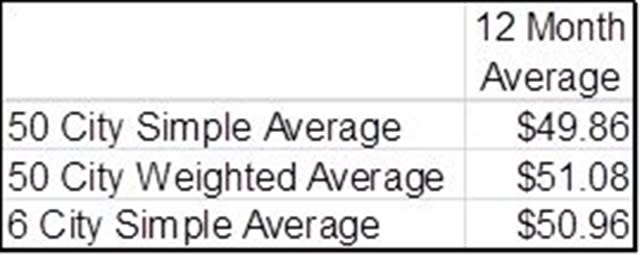
Because the spread between the largest and the smallest of the 50 is significant (the largest has more than 14 times the passenger volume of the smallest), we decided to compare the simple average of all 50 cities’ rates — as we do for the six-city average — with a weighted average, in which we weighted each city’s average rate by its passenger volume.
As might be expected, the much larger sample reduces the volatility of the quotes, because a major event in one city, such as Easter break in Miami, has far less effect on the average. The quotes themselves, besides being less volatile with the larger sample, are somewhat different in absolute terms, as well.
The larger sample’s weighted average rate is higher over the last 12 months than the simple average, indicating that the larger airports have higher rates on average. The six-city simple average, consisting of six large airports, is higher than the 50-city simple average, but lower than the 50-city weighted average.
Looking at individual cities over the past 12 months, the highest 52-week average quote was Ronald Reagan Washington National Airport (DCA) at $87.64. It was nearly three times higher than the lowest average quote for San Diego International Airport (SAN) at $29.49.
The larger sample gives us the opportunity to group the cities by region and look at regional trends and comparisons. We looked at regions a few months ago and will do so again on a regular basis.
Based on the work we have done so far, we believe the larger sample will yield more meaningful results and justifies the extra effort.
More Rental Operations

What Does It Take to Succeed in B2B Rentals?
The fundamentals may be familiar to daily car rental operators, but project-based truck rentals put different demands on the fleet and the business.
Read More →
NPR Builds on International Partnerships to Grow Rental Bookings
With Ana Laborde supporting broker development, NPR Auto Group is tailoring distribution strategies, rate packages, and partnerships to grow international reservations across its three brands.
Read More →
Advantage, Sixt Place Among Top Five in Annual Satisfaction Study
While Enterprise and National retain the top spots in JD Power’s 2026 rankings, the latest customer satisfaction results suggest renters can find competitive service beyond the biggest car rental names.
Read More →
The $100,000 Insurance Trap in Exotic Car Rentals
Exotic rental agencies often rely on customers’ personal auto policies to protect six-figure vehicles. But policy language can dramatically change the coverage for vehicles over $100,000 MSRP.
Read More →
The Booking Is Confirmed, But Is Your Customer Ready to Drive?
For international renters, a confirmed reservation doesn’t always mean they’re eligible to drive. Earlier checks can help operators catch documentation and payment issues before the customer reaches the counter.
Read More →
ICRS 2027 Opens Call for Papers
The International Car Rental Show seeks session proposals on the business, operational, and technology issues facing car rental operators. Submissions are due Jan. 15.
Read More →
Turo to Launch Vehicle Delivery Service
Turo Delivered will let travelers search for vehicles that hosts can deliver directly to hotels, homes, airports, train stations, and other locations.
Read More →
Palm Beach Airport Code Change Creates Car Rental Distribution Gap
A test of rental searches under the old PBI and new DJT airport codes returned largely different sets of brands and vehicles, highlighting a potential distribution problem for rental operators.
Read More →
U-Save Continues Dominican Republic Expansion with Launch in Punta Cana
The new franchise location builds on U-Save’s existing Santo Domingo operation and will begin taking reservations for October 2026.
Read More →
When AI Books the Rental Car, Who Controls the Sale?
As AI moves from comparing rental rates to completing transactions, operators need to understand how travelers find, interpret, rank, and ultimately see their offers. (Part 2 of 2.)
Read More →