





Related: Survey Finds US Travel Resuming, But Not at Pre-COVID Levels
Domestic Business Travel Trending Positive, International Lags
A GBTA survey found that member companies worldwide report an emerging willingness to permit employees to engage in domestic business travel, though members continue to report virtually no willingness for employees to travel internationally.
August 14, 2020

Photo via Depositphotos.
3 min to read
In Europe the outlook remains more positive, 70% of GBTA members in Europe expect domestic business travel to return in the next two to three months compared to just 26% in North America.
Screenshot via GBTA.
Companies worldwide are becoming more willing to allow employees to engage in domestic business travel, according to the latest poll by the Global Business Travel Association, conducted between August 5-9.
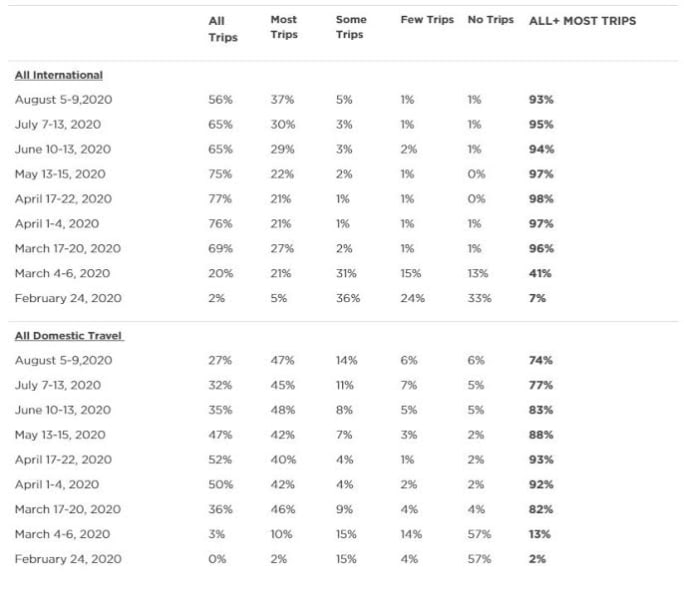
Respondents to the poll — the 10th bi-weekly survey conducted among GBTA’s members since the onset of the coronavirus pandemic in February — continue to report virtually no willingness for employees to travel internationally, with 93% indicating the pandemic has curtailed all or most international business trips. By comparison, 74% of respondents report that the pandemic has curtailed all or most of their organization’s domestic business trips.
That number has fallen by 19 percentage points since GBTA’s mid-April poll of members and the lowest level since the pre-pandemic polling in late winter 2020.
“The business travel landscape continues to be difficult in Europe and the U.S., but we do see some small glimmers of recovery here and there,” Dave Hilfman, the interim executive director of GBTA, said in a statement. “More companies look to be trending positively on domestic trips, with Europe still showing the most positive uplift.”
In Europe the outlook remains more positive, 70% of GBTA members in Europe expect domestic business travel to return in the next two to three months compared to just 26% in North America. Likewise, members based in Europe are more likely to expect international business travel to resume in the next two to three months (20%) than members based in North America (9%).
Three in four respondents (74%) report that their company has started to formulate a travel recovery plan. Tighter booking channels are a trend, with 66% of respondents stating they are less likely to allow travelers to book directly with suppliers and 65% are less likely to allow travelers to book with an online travel agency (OTA), than before the pandemic.
When asked about new safety measures, PPE is the new business travel accessory. One-third (31%) of GBTA member companies plan to provide PPE for their travelers while 20% require their travelers to provide their own as an essential item for their safe return to travel. Only 6% report that their company is not making PPE mandatory for travelers.
While recovery plans are underway, the return to travel remains slow and is taking longer than previously expected. Suppliers (84%) are more likely than travel managers (73%) to say that business travel has resumed more slowly than they had originally expected.
“It is encouraging to see so many members companies working on travel recovery plans in preparation for their return to travel, with virtually all our members keeping employees’ health and safety as their primary concern," Hilfman, added. "New considerations such as PPE are being added to travel policy and GBTA is supporting members and the industry to ensure consistent health and safety measures across all sectors on a global basis."
More Rental Operations

The $100,000 Insurance Trap in Exotic Car Rentals
Exotic rental agencies often rely on customers’ personal auto policies to protect six-figure vehicles. But policy language can dramatically change the coverage for vehicles over $100,000 MSRP.
Read More →
The Booking Is Confirmed, But Is Your Customer Ready to Drive?
For international renters, a confirmed reservation doesn’t always mean they’re eligible to drive. Earlier checks can help operators catch documentation and payment issues before the customer reaches the counter.
Read More →
ICRS 2027 Opens Call for Papers
The International Car Rental Show seeks session proposals on the business, operational, and technology issues facing car rental operators. Submissions are due Jan. 15.
Read More →
Turo to Launch Vehicle Delivery Service
Turo Delivered will let travelers search for vehicles that hosts can deliver directly to hotels, homes, airports, train stations, and other locations.
Read More →
Palm Beach Airport Code Change Creates Car Rental Distribution Gap
A test of rental searches under the old PBI and new DJT airport codes returned largely different sets of brands and vehicles, highlighting a potential distribution problem for rental operators.
Read More →
U-Save Continues Dominican Republic Expansion with Launch in Punta Cana
The new franchise location builds on U-Save’s existing Santo Domingo operation and will begin taking reservations for October 2026.
Read More →
When AI Books the Rental Car, Who Controls the Sale?
As AI moves from comparing rental rates to completing transactions, operators need to understand how travelers find, interpret, rank, and ultimately see their offers. (Part 2 of 2.)
Read More →
European Booked Car Rental Rates Fell 5%, Results Varied by Country
Ireland, Cyprus, and the United Kingdom saw steep declines, while booked rates rose in Poland and Hungary.
Read More →
Is It Time to Rethink Rental Categories?
As traditional economy and compact cars disappear from the market, longtime rental operator Mike DeLorenzo asks whether the industry’s familiar vehicle categories still make sense — and what operators need to rethink along with them.
Read More →
Who Owns the Rate? AI Is Creating a New Distribution Problem for Car Rental
Generative Engine Optimization asks whether AI can find a rental company, but operators also need to know whether the agent inspected enough of the market, compared equivalent offers, and presented a rate the traveler can actually book. (Part 1 of 2)
Read More →