




Enterprise Survey: 63% Work at Least One Weekend per Month
According to Enterprise Rent-A-Car’s “On Weekend” survey, nearly 7 out of 10 individuals work at least one weekend per month. Nearly two-thirds of respondents (63%) said their employers expect them to work over the weekend.
According to Enterprise Rent-A-Car’s “On Weekend” survey, nearly 7 out of 10 individuals work at least one weekend per month.
And when they do work over a weekend, respondents said that they put in the equivalent of a full workday, an average of nearly nine hours.
Nearly two-thirds of respondents (63%) said their employers expect them to work over the weekend, and 61% said they have a hard time not thinking about work over the weekend, according to the survey.
Additionally, 67% of respondents said they are plugged into the office on a typical weekend through reading or answering work-related emails.
Enterprise commissioned an online survey of 1,000 Americans aged 25 and older, which was fielded from February 22-27, 2017.
“We went into the survey anticipating that work would creep into a weekend every now and then,” said Steve Short, vice president at Enterprise. “However, this data opened our eyes to the fact that, for many of us, the workweek doesn’t really end at the weekend, but spills right into it. Realizing this, it’s no wonder that 85% of survey respondents said they want to get more out of their weekends and 83% percent described their weekends as ‘never long enough.’ The bottom line is that we need to make the most of the time we have outside the office. Fortunately, there are things we can do to maximize our weekends and ensure that ‘work creep’ doesn’t become the norm.”
Jonathan Alpert, psychotherapist and author of “BE FEARLESS: Change Your Life in 28 Days,” provides some tips to help individuals make the most of their weekends:
• Change your thinking. Focusing on negative thoughts such as “I’m so busy” and “the weekend is too short” is sure to keep you feeling overwhelmed and prevent you from enjoying the weekend. Shift your thinking to “I’ll make good use of the time that I do have” or “I can only do so much in a day, so I’ll accomplish what’s reasonable today, while making sure I relax, too.”
• Step out of your comfort zone and change the scenery. Don’t let your weekends become a monotonous routine. Challenge yourself with new physical or intellectual activities and make each new weekend different from the last. Give your own vehicle a rest and rent a car. Go someplace new within a few hours of home. We tend to overlook attractions that are within reach when we think about vacations.
• Don’t sleep the day away. Although it’s tempting, sleeping in will rob you of valuable time to get out there and make the most of the day. Further, it will eventually interfere with your sleep schedule during the rest of the week. Instead, if you’re tired, take a short power nap during the day.
• Strike a balance between planning ahead and going with the flow. Look forward to activities and have plans in place, but be flexible and don’t pack your weekend too full. If you make too many plans, then you might feel pressure and stress to accomplish all of them. On the other hand, not doing anything will make you feel like your weekend was unproductive.
• Conquer the “Sunday blues.” People sometimes can’t enjoy the weekend because their head is wrapped up in the workweek that lies ahead. There are things you can do, such as preparing for Monday every Friday, that can help you beat those blues.
More Rental Operations

The Booking Is Confirmed, But Is Your Customer Ready to Drive?
For international renters, a confirmed reservation doesn’t always mean they’re eligible to drive. Earlier checks can help operators catch documentation and payment issues before the customer reaches the counter.
Read More →
ICRS 2027 Opens Call for Papers
The International Car Rental Show seeks session proposals on the business, operational, and technology issues facing car rental operators. Submissions are due Jan. 15.
Read More →
Turo to Launch Vehicle Delivery Service
Turo Delivered will let travelers search for vehicles that hosts can deliver directly to hotels, homes, airports, train stations, and other locations.
Read More →
Palm Beach Airport Code Change Creates Car Rental Distribution Gap
A test of rental searches under the old PBI and new DJT airport codes returned largely different sets of brands and vehicles, highlighting a potential distribution problem for rental operators.
Read More →
U-Save Continues Dominican Republic Expansion with Launch in Punta Cana
The new franchise location builds on U-Save’s existing Santo Domingo operation and will begin taking reservations for October 2026.
Read More →
When AI Books the Rental Car, Who Controls the Sale?
As AI moves from comparing rental rates to completing transactions, operators need to understand how travelers find, interpret, rank, and ultimately see their offers. (Part 2 of 2.)
Read More →
European Booked Car Rental Rates Fell 5%, Results Varied by Country
Ireland, Cyprus, and the United Kingdom saw steep declines, while booked rates rose in Poland and Hungary.
Read More →
Is It Time to Rethink Rental Categories?
As traditional economy and compact cars disappear from the market, longtime rental operator Mike DeLorenzo asks whether the industry’s familiar vehicle categories still make sense — and what operators need to rethink along with them.
Read More →
Who Owns the Rate? AI Is Creating a New Distribution Problem for Car Rental
Generative Engine Optimization asks whether AI can find a rental company, but operators also need to know whether the agent inspected enough of the market, compared equivalent offers, and presented a rate the traveler can actually book. (Part 1 of 2)
Read More →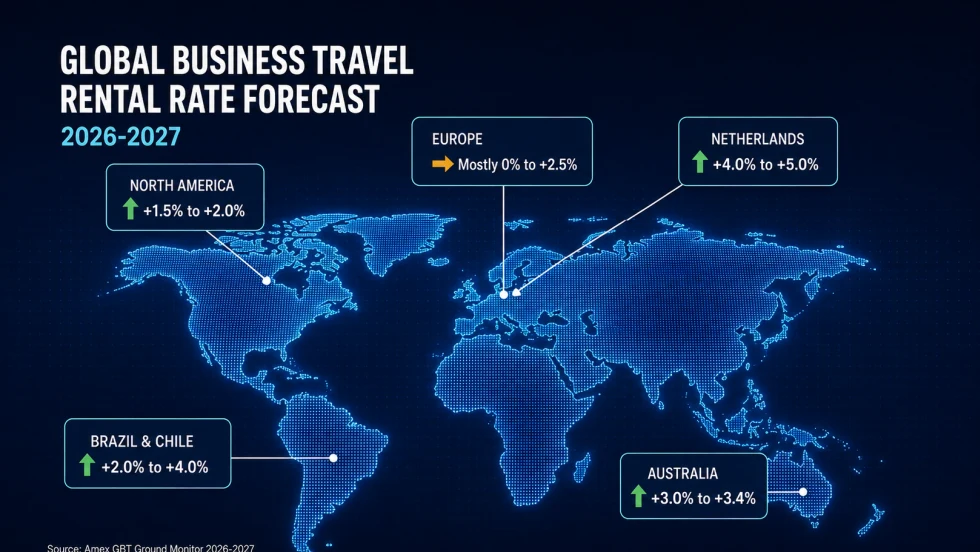
U.S. Business Travel Car Rental Rates Forecast to Rise Up to 2%
Improved fleet supply should limit pricing gains in 2026-27, while insurance, repair costs, and softer residual values continue to pressure rental operations, according to Amex GBT.
Read More →