




Hertz Reports Q1 Operating Results
Worldwide overall revenues slide 23.3 percent year over year, but company expects profit retention to improve in future quarters.
Hertz Global Holdings Inc. reported first quarter 2009 worldwide revenues of $1.6 billion, a decrease of 23.3 percent, or $474.3 million, year-over-year (an 18.3 percent decrease in constant currency). Worldwide car rental revenues for the quarter decreased 21.1 percent (a 15.9 percent decrease in constant currency) to $1.3 billion. Revenues from worldwide equipment rental for the first quarter were $279.5 million, down 32 percent (a 27.5 percent decrease in constant currency) over the prior year period. First quarter 2009 adjusted pre-tax loss was $116.6 million, versus adjusted pre-tax income of $17.1 million in 2008, and loss before income taxes and non-controlling interest (pre-tax loss), on a GAAP basis, was $210.0 million, versus a pre-tax loss of $55.8 million in the first quarter of 2008. Corporate EBITDA for the first quarter of 2009 was $91.9 million, a decrease of 60.9 percent from the same period in 2008. First quarter 2009 adjusted net loss was $80.0 million, versus adjusted net income of $6.5 million from the same period in 2008, resulting in adjusted diluted loss per share for the quarter of $(0.25), compared with adjusted diluted earnings per share of $0.02 for the first quarter of 2008. First quarter 2009 net loss, on a GAAP basis, was $163.5 million, or $(0.51) per share on a diluted basis, compared with a net loss of $57.7 million, or $(0.18) per share on a diluted basis, for the first quarter of 2008. The increase in GAAP net loss is attributable to decreased volume and pricing, increased restructuring and related costs and residual value declines. Mark P. Frissora, the company's chairman and CEO, said, "We continue to generate strong cash flow and maintain significant liquidity in the midst of the global recession. Additionally, we are improving profit retention sequentially, mitigating the effect of declining revenues on adjusted and GAAP earnings. In the first quarter, revenues decreased almost $475 million year-over-year, while adjusted pre-tax income declined approximately $134 million, or $154 million on a GAAP basis. These results compare favorably with a fourth quarter 2008 revenue decline of $350 million and a $256 million decrease in adjusted pre-tax income, or $1.53 billion on a GAAP basis, which included a $1.17 billion non-cash impairment charge. We expect profit retention will continue to improve in future quarters as our financial results more fully reflect recent cost actions. Additionally, we generated improved first quarter total net cash flow of over $760 million, reduced total debt by $1.3 billion and maintained liquidity at quarter end of almost $5.4 billion. We are maintaining our focus on yield-managing high quality revenue with tighter fleets to optimize cash flow and liquidity." The company took $38.4 million in restructuring and related charges in the first quarter of 2009, primarily attributable to costs associated with job reductions, the closure of rental locations and outsourcing/process reengineering. The company ended the first quarter of 2009 with total debt of $9.69 billion and net corporate debt(1) of $3.85 billion, compared with total debt of $10.97 billion and net corporate debt of $3.82 billion as of Dec. 31, 2008, an increase in net corporate debt of $36.7 million. Total net cash flow for the quarter was $760.7 million compared with a use of $95.5 million in the first quarter of 2008. The improvement of $856.2 million is attributable to better management of fleet rotation to preserve liquidity and increase cash flow. On a GAAP basis, net cash provided by operating activities was $966.2 million in the first quarter of 2009, compared to $1,128.2 million in 2008. The company generated total net cash flow yield(1) of 60.2 percent, based on the company's $1,449.3 million of total net cash flow, for the 12 months ending March 31, 2009, compared with total net cash flow yield of 11.7 percent, based on the company's $746.6 million of total net cash flow, for the 12 months ending March 31, 2008.
More Rental Operations
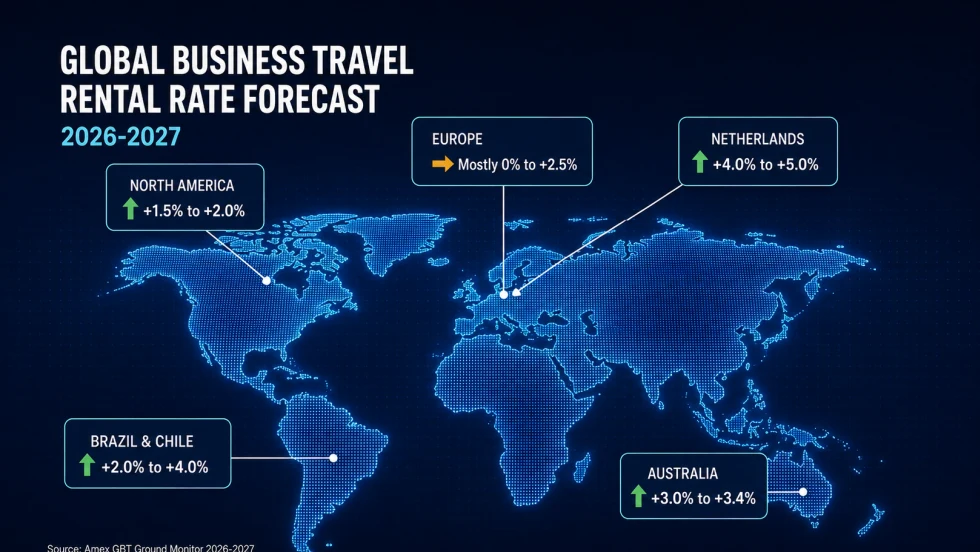
U.S. Business Travel Car Rental Rates Forecast to Rise Up to 2%
Improved fleet supply should limit pricing gains in 2026-27, while insurance, repair costs, and softer residual values continue to pressure rental operations, according to Amex GBT.
Read More →
Sixt Revenue Tops $2.4 Billion in First Half of 2026
Sixt’s first-half revenue surpassed $2.4 billion for the first time as demand outpaced fleet growth, lifting utilization and earnings despite weaker consumer sentiment in North America.
Read More →
In Memoriam: Bobby Klyce, Avis Licensee Legend
The longtime Birmingham Avis operator and 2018 Auto Rental News Impact Award recipient was remembered as an advocate for independent licensees and the broader car rental industry.
Read More →
How to Build Custom Fleet Tools With AI and Vibe Coding [Webinar]
A new Automotive Fleet webinar explores how fleet managers are using AI and vibe coding to automate routine work and create simple operational tools without traditional programming skills.
Read More →
Car Rental Rates Forecast to Rise 3.6% in 2026 Before Easing in 2027
Car rental rates are projected to rise less than airfares and hotel rates in 2026, then become the only major travel category forecast to decline in 2027, according to projections from GBTA and ALTOUR.
Read More →
Avis Cuts Fleet as Summer Demand Trails Expectations
Avis Budget Group increased second-quarter earnings despite lower Americas revenue and softer-than-expected summer demand. The company also expanded Avis First and advanced its autonomous fleet operations with Waymo.
Read More →
Why Bookings Are Only the Start of the Rental Day
A reservation captures demand. The operating test is whether the business can keep the customer, vehicle, commercial terms, and next action aligned until the rental is closed.
Read More →
This Is the Oldest Car Rental Advertisement You’ll Ever See
This ad for Saunders Drive it Yourself, believed to be the first car rental company in the U.S., was found in an Omaha phone book from 1926.
Read More →
The Desk Upsell Is Costing Operators More Than it Earns
Counter upsells generate revenue, but they can also slow transactions, erode trust, and cost repeat business. Fully inclusive pricing may offer operators a better path to long-term value.
Read More →
U-Save Expands Indian Ocean Presence with New Master Franchise for Mauritius
The franchise has been acquired by Mauritian travel entrepreneur Umarfarooq Omarjee, an established figure in the island's tourism and mobility sector.
Read More →