




June 1, 2026
Get Ready To Roll: No Stopping Self-Driving Rental Cars
The autonomous mobility technology revolution will move at its own pace, but sooner rather than later.
Robert Allan Gordon, Car Rental University
We are entering the final stretch toward SAE Level 5, defined as full self-driving with zero human supervision, anywhere and under any conditions.
Credit:
Auto Rental News
9 min to read
- Self-driving rental cars are anticipated to become mainstream sooner rather than later as the technology advances.
- Rental fleets can expect increased availability of self-driving options and a shift in transportation dynamics, offering potentially safer and more efficient travel.
*Summarized by AI
The autonomous mobility revolution keeps moving ahead, despite premature predictions of mass self-driving vehicles by 2025.
But it’s still a question of when, not if.
For the car rental industry, that moment is still looming sooner than most operators realize.
What began as a bold, futuristic scenario will increasingly redefine rental fleet operations, and the companies that transition and adapt over the next few years will be more likely to handle the mobility market of the 2030s.
Last month at the International Car Rental Show (ICRS), I presented this message to industry leaders. The response confirmed what many of us have quietly suspected: rental operators are hungry for a practical roadmap through the impending disruption. They recognize that technology is shifting the automotive and ground transportation industries.
I’m expanding on my presentation by offering a deeper macroeconomic analysis, concrete operational data, and practical strategies for independent and corporate operators.
The Uber Precedent: A Minor Shift Compared to the 50-Cent Pivot
To understand how rapidly consumer behavior shifts when a disruptive mobility model arrives, look no further than ride-hailing. However, many in our industry may be drawing incomplete conclusions from the past decade, viewing Uber as the destination of market disruption rather than a proof of concept.
When Uber and Lyft were aggressively expanding, they operated at a consumer price point of about $1.00 to $1.50 per mile. Even at that rate, the interference with the car rental industry was immediate and highly visible.
Short-trip airport and downtown rentals saw noticeable declines as travelers frequently opted for the convenience of a ride-hailing app over standing in line at a traditional rental counter.
But look at the math moving forward. With driver costs, which consume 60% to 70% of rideshare economics, removed entirely from the equation, full autonomy fundamentally resets the cost of a ride.
When the cost of autonomous transport drops to 50 cents per mile or less, the disruption will be much more noticeable and deeply felt across all segments of the vehicle ownership and car rental markets.
When it becomes far more economical to summon a driverless vehicle than to rent a car, pay for parking, and buy fuel, consumer habits will shift. The rental industry felt the impact of the $1.50-per-mile wave, but the sub-50-cent shift will require a structural evolution from operators.
As technology scales and consumer trust solidify, autonomy will steadily gain traction. So, how will the old "car-line-counter" model adapt to and complement the autonomous vehicle transportation layer?
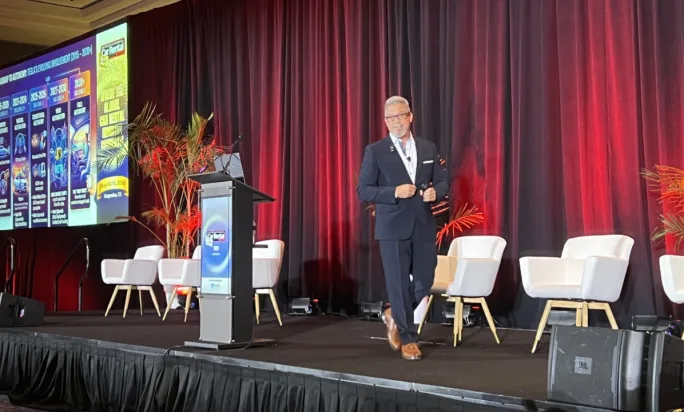
ICRS breakfast keynoter and rental car industry consultant Robert Allan Gordon shared insights on the future of rental fleets on Friday, May 15, 2026, during the conference in Grapevine, Texas.
Credit:
Martin Romjue / Auto Rental News
The Road to Level 5 Autonomy
Many industry skeptics still argue that true autonomy is at least a decade away. This prediction can be a dangerous operational trap. On the other hand, some car rental operators believe autonomy is already here and are embracing it.
We are entering the final stretch toward SAE Level 5, defined as full self-driving with zero human supervision, anywhere and under any conditions. The transition is essentially a data-scaling process, and the real-world mileage accumulated by vision-based fleets has already delivered the safety metrics needed for widespread regulatory approval.
This massive data advantage can instill the regulatory confidence for widespread, nationwide deployment. The hardware and software are ready to deploy autonomous vehicles in greater numbers. That changes the question from who will build the cars to who will care for them.
Enter the Master Shepherds: The Tesla Opportunity
When Elon Musk unveiled the Tesla Cybercab, he introduced a fascinating business vision. He stated that individual owners or small fleet managers wouldn't just be passive investors; they would operate as “shepherds” tending to their “flocks” of autonomous vehicles.
In Musk's vision, anyone could buy a few Cybercabs, turn them loose on the network, and care for them locally.
But here is the reality that Tesla, OEMs, and software companies are facing: Tech giants are historically built for software and manufacturing, not localized fleet operations. They do not want to handle the physical grit of daily vehicle maintenance. They aren't set up to clean out a vehicle after a passenger ruins the interior, nor do they want to manage localized logistics.
Instead, Tesla and other autonomous network providers would much rather trust established operators with the existing, robust infrastructure required to handle high-volume vehicle transformation.
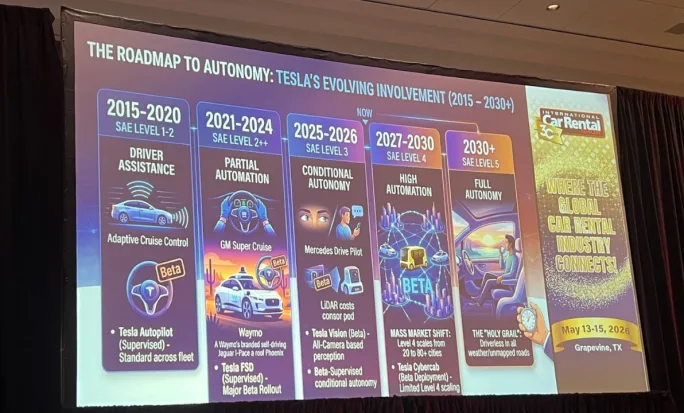
The evolution of autonomous vehicle mobility stretches in five phases from 2015 to 2030, with the final stage rapidly approaching for rental fleets.
Credit:
Martin Romjue / Auto Rental News
The Autonomous Value Chain
Tesla / OEMs build the hardware and scale the global AI network. Car rental operators, the master shepherds, provide localized charging, rapid cleaning, turnaround times, vehicle deployment, and critical asset protection.
This positions the traditional car rental operator not as a victim of the revolution, but as the “master shepherds” of the autonomous era. We already possess the operational DNA that tech companies lack.
An autonomous fleet cannot operate without a localized home base that can seamlessly execute fast-turnaround charging, cleaning, simple, rapid maintenance (tires, brakes, cosmetics), and bodywork repair coordination.
The Two-Pronged Strategic Blueprint for Operators
To transition successfully into this landscape, operators must begin laying the groundwork. This does not mean buying unguided assets today; rather, it requires narrowing our focus down to two aggressive, long-term planning strategies:
Strategy 1: Envision and Redesign Real Estate into Hybrid Mobility Hubs
The physical footprint of our industry is its greatest hidden asset, and operators with locations on or near airports hold a competitive advantage that cannot be replicated. Airports will remain the highest-density demand centers for autonomous travel. Operators must approach their current layouts with an open mind, drawing up blueprints to handle hybrid fleets of traditional ICE vehicles alongside EV robotaxis and cybercabs.
Your infrastructure plans should incorporate a segregated portion of your lot dedicated exclusively to autonomous fleets. This design should require a dedicated entry and exit lane, allowing autonomous vehicles to swiftly glide in, charge, get serviced, and be redeployed back into network service.
Because retrofitting infrastructure requires much lead time and capital, operators should begin researching the financial investment requirements for upgrading local power grids. Map out relationships with local electric companies and fast-charging network providers like Shell or BP.
Furthermore, pay attention to Tesla’s network expansion. We must stay highly attuned to whether Tesla will roll out specific, proprietary inductive or wireless fast chargers developed uniquely for the Cybercab and robotaxi networks.
Simultaneously, track the engineering developments of automated robotic cleaning and sensor-calibration mechanisms so your wash ports are ready to accept them when commercial production lines open.
This infrastructural blueprint opens a massive secondary revenue stream: Caring for third-party Cybercab owners. Thousands of casual, independent "shepherds" will buy a small flock of Cybercabs but will completely lack the real estate, commercial charging grids, or tooling to maintain them.
By planning your airport-adjacent hubs to accommodate B2B care programs that include cleaning, charging, and minor maintenance for independent owners, you can shift your physical footprint into a highly profitable regional utility.
Strategy 2: Secure Dual-Network Alliances That Eliminate Customer Friction
The second strategy requires an operational and technological evolution in how we plan to connect with both autonomous networks and human passengers. Operators must research and pursue strategic alliances with autonomous network providers such as Tesla, positioning their corporate entities as the network's certified regional fulfillment partners for its physical needs.
This deals directly with preparing your business for the digital pipeline shift. To ensure you are the ones managing the cars on the ground, you need to plug into corporate fleet portals early.
Simultaneously, operators must eliminate counter friction for their retail business. If your operations still rely on physical clipboards, manual paperwork, or long terminal lines, you are highly vulnerable to autonomous applications. Transitioning your customer base to keyless, app-driven digital check-ins and frictionless smartphone returns is a prerequisite for survival. By cultivating a consumer base entirely comfortable with seamless, app-based vehicle access, you prepare your business and your clients for a smooth transition into the sub-50-cent autonomous landscape.
Moving from Strategy to Action: Procurement and Logistics
As a self-avowed Tesla enthusiast and a firm believer in the Robotaxi and Cybercab network, I want to pivot from high-level philosophy to immediate, practical steps. Many operators ask me how they can secure their place in this transportation layer today.
Tesla recently confirmed that they absolutely intend to sell the Cybercab directly to both consumers and fleet operators for under $30,000, and continuous production is just getting underway at Giga Texas.
However, Tesla has not opened an official pre-order list or reservation queue for the Cybercab, whether you are looking to buy a single unit or a small fleet. They are not yet taking deposits.
Preparing For Autonomous Vehicles
If you want to position yourself at the forefront of the second the order gates open, you can take a few concrete steps to prepare your corporate infrastructure:
Set up a Tesla business account: If you want to buy a fleet, your best option is the corporate channel rather than the standard consumer app. Go to the Tesla fleet/business portal and set up a company profile. This gets your business credentials, tax information, and authorized buyers vetted in their system early. When a new vehicle launches for fleet sales, Tesla Business account holders are usually the first to receive direct order links and configuration dashboards.
Sign up for direct Robotaxi updates: Tesla has a dedicated landing page for their Robotaxi network. Go to tesla.com/robotaxi and click "Get Updates." Make sure you use the same email address tied to your Tesla Business account. This mailing list will be the primary vector for announcing when purchase queues, regional regulatory approvals, and reservation options go live.
Establish a relationship with a Tesla fleet manager: Once your business account is active, request contact from a Tesla fleet account manager. While they cannot manually place you on a hidden Cybercab waitlist today, establishing this point of contact is valuable. Fleet managers frequently give corporate clients a heads-up right before high-demand order pages open to the public.
An Autonomous Fleet Era
Remember that the Cybercab is built without a steering wheel or pedals, meaning its deployment relies on regional "unsupervised full self-driving" regulatory approval. While you prepare your corporate fleet account, you must closely monitor your specific state and city autonomous vehicle laws to ensure you can legally operate them once Tesla delivers them to you.
The car rental operators who thrived during the ride-hailing boom did so because they recognized that Uber wasn't an enemy, but a massive, asset-hungry customer base. The autonomous mobility revolution presents the exact same crossroads.
The shift from a $1.50 Uber ride to a sub-50-cent Cybercab ride will be deeply felt across our industry. But for those who see the horizon clearly, the opportunity is unprecedented.
Look no further than our own industry leaders for proof. Hertz recently launched a groundbreaking operating company, Oro Mobility, designed specifically to handle daily vehicle asset management that includes charging, maintenance, repairs, cleaning, and depot staffing for Uber’s upcoming robotaxi fleet.
While Uber provides the tech via Lucid and Nuro, Hertz is preparing for the autonomous revolution by beta-testing how legacy car-rental infrastructure can adapt at scale. After all, Hertz was the boldest rental giant to heavily invest in EVs back in 2022.
Although early Tesla adoption backfired on them cost-wise, it doesn't change the fact that they are visionaries pivoting to dominate the logistics of the driverless future.
Over time, autonomy will inevitably become the norm. The tech giants can build the brains, and the casual investors can buy the cars, but the industry will always require the operational expertise of the master shepherds.
By planning our airport real estate redesigns, researching fast-charging requirements, and opening our doors to care for the wider autonomous ecosystem, the car rental industry won't just survive the driverless revolution. We will run it.
Loading data...