




Hertz Revenue Falls 2%
During third quarter 2015, Hertz Global Holdings reported a 2% decrease in its U.S. total revenue year-over-year due to flat transaction days and a 2% decline in total Revenue per Transaction Day (RPD).
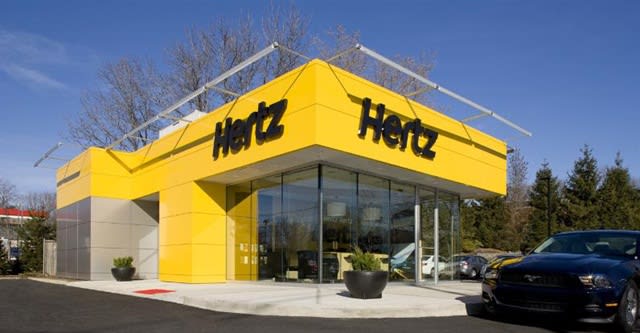
Photo courtesy of The Hertz Corp.
Photo courtesy of The Hertz Corp.
Hertz Global Holdings Inc. has released its 2015 third quarter operating results.
Total U.S. car rental revenue was $1.7 billion in the third quarter 2015, down 2% from 2014 third quarter due to flat transaction days and a 2% decline in total Revenue per Transaction Day (RPD), according to Hertz. However, as a result of a 3% improvement in fleet efficiency, Revenue per Available Car Day (RACD) increased 1% despite the 2% decline in RPD.
Hertz reported a 5% decrease year-over-year in its consolidated total revenue for the third quarter — $3 billion compared to $3.1 billion for third quarter 2014, according to the company.
Foreign currency exchange rates had an unfavorable impact on third quarter 2015 results versus third quarter 2014. Hertz estimates the unfavorable year-over-year impact to total revenue at approximately $144 million, according to the company.
For third quarter, Hertz reported a net income of $237 million, or $0.52 per diluted share — an increase compared with net income of $149 million, or $0.32 per diluted share, for third quarter 2014.
Hertz also reported the recent quarter’s adjusted net income was $226 million, or $0.49 per diluted share, compared with $203 million, or $0.44 per diluted share, for the same period last year, according to the company. Adjusted Corporate EBITDA was also up —$601 million versus $553 million in the third quarter of 2014.
"Our profit improvement in the third quarter is early evidence of the potential we see in our performance improvement plan," said John Tague, Hertz’s president and CEO. "Our fleet efficiency, which measures our ability to match capacity with demand, rose to record levels. In addition, we successfully completed the integration of the Dollar Thrifty operations during a quarter in which we increased customer satisfaction across all of our rental car brands around the world. I want to thank our employees for helping to make this a successful quarter.”
Other highlights from Hertz’s third quarter financial report included:
U.S. car rental fleet efficiency rose to 83%, an increase of three percentage points from third quarter 2014 due to improvements in out-of-service levels and higher rentable utilization.
Hertz Global has successfully renewed its U.S. Car Rental fleet, while maintaining fleet cost slightly below 2014 levels through the first nine months of 2015.
Through Sept. 30, 2015, the company added approximately 335,000 2015 model-year vehicles to its fleet, approximately 50% more than the comparable number of 2014 model-year vehicles through the same period in 2014. More new vehicles contributed to lower out-of-service levels and fleet maintenance costs for the third quarter.
As a result of a 2% improvement in fleet efficiency, worldwide Revenue per Available Car Day (RACD) increased 1% despite a 1% decrease in Total Revenue per Transaction Day (RPD).
During the quarter, Hertz Global successfully migrated Dollar Thrifty operations to the company's common counter and financial systems, completing integration of the Nov. 2012 acquisition of Dollar Thrifty Automotive Group, Inc.
Unrelated to its Q3 2015 operating results, Hertz Global filed a restated Form 10-Q for its second quarter 2015 indicating an increase of $21 million to pre-tax income and $13 million to net income (loss) for the three and six months ended June 30, 2015, according to the company.
The restatement results from a prior period error related to the depreciation of vehicles sold through the company's retail car sales locations that impacted the financial statements filed in its Form 10-Q for the second quarter 2015. As a result of this error, depreciation expense — during the three and six months ended June 30, 2015 — was overstated by $21 million and $18 million, respectively, says Hertz.
More Rental Operations

Advantage, Sixt Place Among Top Five in Annual Satisfaction Study
While Enterprise and National retain the top spots in JD Power’s 2026 rankings, the latest customer satisfaction results suggest renters can find competitive service beyond the biggest car rental names.
Read More →
The $100,000 Insurance Trap in Exotic Car Rentals
Exotic rental agencies often rely on customers’ personal auto policies to protect six-figure vehicles. But policy language can dramatically change the coverage for vehicles over $100,000 MSRP.
Read More →
The Booking Is Confirmed, But Is Your Customer Ready to Drive?
For international renters, a confirmed reservation doesn’t always mean they’re eligible to drive. Earlier checks can help operators catch documentation and payment issues before the customer reaches the counter.
Read More →
ICRS 2027 Opens Call for Papers
The International Car Rental Show seeks session proposals on the business, operational, and technology issues facing car rental operators. Submissions are due Jan. 15.
Read More →
Turo to Launch Vehicle Delivery Service
Turo Delivered will let travelers search for vehicles that hosts can deliver directly to hotels, homes, airports, train stations, and other locations.
Read More →
Palm Beach Airport Code Change Creates Car Rental Distribution Gap
A test of rental searches under the old PBI and new DJT airport codes returned largely different sets of brands and vehicles, highlighting a potential distribution problem for rental operators.
Read More →
U-Save Continues Dominican Republic Expansion with Launch in Punta Cana
The new franchise location builds on U-Save’s existing Santo Domingo operation and will begin taking reservations for October 2026.
Read More →
When AI Books the Rental Car, Who Controls the Sale?
As AI moves from comparing rental rates to completing transactions, operators need to understand how travelers find, interpret, rank, and ultimately see their offers. (Part 2 of 2.)
Read More →
European Booked Car Rental Rates Fell 5%, Results Varied by Country
Ireland, Cyprus, and the United Kingdom saw steep declines, while booked rates rose in Poland and Hungary.
Read More →
Is It Time to Rethink Rental Categories?
As traditional economy and compact cars disappear from the market, longtime rental operator Mike DeLorenzo asks whether the industry’s familiar vehicle categories still make sense — and what operators need to rethink along with them.
Read More →