



U.S. Business Travel Spending Hits $424B in 2016
A new report by the Global Business Travel Association (GBTA) Foundation found that U.S. businesses spent $424 billion to send travelers out on the road for 514.4 million domestic business trips in 2016.
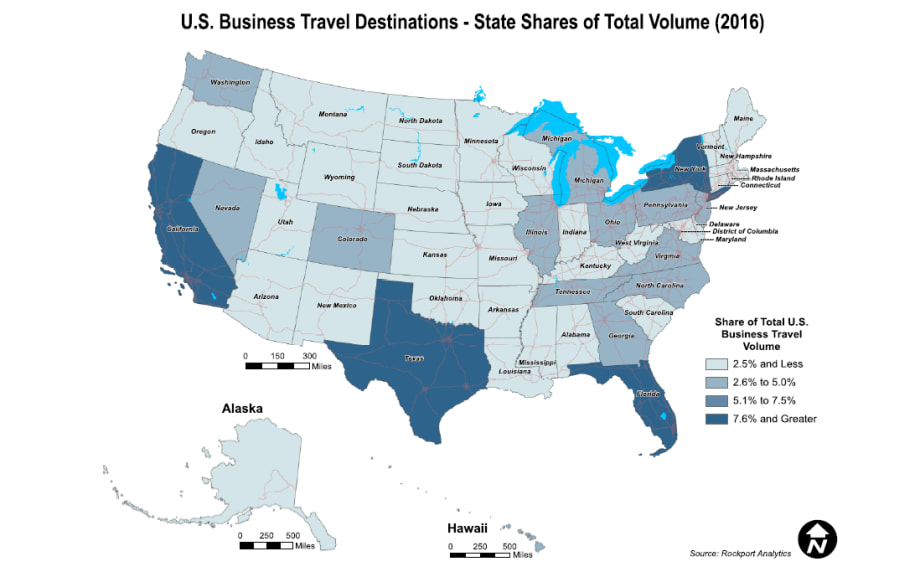
Map courtesy of the Global Business Travel Association
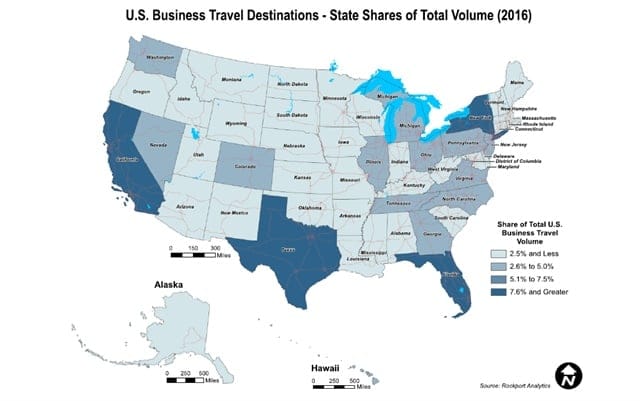
Map courtesy of the Global Business Travel Association
A new report by the Global Business Travel Association (GBTA) Foundation, in partnership with American Express Global Business Travel (GBT), highlights the positive economic impact business travel has on the nation’s economy.
“The U.S. Business Travel Economic Impact Report” revealed that business travel was responsible for about 3% ($547 billion) of U.S. GDP in 2016. Additionally, the research found that for every 1% change in business travel spending, the U.S. economy gains or loses 74,000 jobs, $5.5 billion in GDP, $3.3 billion in wages, and $1.3 billion in taxes, according to the report.
The report found that U.S. businesses spent $424 billion to send travelers out on the road for 514.4 million domestic business trips in 2016. The business travel industry supports 7.4 million jobs and generated $135 billion in federal, state, and local taxes, according to GBTA.
Much of business travel’s contribution to the economy accrues directly to industries that serve business travelers, but their supply chain beneficiaries received an additional indirect contribution of $132 billion.
“Business travel matters — it is a critical driver of the economy,” said Michael W. McCormick, GBTA’s executive director and chief operating officer. “In a time where many policies have created uncertainty and disruption around travel, this study shows the importance of enacting pro-travel polices to our nation’s bottom line.”
“The way that people and companies conduct business has undergone transformative, digitally-led changes in the past 20 years,” said David Reimer, senior vice president and general manager, North America, American Express Global Business Travel. “Yet, the U.S. Business Travel Economic Impact Report shows that face-to-face interaction enabled by business travel remains a critical business tool. Today’s modern business travelers want access to all content, to the best personalized rates and fares, and via consumerized channels. To sustain business travel’s economic impact, our industry must continue to evolve to meet the needs of these travelers.”
In 2016, the average amount spent per business fell 2.2% to $520, including $163 on lodging, $180 on transportation, $94 on food and beverages in restaurants, $33 on entertainment, and $50 on shopping and merchandise, according to the report. These averages include both domestic and international inbound trips, as well as both day and overnight trips.
Roughly half (48%) of U.S. business trips were taken for transient purposes (sales trips, client services, government and military travel, and travel for construction or repair), while 28% were taken for group travel purposes.
A personal car or truck (35%) was the most popular mode of transportation among U.S. business travelers in 2016, followed by airplane (28%) and rental cars (13%), according to the report.
Originally posted on Automotive Fleet
More Rental Operations
The Booking Is Confirmed, But Is Your Customer Ready to Drive?
For international renters, a confirmed reservation doesn’t always mean they’re eligible to drive. Earlier checks can help operators catch documentation and payment issues before the customer reaches the counter.
Read More →
ICRS 2027 Opens Call for Papers
The International Car Rental Show seeks session proposals on the business, operational, and technology issues facing car rental operators. Submissions are due Jan. 15.
Read More →
Turo to Launch Vehicle Delivery Service
Turo Delivered will let travelers search for vehicles that hosts can deliver directly to hotels, homes, airports, train stations, and other locations.
Read More →
Palm Beach Airport Code Change Creates Car Rental Distribution Gap
A test of rental searches under the old PBI and new DJT airport codes returned largely different sets of brands and vehicles, highlighting a potential distribution problem for rental operators.
Read More →
U-Save Continues Dominican Republic Expansion with Launch in Punta Cana
The new franchise location builds on U-Save’s existing Santo Domingo operation and will begin taking reservations for October 2026.
Read More →
When AI Books the Rental Car, Who Controls the Sale?
As AI moves from comparing rental rates to completing transactions, operators need to understand how travelers find, interpret, rank, and ultimately see their offers. (Part 2 of 2.)
Read More →
European Booked Car Rental Rates Fell 5%, Results Varied by Country
Ireland, Cyprus, and the United Kingdom saw steep declines, while booked rates rose in Poland and Hungary.
Read More →
Is It Time to Rethink Rental Categories?
As traditional economy and compact cars disappear from the market, longtime rental operator Mike DeLorenzo asks whether the industry’s familiar vehicle categories still make sense — and what operators need to rethink along with them.
Read More →
Who Owns the Rate? AI Is Creating a New Distribution Problem for Car Rental
Generative Engine Optimization asks whether AI can find a rental company, but operators also need to know whether the agent inspected enough of the market, compared equivalent offers, and presented a rate the traveler can actually book. (Part 1 of 2)
Read More →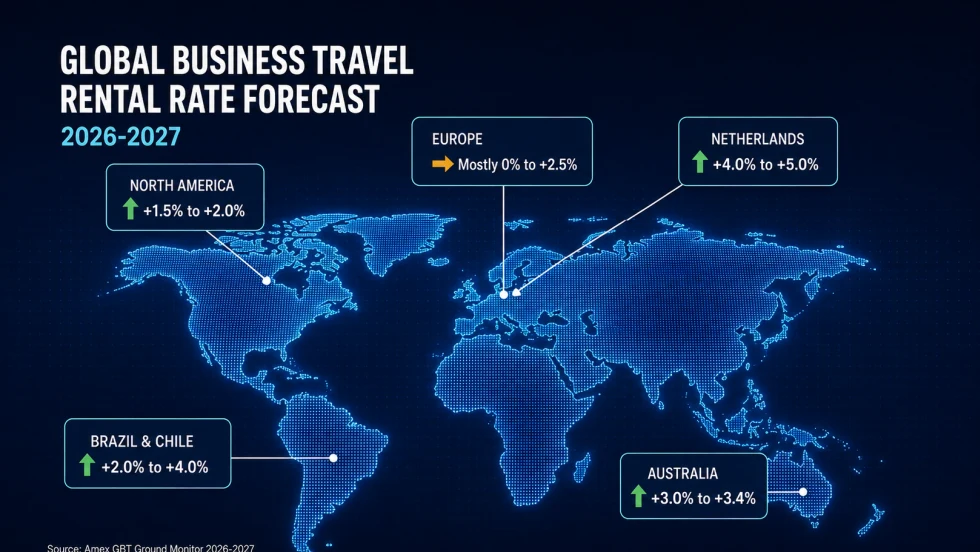
U.S. Business Travel Car Rental Rates Forecast to Rise Up to 2%
Improved fleet supply should limit pricing gains in 2026-27, while insurance, repair costs, and softer residual values continue to pressure rental operations, according to Amex GBT.
Read More →