With claims on the rise, employers need to understand the areas of greatest potential liability to help limit their employment law-related exposure before a charge is filed or a lawsuit is served.
by Richard D. Alaniz
March 11, 2014
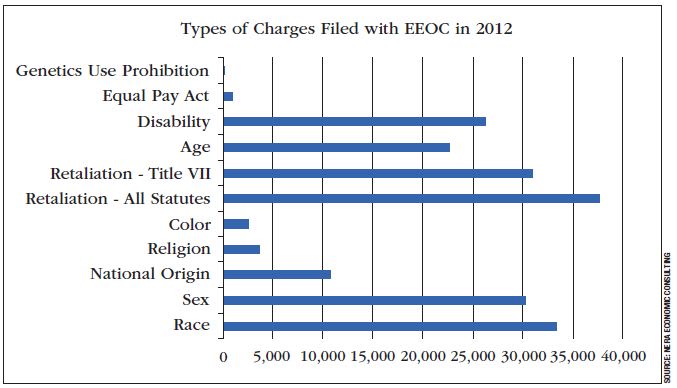
This figure breaks down the types of charges filed with the Equal Employment Opportunity Commission (EEOC) in 2012. In that year, the latest in which data is available, more than 26,000 charges of disability discrimination were filed, or 26.5% of total charges. Source: NERA Economic Consulting
7 min to read
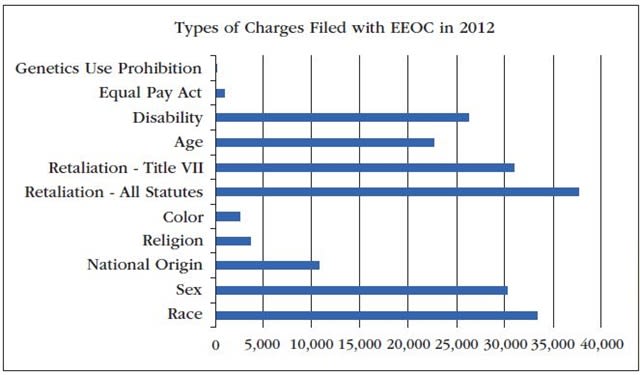
This figure breaks down the types of charges filed with the Equal Employment Opportunity Commission (EEOC) in 2012. In that year, the latest in which data is available, more than 26,000 charges of disability discrimination were filed, or 26.5% of total charges. Source: NERA Economic Consulting
Over the past several years, government agencies that regulate the workplace have been in a mode of aggressive enforcement.
Whether the agency in question is the Equal Employment Opportunity Commission (EEOC), the Occupational Safety and Health Administration (OSHA), the National Labor Relations Board (NLRB), the Office of Federal Contract Compliance Programs (OFCCP) or the Wage and Hour Division of the U.S. Department of Labor, agency actions have been up across the board.
Ad Loading...
For example, total EEOC filings have been steadily increasing, up more than 12% in the last 10 years.
In addition, disability claims are becoming increasingly prevalent. In 2012, the latest year that such data is available, more than 26,000 charges of disability discrimination were filed with the EEOC (about 26.5% of total charges). Race, sex discrimination and retaliation claims also remain extremely prevalent. The bar chart demonstrates the breakdown in types of charges filed with the agency.
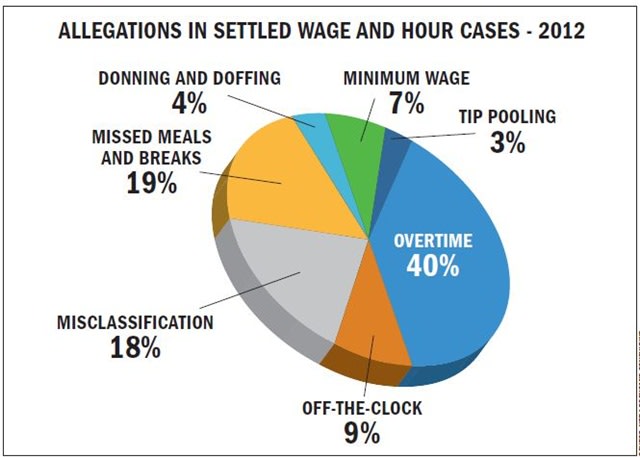
At the same time, wage and hour lawsuits, both private as well as agency driven, have become increasingly commonplace. According to the consulting firm NERA Economic Consulting, wage and hour settlements for U.S. companies totaled $467 million in 2012, with overtime allegations — at 40% — the most prevalent. The pie chart on the next page illustrates a breakdown of types of wage and hour allegations settled in 2012.
Finally, with the continuing decline of unions, the NLRB has become increasingly focused on non-union workplaces. Under the National Labor Relations Act of 1935, private-sector employees, including non-union employees, have certain rights to air their grievances.
Increasing Regulation
The NLRB has been using this to extend its reach into non-union workplaces, including through regulation of social media policies, confidentiality in internal investigation procedures, appropriate use of workplace email and the content and form of employee handbooks.
Ad Loading...
All of these combine to confirm that employment law liability should be a serious consideration for all employers. It costs real dollars to respond and deal with agency enforcement actions, and plaintiffs’ attorneys have become increasingly active and adept at making claims under employment laws in recent years.
For example, in April of 2013, Enterprise agreed to pay $7.7 million to settle multidistrict litigation alleging the company failed to pay its assistant car rental managers overtime wages. The dispute centered on allegations that Enterprise had misclassified its regional assistant rental managers as exempt from overtime regulations under the Fair Labor Standards Act (FLSA).
Although Enterprise denied wrongdoing — and had strong evidence that its classification was appropriate — it cited the costs of ongoing massive litigation as the reason for settling.
Agency actions and lawsuits can dramatically affect any company. However, with some preventive care, employers can limit the potential for charges to be filed against them and also help put themselves in the best position to defend any claims that are filed.
Here are some tips and best practices for limiting employment law-related liability.
Ad Loading...
Minimize Suits through Arbitration Agreements
Employers can minimize employee lawsuits and their fallout through arbitration agreements, whereby a neutral arbitrator hears the facts of the dispute and makes a binding ruling, thus avoiding the courts and juries. A study by Alexander Colvin of Cornell University found that employers win more often in arbitration than in litigation, employee awards are fewer and the proceedings move much faster.
In addition, recent cases have made arbitration agreements even more enforceable. Having valid, well-drafted and enforceable arbitration agreements in place can help employers limit their liability exposure, especially agreements with class-action waivers. It is vitally important that employers utilize knowledgeable employment counsel when drafting the agreements.
While the NLRB has taken an aggressive stance against arbitration agreements that contain class-action waivers — asserting that they violate employees’ rights to engage in concerted action — every court that has ruled on the issue has found against the NLRB.
Currently, the NLRB is considering its options for review of a high-profile decision by the 5th U.S. Circuit Court of Appeals that found in favor of a broad arbitration agreement at the home builder D.R. Horton.
[PAGEBREAK]
Wage and hour settlements for U.S. companies totaled $467 million in 2012, with overtime allegations - at 40% - the most prevalent, according to the consulting firm NERA Economic Consulting.
Educate on FMLA
Under the Family and Medical Leave Act (FMLA), an employer must allow an eligible employee to take up to 12 workweeks of unpaid leave in any 12-month period for any of the following reasons:
Ad Loading...
The birth of a child to the employee or the employee’s spouse.
The placement of a child with the employee for adoption or foster care.
The need to care for a spouse, son, daughter or parent with a “serious health condition.”
A “serious health condition” that makes the employee unable to perform his or her job functions.
Also, there is certain additional time off that must be given to military caregivers or other categories. Employers consistently continue to manage FMLA incorrectly, whether by utilizing improper forms (or no forms at all), improperly denying FMLA leave or mishandling the right to intermittent leave.
Employers can help avoid claims under this complex law by training their human resources departments and supervisors on the ins-and-outs of FMLA management. A number of companies provide such training, and its benefits far outweigh the costs should an FMLA-based lawsuit ever arise.
In addition, some employers completely outsource their FMLA practices and procedures to an outside service that has specific expertise on the requirements of the law.
Understand the ADA
Disability discrimination continues to be one of the most active areas of EEOC complaints and enforcement. The Americans with Disabilities Act (ADA) and its amendments, the ADAAA, prohibit disability discrimination in employment.
Ad Loading...
Disability includes both physical and mental impairments. Under the law, covered employers (those with more than 15 employees) must reasonably accommodate any disabled employee, so long as the accommodation does not impose an undue hardship on the employer.
Steps employers should take to limit their ADA exposure include:
Take any claim of disability seriously.
Do not use the term “disability” lightly.
Ensure that your management team is alert to claims of “disability” by employees.
Refer all disability claims to human resources.
Go through the required interactive process to consider potential reasonable accommodations in all situations.
Implement a written procedure for dealing with disability claims and consistently follow it.
Thoroughly document all actions taken on any claim.
Taking these steps can help insulate your company from disability-related claims. In addition, as discussed in the next section, ADA training should be a part of all employment law training at your workplace.
[PAGEBREAK]
Ad Loading...
Train Your Supervisors
Your supervisors are, or should be, your most effective buffer against employment law-related allegations and lawsuits. The only way to ensure that your supervisors are knowledgeable of — and correctly implementing — the myriad federal and state employment laws is to provide them with up-to-date and thorough training.
Supervisor training should focus on several key areas:
Federal and state laws: The various employment laws that affect your workplace should be covered, including Title VII, the ADA, the FMLA and union issues, if unionization is a concern.
Documentation: Documentation issues should be covered. To defend any lawsuit, you must have good documentation (i.e., counseling employees, hiring documentation, investigation of complaints, medical/leave issues, etc.). Your supervisors should be trained on correctly documenting all employment actions.
Hiring process: It is always a good idea to support the objectivity and non-discriminatory nature of your interview and hiring process.
Ad Loading...
Discrimination and harassment issues: Covered by both state and federal laws, these issues routinely crop up in the workplace. Specific areas that should be covered involve promptly responding to employee complaints, adequately conducting investigations and preventing harassment on any protected basis.
Spotting medical and other leave issues and getting help: As discussed, the ADA and FMLA are among the largest areas of risk for employers in every industry. Training should address the specific obligations of supervisors in these areas.
Counseling and terminating employees: There are many issues to consider when counseling an employee, and terminations can often lead to some type of complaint or lawsuit. Training managers and supervisors on these issues can help avoid a complaint or at the very least prepare you to defend one.
By understanding the areas of greatest potential liability — and utilizing preemptive measures such as arbitration agreements and comprehensive training — employers can help limit their employment law-related exposure before a charge is filed with an administrative agency or a lawsuit is served.
About the Author
Richard D. Alaniz is senior partner at Alaniz Schraeder Linker Farris Mayes, L.L.P., a national labor and employment firm. Alaniz has been involved in labor and employment law for more than 30 years, including stints with the U.S. Department of Labor and the National Labor Relations Board. He can be reached at 281-833-2200 or ralaniz@alaniz-schraeder.com.
While Enterprise and National retain the top spots in JD Power’s 2026 rankings, the latest customer satisfaction results suggest renters can find competitive service beyond the biggest car rental names.
Exotic rental agencies often rely on customers’ personal auto policies to protect six-figure vehicles. But policy language can dramatically change the coverage for vehicles over $100,000 MSRP.
For international renters, a confirmed reservation doesn’t always mean they’re eligible to drive. Earlier checks can help operators catch documentation and payment issues before the customer reaches the counter.
The International Car Rental Show seeks session proposals on the business, operational, and technology issues facing car rental operators. Submissions are due Jan. 15.
A test of rental searches under the old PBI and new DJT airport codes returned largely different sets of brands and vehicles, highlighting a potential distribution problem for rental operators.
As AI moves from comparing rental rates to completing transactions, operators need to understand how travelers find, interpret, rank, and ultimately see their offers. (Part 2 of 2.)
As traditional economy and compact cars disappear from the market, longtime rental operator Mike DeLorenzo asks whether the industry’s familiar vehicle categories still make sense — and what operators need to rethink along with them.