





Related: Mobility Startups Test Fleet Tech
Kyte: Disrupting the Car Rental Model at the Right Time
This startup car rental platform has grown 20% to 40% month-on-month since the beginning of the COVID-19 pandemic with partners’ fleets and an app-based delivery model.
August 5, 2020
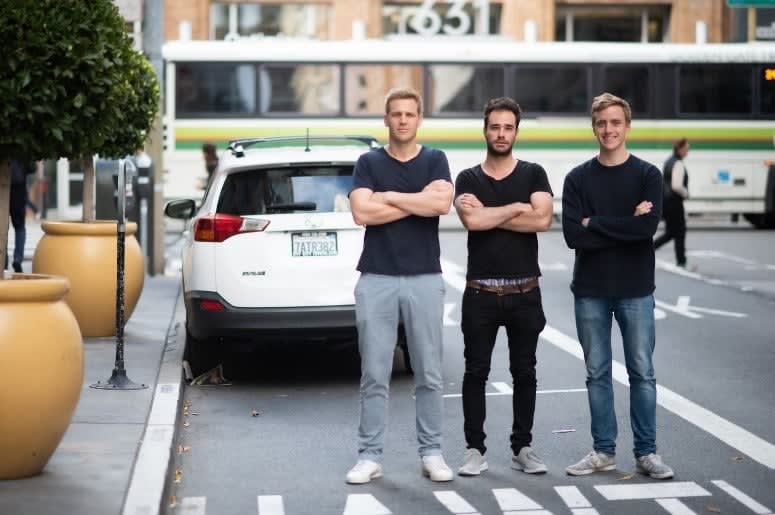
Kyte founders Ludwig Schoenack (left), Nikolaus Volk, and Francesco Wiedemann spent their early careers in the auto and transportation industries.
Photo courtesy of Kyte.
6 min to read
Note to Readers: This article was updated on Aug. 18, 2023 to reflect that Kyte now owns 100% of its fleet.
“We’ve got the best way to rent a car.” Heard that one before?
Kyte, a San Francisco-based startup, is the latest to make the claim. “We want to make people love renting cars again,” says co-founder Ludwig Schoenack. “So we built Kyte to redefine every aspect of the customer journey.”
In short, Kyte is an app-based rental system that delivers cars to clients. Kyte owns 100% of its fleet after it first partnered with car rental companies and other professional, large scale fleet providers that put their inventory on the platform to make money without any physical branch infrastructure.
“Kyte’s partners enjoy steady cash flows from the Kyte business,” Schoenack says. “They also participate significantly in the upside in Kyte’s unique partnership model based on a fair revenue share agreement.”
A process built on mobile-first checkout, pre-verification, smartphone unlock systems, and cars delivered to customers’ doors has been in the car rental industry lexicon for years. Yet the Kyte team says it has found a way to scale its approach.
Kyte was founded in early 2019 by Francesco Wiedemann, Nikolaus Volk, and Ludwig Schoenack. The German natives spent their early careers in the auto and transportation industries: Volk from Uber via Stanford, Wiedemann from BMW mobility services via MIT, and Schoenack from McKinsey & Company via UC Berkeley.
As avid travelers for leisure and work, they used to rent cars from the big rental car companies but had frustrations with the process.
“I think Hertz’s checkout terminals that connected renters to remote agents used technology in all the wrong ways,” Schoenack says. “Instead of standing in line at the counter, now we had to stand in the same line to talk to a machine.”
Kyte is another Silicon Valley garage success story — literally — as the trio bootstrapped the company out of a garage in San Francisco’s West Portal neighborhood where all three of them worked and lived.
Flash forward only a year later, and the company claims as investors major Silicon Valley Venture Capitalists, former Google and Uber executives and Terry Jones, the founder of Travelocity and founding chairman of Kayak. The team hails from Uber, Lime, Bird, Lyft, Expedia, Chariot, and BMW amongst other travel and transportation companies.
“When we first started Kyte, we got the chance to set up a whole new operating model from the start,” says Schoenack.
As carsharing struggled to grow, Kyte saw an opportunity: “Today, more than 80% of our bookings come from local business and leisure rentals,” says Schoenack. “These types of bookings traditionally have high customer lifetime value, but they’ve been disappointed by carsharing players and by the inconsistencies of P2P rentals.”
The Model
The Kyte business model is a true partnership, Schoenack says: “We’re a technology business, not a rental car company, so we’re lucky to be able to partner with those that have expertise in fleet management, rental operations, and local markets.”
Eligible fleet partners can test with only a few vehicles on the platform for the start with no long-term commitment. They can expect a healthy utilization, revenues, and profit margin right away, Schoenack says. From there, partners can decide how fast they’d like to scale with Kyte.
Schoenack says most of Kyte’s partners have bought more fleet as a result of the partnership.
Presently, Kyte has operations predominantly in local neighborhoods from which they serve local renters, business travel. For local operations, fleet vehicles are stationed in a strategic, non-customer facing location accessible to Kyte “surfers” (as they call the delivery drivers) to make the deliveries.
Kyte equips its vehicles with a full telematics suite to increase efficiencies and safety including GPS and a remote unlock system with selected partners. Partners benefit from Kyte’s risk engine to assess and verify renters, enabling them to, for example, avoid renting to under 25-year-olds if they so choose.
Customers access vehicles through the Kyte app or website, and the vehicles are delivered and picked up directly from the customers. The customer contract ultimately still belongs to the vehicle owner. These rental car companies can choose to utilize Kyte’s suite of over-the-counter products or agree to sell their own products for e.g. liability protection. The delivery periods are covered by Kyte’s custom insurance policy.

Kyte delivery drivers (aka “surfers”) employ a contact-free rental process and often use collapsible electric scooters to travel to their next pickup point.
Photo courtesy of Kyte.
Kyte sets the prices and takes a revenue share. “Kyte has helped us to get to better profit margins while still growing the fleet in the double digits during the pandemic,” says Jennie Thomas from West Coast based XOM Global, one of the first car rental partners.
Schoenack says that Kyte can remain competitive due to a much lower cost structure, as the platform eliminates counter agents as well as much of the systems and physical parking and branch infrastructure of traditional rental.
At the same time, Kyte’s partners don’t need to invest in infrastructure, real estate, labor, or marketing, allowing them to scale their fleet without increasing overhead.
“Through Kyte, we’re able to put double the number of cars on the road as we would be able to support with our own operations and distribution,” Daniel Wang from Yesaway Car Rental says. “We’re reaching a different demographic that spends more and keeps coming back so we decrease our reliance on OTAs."
Grand Ambitions
As a result of the seismic disruptions caused by the pandemic, all the major car rental companies have tried to establish forms of a contact-free rental process and implemented serious cleaning protocols while keeping social distancing at the rental counter.
On the other hand, “Kyte never had rental counters so we’ve just adapted our user flow to process bookings and handovers entirely on the user’s phone,” Schoenack says. “The Kyte ‘surfers’ have protective gear and diligently sanitize the cars.”
As car rental operators have excess fleet to rent during the pandemic, the new model seized the opportunity. Kyte calls itself “the fastest growing company in the global car rental market,” as it points to 20% to 40% month-on-month growth since the beginning of the pandemic.
New user groups, such as travelers avoiding planes, trains and buses and local residents moving away from rideshare and public transit, have gravitated to the platform.
“Many thought we were crazy to enter the industry in a time when such heavy consolidation was happening,” says Schoenack. “However, we convinced them it’s not the industry that has low profit margins, it’s the current operating model that causes the profit equation to be upside down.”
Shy of a 500-car fleet, Kyte has operations currently in San Francisco, Los Angeles, and Boston. The company is currently testing in multiple additional markets and is always looking for partnerships with new fleet operators in metropolitan areas across the US.
As you may have guessed, the trio from Germany isn’t about to stop here.
“We will have accomplished our mission when personal car ownership is a thing of the past and professional fleets use our fleet operating system to supply vehicles to users when and where they need it,” Schoenack says.
Subscribe to Our Newsletter
More Rental Operations
How Did This Independent Rental Operator Grow to 170 Vehicles in 4 Years?
With 170 vehicles across three Kentucky locations, Joel Price relies on an overseas team to handle reservations, payments, and after-hours customer service. It's one part of an unconventional approach to growing an independent rental operation.
Read More →
What Does It Take to Succeed in B2B Rentals?
The fundamentals may be familiar to daily car rental operators, but project-based truck rentals put different demands on the fleet and the business.
Read More →
NPR Builds on International Partnerships to Grow Rental Bookings
With Ana Laborde supporting broker development, NPR Auto Group is tailoring distribution strategies, rate packages, and partnerships to grow international reservations across its three brands.
Read More →
Advantage, Sixt Place Among Top Five in Annual Satisfaction Study
While Enterprise and National retain the top spots in JD Power’s 2026 rankings, the latest customer satisfaction results suggest renters can find competitive service beyond the biggest car rental names.
Read More →
The $100,000 Insurance Trap in Exotic Car Rentals
Exotic rental agencies often rely on customers’ personal auto policies to protect six-figure vehicles. But policy language can dramatically change the coverage for vehicles over $100,000 MSRP.
Read More →
The Booking Is Confirmed, But Is Your Customer Ready to Drive?
For international renters, a confirmed reservation doesn’t always mean they’re eligible to drive. Earlier checks can help operators catch documentation and payment issues before the customer reaches the counter.
Read More →
ICRS 2027 Opens Call for Papers
The International Car Rental Show seeks session proposals on the business, operational, and technology issues facing car rental operators. Submissions are due Jan. 15.
Read More →
Turo to Launch Vehicle Delivery Service
Turo Delivered will let travelers search for vehicles that hosts can deliver directly to hotels, homes, airports, train stations, and other locations.
Read More →
Palm Beach Airport Code Change Creates Car Rental Distribution Gap
A test of rental searches under the old PBI and new DJT airport codes returned largely different sets of brands and vehicles, highlighting a potential distribution problem for rental operators.
Read More →
U-Save Continues Dominican Republic Expansion with Launch in Punta Cana
The new franchise location builds on U-Save’s existing Santo Domingo operation and will begin taking reservations for October 2026.
Read More →