




Study Grades Credit Card Auto Rental Insurance Coverages
CardHub report finds that types and levels of coverage vary greatly by card; American Express named as having the best coverage.
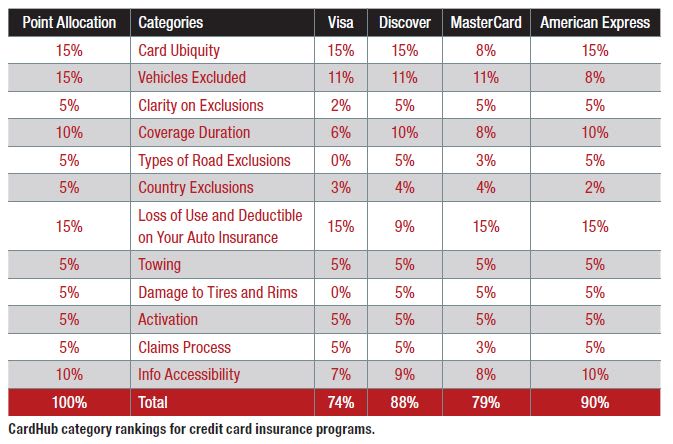
While all four major card networks provide some form of rental car insurance coverage to their customers, types and levels of coverage vary greatly by card, according to the “2014 Credit Card Auto Rental Insurance Report” by CardHub, an online credit card search and compare tool.
In grading the major credit cards for their rental car insurance policies, CardHub awarded American Express the highest cumulative score (90%) followed by Discover (88%), MasterCard (79%) and Visa (74%).
This report is the second version of CardHub’s car rental-specific study. In the inaugural study, in 2012, Visa took the top spot, followed by Discover, American Express and MasterCard.
Odysseas Papadimitriou, CEO and founder of CardHub, notes that there were methodology changes to the 2014 study, including more classifications, which likely affected the updated credit card rankings.
Key Findings
To be eligible for rental insurance coverage, all four card networks require cardholders to charge their entire rental car purchase on their credit card. In addition, the renter must decline supplemental insurance (CDW/LDW) offered by the rental company.
None of the four card networks provide coverage for exotic vehicles, trucks, vehicles with open beds and off-road vehicles. American Express is the only network that doesn’t cover certain SUVs, including the GMC Yukon, Ford Exposition, Range Rover and Lincoln Navigator.
Other findings include:
Visa is the only network that doesn’t cover accidents on dirt and gravel roads.
MasterCard only covers accidents on dirt and gravel roads “if they are regularly maintained.”
MasterCard is the only network that doesn’t offer coverage on all of its cards.
To qualify, most cards exclude certain countries and limit length of rental.
Because each card network has different specifications, it is important for renters and car rental operators to understand each card’s coverage, says Papadimitriou.
Papadimitriou recommends being honest and upfront with renters and helping guide them to use the right card. Knowing that the renter has some type of coverage should bring operators some peace of mind — even if it’s not their company’s supplemental insurance.
CardHub’s Methodology
CardHub collected information from each of the four card networks to answer these seven questions: 1) “Who is eligible for car rental insurance coverage?” 2) “What vehicles are excluded?” 3) “What exclusions do the policies have?” 4) “What is the quality of the coverage?” 5) “How does one activate the benefit?” 6) “How should claims be filed?” 7) “How easy is it to obtain complete information about the policy?”
According to the chart, the 100% point allocation includes 12 categories: card ubiquity, vehicles excluded, clarity on exclusions, coverage duration, types of road exclusions, country exclusions, loss of use and deductible on your auto insurance, towing, damage to tires and rims, activation, claims process and info accessibility.
Based on the card network’s answers, CardHub gave each card network a percentage score for each of the 12 categories, and then added them up for the total coverage percentage.
[PAGEBREAK]
Buyer Beware
Leslie Saunders of Leslie Saunders Insurance and Marketing International cautions rental operators — and by extension renters — to understand the difference between CDW and LDW, and between a waiver of financial responsibility and an insurance contract.
In regard to renters taking advantage of credit card insurance, “It is still ‘buyer beware,’” Saunders says. “The loss always has special circumstances, including business use on a personal card, other drivers, and whether free rental days are covered. The charge for LDW from the car rental company — relative to the value of the vehicle and unknown driving habits of the renter — is still a value offering.
More Fleet Insurance

Hanging By A Vote: What the Hertz Insurance Ruling Means for Rental Operators
A recent precedent-setting court case points to the precautions and steps a rental fleet operation should take to minimize risk, reduce exposure, and avert legal consequences.
Read More →
Using AI to Create Clarity, Not Conflict, in Rental Car Damage
Rental companies still need people, policy, judgment, and thoughtful implementation, with operators remaining in control of the customer experience.
Read More →
Go Rentals, Repair Provider Partner To Ease Insurance Claims Experience
The arrangement helps reduce the stress of collision repair for vehicle owners by connecting them to reliable, timely rental cars.
Read More →
U.S. Collision-Related Rental Length of Rental Declined Modestly in Q4 2025
While LOR continues to decrease from post-pandemic highs, ongoing market and economic conditions could impact future results.
Read More →
Beyond The Rental Desk: Inside Car Rental’s Push To Simplify
Greater transparency, simplified digital access, and connected fleets will be the key factors in determining who comes out on top over the next 10 years.
Read More →
Tripiamo Brings Certified Driving Confidence Training For Car Renters
Driving abroad is one of the leading causes of death among international travelers, who are not used to new traffic patterns.
Read More →
AI in Car Rental Should Be the Customer’s Advocate, Not Accuser
Opinion/Editorial: What happens when AI randomly overcharges car renters outrageous fees and penalties?
Read More →
TSD Mobility, Canopy Connect Partner to Ease Insurance Verification
The new integration brings streamlined functionality to rental agents and dealerships.
Read More →
Length of Rental Could Be Finding a New Normal of More Days
The industry may not be returning to the lower LORs of 2019 and 2020 as two years of declining repair shop backlogs appear to flatline.
Read More →
Gallagher Insurance Hires Broker Focused on Rental Car Operations
The former rental fleet executive informs his insurance practices with the everyday realities of managing rented vehicles.
Read More →