




The Growth of Prepaid Reservations
Prepaid reservations are growing, albeit slowly. Perfecting the model to balance customer service, utilization and profits is where the challenge lies.

Source: Rate-Highway Inc.
For years, th
Source: Rate-Highway Inc.
e airline and hotel industries have had industry-wide policies requiring customers to prepay for their flight or room and accept a financial penalty if they broke their reservations. Yet the concept of guaranteed reservations was never widely adapted in the car rental industry.
Recently, however, the car rental industry has seen progress with prepaid reservations, viewed as a customer-friendly alternative to guaranteed reservations. The prepaid reservations model is catching on, though still small as a percentage of overall revenue.
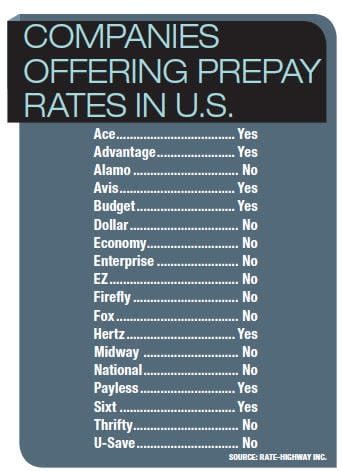
While major car rental companies such as Hertz and Avis have had forms of prepay for a few years, this option is now prominent in their bookings process. Now, franchised and independent companies are offering prepaid reservations, facilitated by new technology in car rental operating systems and online travel agencies (OTAs).
CarRentals.com is now accepting credit card prepayment for a 10% discount. At the time of its bankruptcy filing, Advantage had $13.9 million in bookings in prepaid business. ACE now offers prepaid to its affiliates through its reservations system.
Overcoming the Hurdles
One hurdle is perfecting the model, which entails a daily balancing of utilization with the right discount to attract customers while maintaining a profit margin.
“Early data shows that a 5% discount is enough to get people to move,” says Kevin Stutz, business manager for ACE Car Rental Reservations. That savings may only be a couple of dollars per day, says Stutz, however, “Other times it’s not. It’s a learning process to understand the breaking point by car class.”
Random checks of prepaid offerings from Hertz and Avis show discounts ranging from 7% to 15% and varying by car class, but not necessarily increasing with rental rate. This suggests that a determining factor in setting the discount is utilization in a particular class at a location.
An over-fleeting situation would be a reason to increase the discount, though this must be balanced against the threshold of eroding profits, Stutz says.
Another issue is fraud. When a customer prepays for the entire rental through the Internet, counter procedures to verify the renter must be extra stringent. Some companies state the renter must use the booking credit card at the counter while others just ask renters to verify their identity.
Stutz says ACE was able to recover a car from a renter who used a stolen credit card to prepay for a convertible for 20 days.
“[Prepaid] adds a new dynamic when you’ve already taken the money upfront,” Stutz says. “For a lot of agents, it’s human to want to OK it, especially if the reservation is for a $1,000. You have to be more vigilant with policy.”
[PAGEBREAK]
Stutz says that in the first months of prepaid, the company held fast to its cancellation policy. But the result was a customer service department that was spending too much time dealing with upset customers. ACE now offers a voucher toward a future rental if a customer cancels. The new ACE policy has resulted in a dramatic drop in complaints, Stutz says.
The Avis website states that customers will receive a full refund less $25 if they cancel more than six hours before their reservation. Those that don’t show up are charged $100. Hertz rules state: “Cancellation fees apply for prepaid reservations. No refunds or credits for unused rental days.”
Analyzing the Metrics
If the desired outcome with prepaid reservations is to decrease no-show rates, ACE offers compelling metrics. Stutz reports that the total no-show rate in the 24 months prior to launching prepaid on channels — that would eventually participate in prepaid — was 21%, while the combined no-show and cancellation rate was 38%. “It was not uncommon for ACE to observe a no-show rate in the 50% range in certain locations on certain channels,” Stutz says.
In the 24 months following the launch of prepaid, the total no-show rate declined to 11% — a 48% decrease — on those same channels. The combined no-show and cancellation rate dipped to 25%, or a 34% decline. Those numbers improved in 2013. Last year, 40% of the reservations had some form of collection on these channels, with a no-show rate of 5%, Stutz reports.
More Rental Operations

What Does It Take to Succeed in B2B Rentals?
The fundamentals may be familiar to daily car rental operators, but project-based truck rentals put different demands on the fleet and the business.
Read More →
NPR Builds on International Partnerships to Grow Rental Bookings
With Ana Laborde supporting broker development, NPR Auto Group is tailoring distribution strategies, rate packages, and partnerships to grow international reservations across its three brands.
Read More →
Advantage, Sixt Place Among Top Five in Annual Satisfaction Study
While Enterprise and National retain the top spots in JD Power’s 2026 rankings, the latest customer satisfaction results suggest renters can find competitive service beyond the biggest car rental names.
Read More →
The $100,000 Insurance Trap in Exotic Car Rentals
Exotic rental agencies often rely on customers’ personal auto policies to protect six-figure vehicles. But policy language can dramatically change the coverage for vehicles over $100,000 MSRP.
Read More →
The Booking Is Confirmed, But Is Your Customer Ready to Drive?
For international renters, a confirmed reservation doesn’t always mean they’re eligible to drive. Earlier checks can help operators catch documentation and payment issues before the customer reaches the counter.
Read More →
ICRS 2027 Opens Call for Papers
The International Car Rental Show seeks session proposals on the business, operational, and technology issues facing car rental operators. Submissions are due Jan. 15.
Read More →
Turo to Launch Vehicle Delivery Service
Turo Delivered will let travelers search for vehicles that hosts can deliver directly to hotels, homes, airports, train stations, and other locations.
Read More →
Palm Beach Airport Code Change Creates Car Rental Distribution Gap
A test of rental searches under the old PBI and new DJT airport codes returned largely different sets of brands and vehicles, highlighting a potential distribution problem for rental operators.
Read More →
U-Save Continues Dominican Republic Expansion with Launch in Punta Cana
The new franchise location builds on U-Save’s existing Santo Domingo operation and will begin taking reservations for October 2026.
Read More →
When AI Books the Rental Car, Who Controls the Sale?
As AI moves from comparing rental rates to completing transactions, operators need to understand how travelers find, interpret, rank, and ultimately see their offers. (Part 2 of 2.)
Read More →