




4 Global Trends in Carsharing for 2025
Despite operational challenges and questions, the global car-sharing market continues growing and will likely double during the next decade.

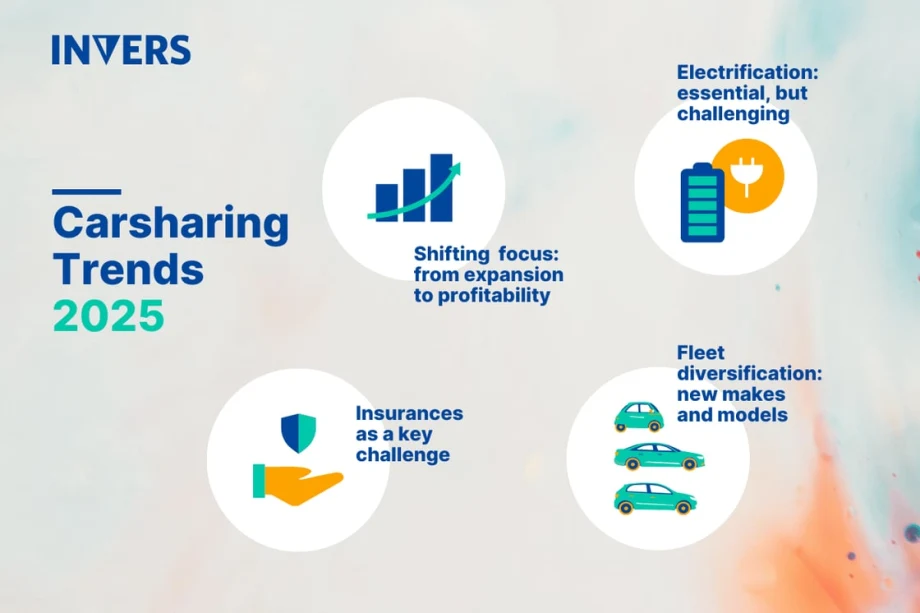
2025 will bring strong influences on the car sharing industry from macro-economic developments, a struggling automotive industry, and a growing regulatory force for sustainable mobility.
Graphic: Invers
Rising vehicle prices, steep maintenance costs, and ongoing debates over parking are creating significant hurdles for personal car ownership, according to a recent study from Invers, a company that enables car sharing operators to launch and run fleets with integrated hardware and software.
As cities tighten regulations and push zero-emission targets, car sharing is emerging as a critical component of urban mobility.
“For 2025, we are expecting strong influences on the car sharing industry from macro-economic developments, a struggling automotive industry, and a growing regulatory force for sustainable mobility”, said Bharath Devanathan, chief business officer at Invers, in a Dec. 30 news release. “Through our discussions with customers and partners, we’ve pinpointed specific trends and obstacles that operators must navigate to provide viable alternatives to private car ownership, grow their businesses, and advance sustainable mobility.”
Invers offered details of its four key findings in the news release:
1: Insurance Coverage Gaps
Car sharing operators are grappling with insurance challenges as traditional insurers often decline to cover damages to shared vehicles. This stems from the unique complexities of the car sharing model that traditional insurance policies are not designed to address. A major issue is the difficulty in proving when and how damage occurred and identifying who is responsible, problems compounded by the lack of clear documentation in many cases.
To address this, car-sharing companies need tailored solutions that go beyond conventional insurance. AI-powered tools, such as advanced damage and smoke detection, are crucial for bridging this gap. These technologies provide evidence with timestamps and user identification, enabling operators to hold the responsible party accountable. The need for customized insurance policies is equally critical. Insurers must adapt their coverage to accommodate the high turnover of users and the continuous risk exposure inherent to car sharing, although widespread adoption of such changes remains unlikely. By investing in specialized technologies and advocating for updated insurance models, operators can protect their assets, streamline operations, and foster a more sustainable car-sharing ecosystem.
2: Fleet Diversification: New Makes and Models
Operators continue to evaluate new vehicles to add to their car-sharing fleets. One key driver is availability. Following the COVID-19 pandemic and the subsequent chip crisis, many vehicle components and models became scarce or even unavailable.
For example, a significant shortage of keyless start vehicles prompted operators to diversify their fleets by including models like Stellantis' Opel Corsa as alternatives to Volkswagen vehicles. Global economic factors are also influencing fleet choices. Vehicles like the Dacia Spring, produced in China, face high taxation, making them less attractive. In response, operators are exploring options from emerging providers, such as a joint venture between Leapmotor International and Stellantis, which manufactures vehicles in Poland. At Invers, the team is getting more and more requests for vehicle analyses for previously unknown models, and this trend is happening earlier and more frequently than in recent years.
3: Electrification: Essential But Complicated
As governments, communities, and cities enforce stricter zero-emission targets, car-sharing operators will continue to integrate EVs into their fleets to meet these requirements. One in four European station-based and free-floating car-sharing services operate all-electric fleets. However, the transition comes with challenges. In some markets, like the Netherlands, operators are mandated to switch entirely to battery electric vehicles (BEVs) but receive little government support for building charging infrastructure or providing incentives.
Other regions are taking an indirect approach: heavily penalizing internal combustion engine vehicles (ICEVs) and banning them from city centers. However, both approaches pursue the same sustainability goals: Low-emission zones by calling for more low-emission vehicles while phasing out high-emission vehicles. Additionally, operating electric fleets poses unique challenges, including higher overhead costs and complex logistics, while vehicle procurement remains prohibitively expensive.
4: Shifting Focus: From Expansion to Profitability
After more than three decades of growth, some operators are consolidating their operations by scaling back from less profitable regions and concentrating on markets where they can achieve sustainable growth. For instance, Zity recently left Paris, while GreenMobility refocused on Denmark, prioritizing core regions to meet their profit targets. Others, like AimoShare and Volvo on Demand, have exited the market entirely or pivoted to new business models.
Operators are also striving for greater operational excellence to boost profits. A growing trend is insourcing, which allows companies to maintain control over key business processes and retain critical business knowledge in-house, bolstering their competitive edge.
Despite these adjustments, the global car-sharing market continues to grow. According to the recent Invers’ mobility research, station-based and free-floating fleets in Europe increased by 14%. Looking ahead, Frost & Sullivan projects that the global car-sharing market will double in size between 2023 and 2032.
Germany-based Invers acts as an independent partner for operators of services such as car sharing, rental, and subscription services. Its vision is to make using shared vehicles more convenient and affordable than ownership.
Customers include Cambio, Flinkster, Free2Move, Getaround, GreenMobility, Miles, MyWheels and Zity. The company was founded in 1993 and has locations in Siegen, Cologne, and Vancouver.
More Rental Operations

What Does It Take to Succeed in B2B Rentals?
The fundamentals may be familiar to daily car rental operators, but project-based truck rentals put different demands on the fleet and the business.
Read More →
NPR Builds on International Partnerships to Grow Rental Bookings
With Ana Laborde supporting broker development, NPR Auto Group is tailoring distribution strategies, rate packages, and partnerships to grow international reservations across its three brands.
Read More →
Advantage, Sixt Place Among Top Five in Annual Satisfaction Study
While Enterprise and National retain the top spots in JD Power’s 2026 rankings, the latest customer satisfaction results suggest renters can find competitive service beyond the biggest car rental names.
Read More →
The $100,000 Insurance Trap in Exotic Car Rentals
Exotic rental agencies often rely on customers’ personal auto policies to protect six-figure vehicles. But policy language can dramatically change the coverage for vehicles over $100,000 MSRP.
Read More →
The Booking Is Confirmed, But Is Your Customer Ready to Drive?
For international renters, a confirmed reservation doesn’t always mean they’re eligible to drive. Earlier checks can help operators catch documentation and payment issues before the customer reaches the counter.
Read More →
ICRS 2027 Opens Call for Papers
The International Car Rental Show seeks session proposals on the business, operational, and technology issues facing car rental operators. Submissions are due Jan. 15.
Read More →
Turo to Launch Vehicle Delivery Service
Turo Delivered will let travelers search for vehicles that hosts can deliver directly to hotels, homes, airports, train stations, and other locations.
Read More →
Palm Beach Airport Code Change Creates Car Rental Distribution Gap
A test of rental searches under the old PBI and new DJT airport codes returned largely different sets of brands and vehicles, highlighting a potential distribution problem for rental operators.
Read More →
U-Save Continues Dominican Republic Expansion with Launch in Punta Cana
The new franchise location builds on U-Save’s existing Santo Domingo operation and will begin taking reservations for October 2026.
Read More →
When AI Books the Rental Car, Who Controls the Sale?
As AI moves from comparing rental rates to completing transactions, operators need to understand how travelers find, interpret, rank, and ultimately see their offers. (Part 2 of 2.)
Read More →