




Bosch, Mercedes Launch Driverless Ride-Hailing Service
Using autonomous Mercedes-Benz S-Class vehicles, the companies have started a pilot project in San Jose to test out their app-based ride-hailing service.
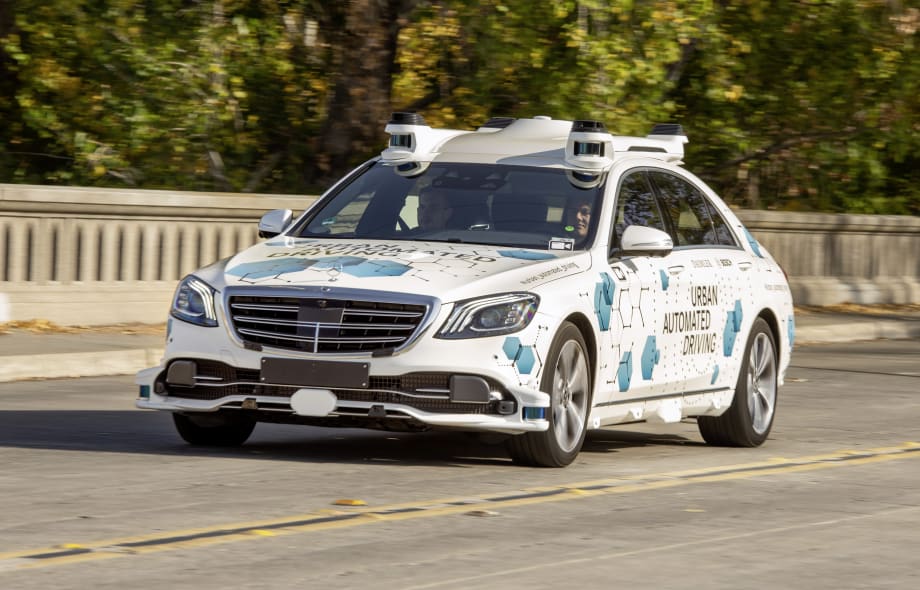
The service will initially be available to a select group of users. Using an app developed by Daimler Mobility AG, customers will book a trip from a defined pick-up point to their destination.
Photo courtesy of Mercedes-Benz.
Bosch and Mercedes-Benzs have launched a pilot project for an app-based ride-hailing service. Using automated Mercedes-Benz S-Class vehicles, the service has started in San Jose. Monitored by a safety driver, the self-driving cars shuttle between West San Jose and downtown, along San Carlos Street and Stevens Creek Boulevard.
The service will initially be available to a select group of users. Using an app developed by Daimler Mobility AG, customers will book a trip from a defined pick-up point to their destination.
Mercedes-Benz and Bosch hope this trial will provide insight into the further development of their SAE Level 4/5 automated driving system. Additionally, they expect to gain further insight into how self-driving cars can be integrated into an intermodal mobility system that also includes public transportation and carsharing, according to the companies.
“It’s not just the automated vehicles that have to prove their mettle,” said Uwe Keller, head of autonomous driving at Mercedes-Benz AG. “We also need proof that they can fit in as a piece of the urban mobility puzzle. We can test both these things in San Jose.”
In mid-2017, San Jose was the first U.S. city to invite private companies to perform field tests of automated driving and analyze the growing challenges in road traffic.
“As a city, we want to know more about how automated vehicles can help improve safety and reduce congestion, as well as make mobility more available, sustainable, and inclusive,” said Dolan Beckel, director of Civic Innovation and Digital Strategy. “The project of Mercedes-Benz and Bosch ties in with San Jose’s extensive ‘smart city’ objectives. It will also help us develop guidelines for dealing with new technologies and prepare for the traffic system of the future.”
For around two and a half years, Mercedes-Benz and Bosch have been working together on solutions for automated driving in cities. Their common goal is an SAE Level 4/5 driving system for fully automated and driverless vehicles, including the software for vehicle management. They want to develop a production-ready system that can be integrated into different vehicle types and models.
“If automated driving is to become everyday reality, the technology has to work reliably and safely,” said Michael Fausten, head of engineering for urban automated driving at Robert Bosch GmbH. “And this is where we need tests such as our pilot project in San Jose.”
Originally posted on Automotive Fleet
More Rental Operations

What Does It Take to Succeed in B2B Rentals?
The fundamentals may be familiar to daily car rental operators, but project-based truck rentals put different demands on the fleet and the business.
Read More →
NPR Builds on International Partnerships to Grow Rental Bookings
With Ana Laborde supporting broker development, NPR Auto Group is tailoring distribution strategies, rate packages, and partnerships to grow international reservations across its three brands.
Read More →
Advantage, Sixt Place Among Top Five in Annual Satisfaction Study
While Enterprise and National retain the top spots in JD Power’s 2026 rankings, the latest customer satisfaction results suggest renters can find competitive service beyond the biggest car rental names.
Read More →
The $100,000 Insurance Trap in Exotic Car Rentals
Exotic rental agencies often rely on customers’ personal auto policies to protect six-figure vehicles. But policy language can dramatically change the coverage for vehicles over $100,000 MSRP.
Read More →
The Booking Is Confirmed, But Is Your Customer Ready to Drive?
For international renters, a confirmed reservation doesn’t always mean they’re eligible to drive. Earlier checks can help operators catch documentation and payment issues before the customer reaches the counter.
Read More →
ICRS 2027 Opens Call for Papers
The International Car Rental Show seeks session proposals on the business, operational, and technology issues facing car rental operators. Submissions are due Jan. 15.
Read More →
Turo to Launch Vehicle Delivery Service
Turo Delivered will let travelers search for vehicles that hosts can deliver directly to hotels, homes, airports, train stations, and other locations.
Read More →
Palm Beach Airport Code Change Creates Car Rental Distribution Gap
A test of rental searches under the old PBI and new DJT airport codes returned largely different sets of brands and vehicles, highlighting a potential distribution problem for rental operators.
Read More →
U-Save Continues Dominican Republic Expansion with Launch in Punta Cana
The new franchise location builds on U-Save’s existing Santo Domingo operation and will begin taking reservations for October 2026.
Read More →
When AI Books the Rental Car, Who Controls the Sale?
As AI moves from comparing rental rates to completing transactions, operators need to understand how travelers find, interpret, rank, and ultimately see their offers. (Part 2 of 2.)
Read More →