



Car Sharing Platforms Grow Across North America
A new white paper presents a thorough overview of how car sharing is diversifying in the U.S., Canadian, and Mexican rental car markets.

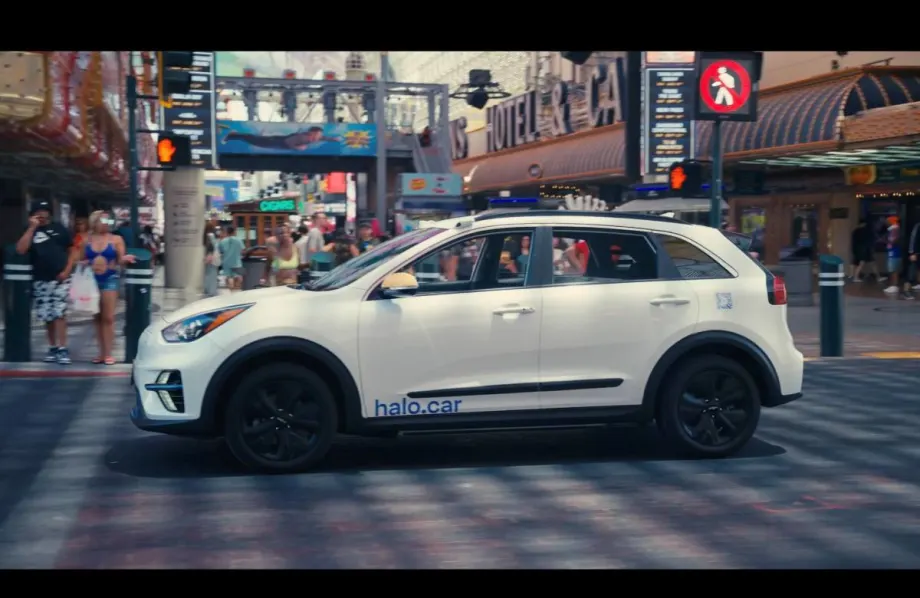
A remarkable trend in the U.S. market is the trials of tele-operated car sharing. Las Vegas has seen the introduction of the first tele-operated car sharing services like Halo.
Photo: Halo.Car
The North American car sharing market in the US, Canada, and Mexico counts at least 70 operators today, according to a new white paper “Car Sharing in North America” from Invers released July 24.
That is one of the key results and the research basis of the new white paper based on research that analyzes the business operations of major operators, their business models, vehicle choices, the North American fleet size, and user numbers.
“Going for a deep dive into the North American car sharing market has proven once again: national mobility markets are very unique”, said Alexander Kirn, CEO of Invers, in a news release. “The U.S. is the largest North American car sharing market by fleet size, while Canadian round-trip and free-floating operators boast a very high ratio of car sharing vehicles per capita.”
Mexico has a niche market, whereas Europe may have led the way into traditional car sharing. “But in the U.S. we witness promising first trials of tele-operated car sharing in — a potential game changer for the industry," Kim said.
The major operators in the U.S. include Free2move, Hyrecar, Getaround and GIG Carshare.
In Canada there are car sharing services from operators like Communauto, Evo Car Share, and Modo.
Large players like Enterprise CarShare, KINTO, Turo and Zipcar operate in both, the U.S. and Canada. Operators in Mexico include Drivana and Punto.
Multiple Business Models Connect Cars and Customers
The operators offer a wide variety of business models including round-trip, free-floating, peer-to-peer, tele-operated, corporate, condo, or community car sharing. There is a noticeable trend towards the convergence of these traditionally distinct car sharing models.
Many operators are now integrating combinations of these models into their service offerings. In the research, operators offer over 75 different vehicle models from more than 20 brands in their car sharing fleets, excluding P2P services.
Vehicle types include standard passenger cars, SUVs, transporter and cargo vans, as well as pickups and electric vehicles. Popular makes and models include the Chevrolet Bolt, Kia Niro, Nissan Leaf, Tesla Model 3, and Toyota Prius, among others.
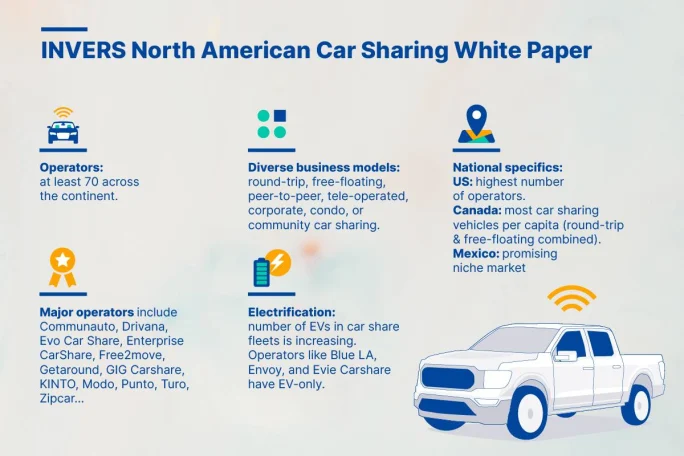
A new Invers white paper, “Car Sharing in North America,” analyzes the business operations of major operators, their business models, vehicle choices, the North American fleet size, and user numbers.
Graphic: Invers
Fleet Sizes Create More Sharing Options
North American car sharing operators are increasingly offering electric vehicles (EVs) in their fleets. Many operators like Blue LA, Envoy, and Evie Carshare have EV-only fleets.
The number of users of car sharing – covering round-trip, free-floating, and corporate car sharing – is estimated to be at least 2.4 million, according to a recent Berg Insight report. This figure does not account for the many users of peer-to-peer car sharing and other business models.
The exact fleet size of North American car sharing is difficult to estimate. The academic researchers Shaheen & Cohen (UC Berkeley) estimated over 23,000 vehicles in the North American station-based/round-trip and free-floating car sharing in a study from 2020.
Another recent estimate came from the market analysts at Berg Insight that estimated at least 41,000 vehicles in corporate car sharing, station-based/round-trip, and free-floating in 2023.
P2P car sharing operators tend to communicate global fleet sizes, rather than regional or national fleet sizes. Turo for instance communicates a global fleet size of 350,000 vehicles; Getaround another 75,000 active vehicles globally that can be rented on their platform.
A remarkable trend in the U.S. market is the trials of tele-operated car sharing. Las Vegas has seen the introduction of the first tele-operated car sharing services. Companies like Vay and Halo are pioneering this newest innovation to car sharing. In these services, a booked car is delivered to the customer by remote drivers. The customer then manually drives the car to their destination, exits the vehicle, and a remote driver takes over once more. This eliminates the need for customers to search for parking spots.
In addition, there is a strong presence of non-profit organizations, cooperatives of various sizes, and community-based car sharing operators in the U.S. and Canada. These operators focus on providing car sharing services tailored for smaller communities, emphasizing sustainability. Many of them exclusively offer electric vehicles (EVs). There is also a notable trend towards subsidized rates to support low-income communities.
Information: Download the free Invers white paper Car Sharing in North America.
More Rental Operations
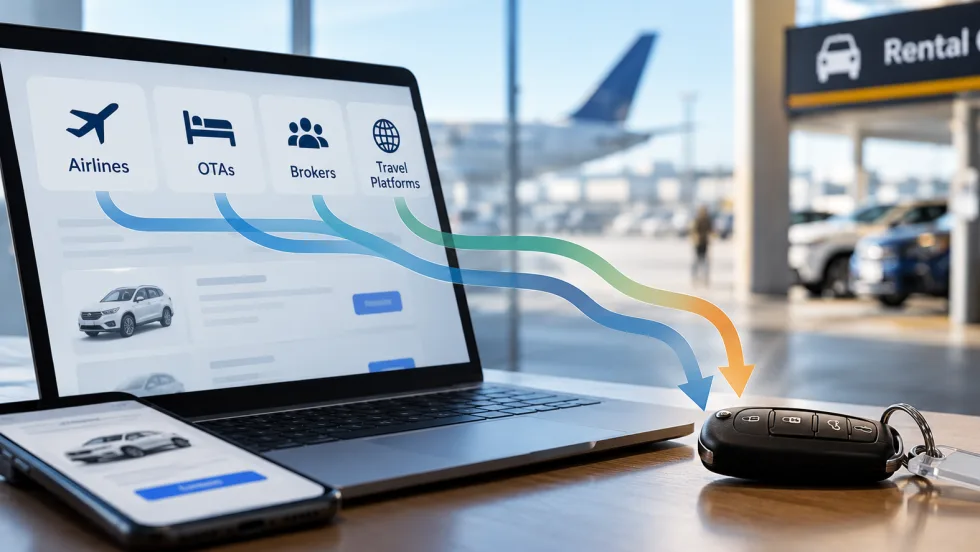
Direct, Broker or Hybrid? How Travel Retailers Source Rental Cars
As travel retailers weigh direct supplier relationships against third-party distribution, rental operators need to understand how those decisions affect their business.
Read More →
How Did This Independent Rental Operator Grow to 170 Vehicles in 4 Years?
With 170 vehicles across three Kentucky locations, Joel Price relies on an overseas team to handle reservations, payments, and after-hours customer service. It's one part of an unconventional approach to growing an independent rental operation.
Read More →
What Does It Take to Succeed in B2B Rentals?
The fundamentals may be familiar to daily car rental operators, but project-based truck rentals put different demands on the fleet and the business.
Read More →
NPR Builds on International Partnerships to Grow Rental Bookings
With Ana Laborde supporting broker development, NPR Auto Group is tailoring distribution strategies, rate packages, and partnerships to grow international reservations across its three brands.
Read More →
Advantage, Sixt Place Among Top Five in Annual Satisfaction Study
While Enterprise and National retain the top spots in JD Power’s 2026 rankings, the latest customer satisfaction results suggest renters can find competitive service beyond the biggest car rental names.
Read More →
The $100,000 Insurance Trap in Exotic Car Rentals
Exotic rental agencies often rely on customers’ personal auto policies to protect six-figure vehicles. But policy language can dramatically change the coverage for vehicles over $100,000 MSRP.
Read More →
The Booking Is Confirmed, But Is Your Customer Ready to Drive?
For international renters, a confirmed reservation doesn’t always mean they’re eligible to drive. Earlier checks can help operators catch documentation and payment issues before the customer reaches the counter.
Read More →
ICRS 2027 Opens Call for Papers
The International Car Rental Show seeks session proposals on the business, operational, and technology issues facing car rental operators. Submissions are due Jan. 15.
Read More →
Turo to Launch Vehicle Delivery Service
Turo Delivered will let travelers search for vehicles that hosts can deliver directly to hotels, homes, airports, train stations, and other locations.
Read More →
Palm Beach Airport Code Change Creates Car Rental Distribution Gap
A test of rental searches under the old PBI and new DJT airport codes returned largely different sets of brands and vehicles, highlighting a potential distribution problem for rental operators.
Read More →