




Hertz Increases Revenues, Narrows Losses for Q4 and Full Year
Company reports full year 2010 worldwide revenues of $7.6 billion, up 6.5% over prior year, and a net loss, on a GAAP basis, of $48 million, compared with a net loss of $126 million for 2009.
Hertz Global Holdings, Inc. reported fourth quarter 2010 worldwide revenues of $1.8 billion, an increase of 5.5% year-over-year (a 6.3% increase excluding the effects of foreign currency). Worldwide car rental revenues for the quarter increased 5.8% (a 6.9% increase excluding the effects of foreign currency) to $1.5 billion. Revenues from worldwide equipment rental for the fourth quarter were $286.1 million, up 4.4% (a 4.1% increase excluding the effects of foreign currency) over the prior year period.
Fourth quarter 2010 adjusted pre-tax income was $68.0 million, versus $39.2 million in the same period in 2009, an increase of $28.8 million, or 73.5%, and loss before income taxes ("pre-tax loss"), on a GAAP basis, was $7.8 million, versus a loss of $67.4 million in the fourth quarter of 2009. Corporate EBITDA for the fourth quarter of 2010 was $265.7 million, an increase of 20.2% from the same period in 2009.
Fourth quarter 2010 adjusted net income was $40.4 million, an increase of 79.6% from $22.5 million in the same period of 2009, resulting in adjusted diluted earnings per share for the quarter of $0.10, compared with $0.06 for the fourth quarter of 2009. Fourth quarter 2010 net loss attributable to Hertz Global Holdings, Inc. and Subsidiaries' common stockholders, or "net loss," on a GAAP basis, was $29.2 million or $0.07 per share on a diluted basis, compared with a net loss of $30.9 million, or $0.08 per share on a diluted basis, for the fourth quarter of 2009.
Mark P. Frissora, the company's chairman and chief executive officer, said, " As previously announced on January 24, 2011, we beat our high end guidance for all adjusted earning metrics for the full year 2010 due to strong performance by our car rental businesses and consistent sequential improvement by HERC. We reduced costs by an additional $438 million during 2010, bringing our four-year total to almost $1.7 billion, and we generated approximately $380 million in incremental revenues from a variety of new products, services and geographies. In 2011, Hertz will continue to focus on incremental cost management and revenue growth, as well as additional refinancings to optimize our global debt structure, including improvements to our maturity profile. In 2010, we completed almost $6 billion of global debt refinancings on highly favorable terms which will materially decrease our interest expense through 2015."
The company took $14.4 million in restructuring and related charges in the fourth quarter of 2010, primarily attributable to job reductions, the closure of rental locations and process reengineering.
The company ended the fourth quarter of 2010 with total debt of $11.3 billion and net corporate debt(1) of $3.36 billion, compared with total debt of $12.0 billion and net corporate debt of $3.78 billion as of September 30, 2010. Total debt decreased primarily due to a decrease in fleet debt related to seasonality, partly offset by an increase due to the private offering of $500 million of 7.375% senior notes issued in December 2010. Net cash provided by operating activities was $479.1 million in the fourth quarter of 2010, compared to $498.6 million last year.
WORLDWIDE CAR RENTAL
Worldwide car rental revenues were $1.5 billion for the fourth quarter of 2010, an increase of 5.8% (a 6.9% increase excluding the effects of foreign currency) from the prior year period. Transaction days for the quarter increased 6.6% [6.7% U.S.; 6.3% International]. U.S. off-airport total revenues for the fourth quarter increased 13.8% year-over-year, and transaction days increased 11.6%. Rental rate revenue per transaction day(1) ("RPD") for the quarter decreased 0.9% [(1.5)% U.S.; 0.1% International] from the prior year period.
Worldwide car rental adjusted pre-tax income for the fourth quarter of 2010 was $130.3 million, an increase of $33.4 million from $96.9 million in the prior year period. The result was driven by increased volume and strong cost management performance. As a result, worldwide car rental achieved an adjusted pre-tax margin, based on revenues, of 8.4% for the quarter, versus 6.6% in the prior year period.
The worldwide average number of company-operated cars for the fourth quarter of 2010 was 427,600, an increase of 3.1% over the prior year period.
WORLDWIDE EQUIPMENT RENTAL
Worldwide equipment rental revenues were $286.1 million for the fourth quarter of 2010, a 4.4% increase (a 4.1% increase excluding the effects of foreign currency) from the prior year period.
Adjusted pre-tax income for worldwide equipment rental for the fourth quarter of 2010 was $35.0 million, an increase of 35.7% from $25.8 million in the prior year period, primarily attributable to the effects of increased volume and cost management initiatives. Worldwide equipment rental achieved an adjusted pre-tax margin, based on revenues, of 12.2%, a 280 basis point improvement over the prior year period, and a Corporate EBITDA margin, based on revenues, of 40.1% for the quarter.
The average acquisition cost of rental equipment operated during the fourth quarter of 2010 decreased by 3.1% year-over-year and net revenue earning equipment as of December 31, 2010 was $1,703.7 million, a 7.0% decrease from the amount as of December 31, 2009.
FULL YEAR RESULTS
Worldwide revenues for the full year 2010 were $7.6 billion, an increase of 6.5% over the prior year (the same increase when the effects of foreign currency are excluded). Worldwide car rental revenues for the year increased 8.5% (a 8.8% increase excluding the effects of foreign currency) to $6.5 billion. Revenues from worldwide equipment rental for the year were $1,070.1 million, down 3.7% (a 5.2% decrease excluding the effects of foreign currency) over the prior year.
Adjusted pre-tax income for the year was $348.1 million, versus $198.9 million in the prior year, an increase of $149.2 million, or 75.0%, and pre-tax loss, on a GAAP basis, was $13.6 million, versus a pre-tax loss of $171.0 million in 2009. Corporate EBITDA for the year was $1,101.3 million, an increase of 12.4% from 2009.
Full year 2010 adjusted net income was $212.4 million, an increase of 82.2% from 2009, resulting in adjusted diluted earnings per share for the year of $0.52, compared to $0.29 in the prior year. Full year 2010 net loss, on a GAAP basis, was $48.0 million or $0.12 per share on a diluted basis, compared with a net loss of $126.0 million, or $0.34 per share on a diluted basis, for 2009.
The company ended 2010 with total debt of $11.3 billion and net corporate debt of $3.36 billion, compared with total debt of $10.4 billion and net corporate debt of $3.63 billion as of December 31, 2009. Total debt increased primarily due to the private offerings of $700 million of 7.50% senior notes issued in September 2010 and $500 million of 7.375% senior notes issued in December 2010. Net cash provided by operating activities was $2,208.7 million for the year, compared to $1,693.3 million in 2009.
OUTLOOK
For the full year 2011, the company forecasts the following:
Revenues $7.95 to $8.1 billion
Corporate EBITDA(2) $1.265 to $1.305 billion
Adjusted Pre-Tax Income(2) $525 - $565 million
Adjusted Net Income(2) $330 - $355 million
The company forecasts full year 2011 revenues in the range of $7.95 billion to $8.1 billion. The range is based on the projection of modest economic growth, a strong U.S. Dollar and incremental franchising of certain rental operations. The company has replaced adjusted diluted earnings per share guidance with guidance for adjusted net income. The adjusted diluted number of shares outstanding is estimated to fluctuate within a range of 413 million to 450 million through the year. The estimate for Q1 is 413 million shares outstanding. For example, based on 440 million adjusted diluted shares outstanding, the company's full year 2011 guidance for adjusted diluted earnings per share is $0.81 at the upper end of the guidance range. The company will provide an estimate of forecasted adjusted diluted shares outstanding on a quarterly basis.
For additional information and charts, click here.
More Rental Operations

Palm Beach Airport Code Change Creates Car Rental Distribution Gap
A test of rental searches under the old PBI and new DJT airport codes returned largely different sets of brands and vehicles, highlighting a potential distribution problem for rental operators.
Read More →
U-Save Continues Dominican Republic Expansion with Launch in Punta Cana
The new franchise location builds on U-Save’s existing Santo Domingo operation and will begin taking reservations for October 2026.
Read More →
When AI Books the Rental Car, Who Controls the Sale?
As AI moves from comparing rental rates to completing transactions, operators need to understand how travelers find, interpret, rank, and ultimately see their offers. (Part 2 of 2.)
Read More →
European Booked Car Rental Rates Fell 5%, Results Varied by Country
Ireland, Cyprus, and the United Kingdom saw steep declines, while booked rates rose in Poland and Hungary.
Read More →
Is It Time to Rethink Rental Categories?
As traditional economy and compact cars disappear from the market, longtime rental operator Mike DeLorenzo asks whether the industry’s familiar vehicle categories still make sense — and what operators need to rethink along with them.
Read More →
Who Owns the Rate? AI Is Creating a New Distribution Problem for Car Rental
Generative Engine Optimization asks whether AI can find a rental company, but operators also need to know whether the agent inspected enough of the market, compared equivalent offers, and presented a rate the traveler can actually book. (Part 1 of 2)
Read More →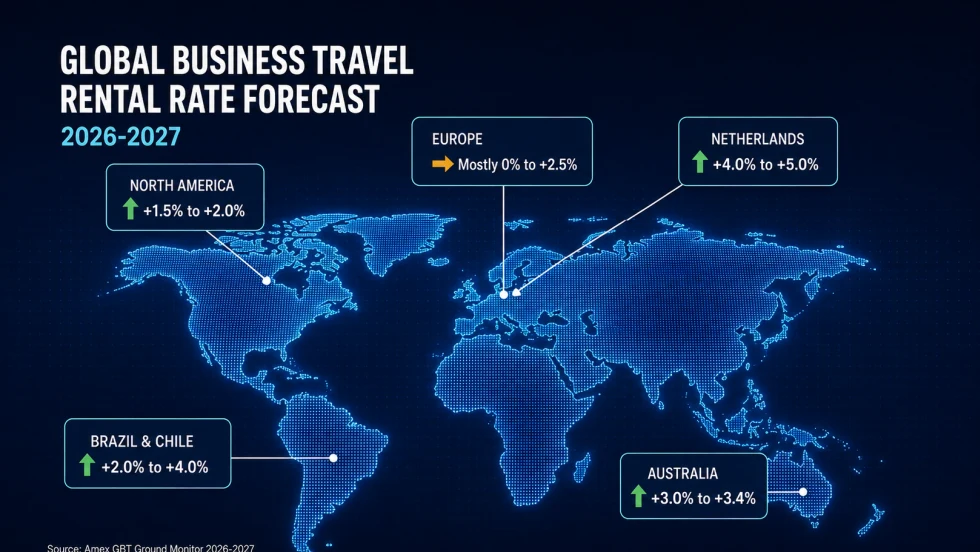
U.S. Business Travel Car Rental Rates Forecast to Rise Up to 2%
Improved fleet supply should limit pricing gains in 2026-27, while insurance, repair costs, and softer residual values continue to pressure rental operations, according to Amex GBT.
Read More →
Sixt Revenue Tops $2.4 Billion in First Half of 2026
Sixt’s first-half revenue surpassed $2.4 billion for the first time as demand outpaced fleet growth, lifting utilization and earnings despite weaker consumer sentiment in North America.
Read More →
In Memoriam: Bobby Klyce, Avis Licensee Legend
The longtime Birmingham Avis operator and 2018 Auto Rental News Impact Award recipient was remembered as an advocate for independent licensees and the broader car rental industry.
Read More →
How to Build Custom Fleet Tools With AI and Vibe Coding [Webinar]
A new Automotive Fleet webinar explores how fleet managers are using AI and vibe coding to automate routine work and create simple operational tools without traditional programming skills.
Read More →