




Mobility Shift Will Come with Mass Autonomous Vehicle Adoption
Mass adoption of autonomous vehicles should begin ramping up in 2023 and will ultimately drive a shift in vehicle ownership from consumers to larger mobility service providers with large fleets of battery-electric, autonomous vehicles, according to a new study from Cox Automotive.

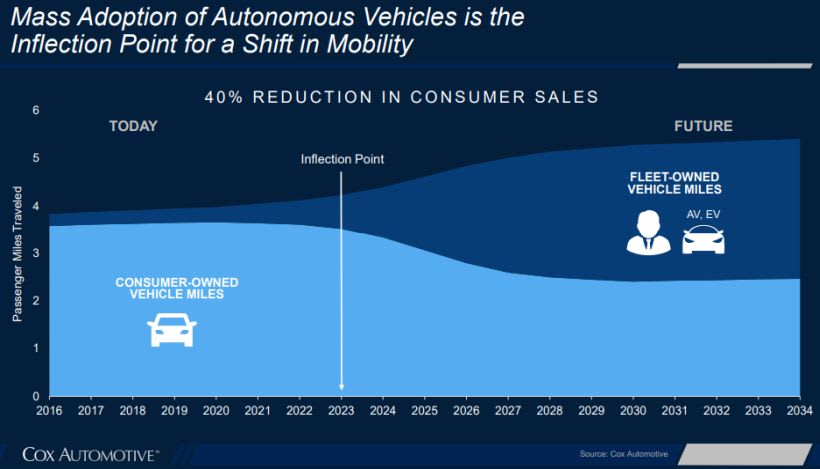
Cox Automotive sees mobility services reaching an inflection point in 2023.
Chart courtesy of Cox Automotive.
Mass adoption of autonomous vehicles should begin ramping up in 2023 and will ultimately drive a shift in vehicle ownership from consumers to larger mobility service providers with large fleets of battery-electric, autonomous vehicles, according to a new study from Cox Automotive.
This shift is expected to eventually lead to a 40% decline in consumer vehicle sales, as mobility models gain larger adoption for carsharing, ride-hailing, subscription services, and other services that gradually supplant consumers as the primary owners of vehicles by 2034.
The findings come as part of the 2018 Cox Automotive Evolution of Mobility study, which the company released on Aug. 16.
The study's findings about future trends somewhat bely current consumer attitudes about autonomous vehicles. While those who participated expressed increasing awareness of autonomy, they also expressed greater worries about their safety since the last Cox survey in 2016. The study attributed the safety worries to awareness of several high-profile accidents involving autonomous vehicles operated by Uber and Waymo. Respondents were 19% more aware of fully autonomous vehicles with or without a human operator since 2016.
Only 16% of respondents said they would feel comfortable riding in a fully autonomous vehicle without the option of being able to take control. Respondents also increasingly believe roadways wouldn't be safer with autonomous vehicles — 18% fewer said roadways would be safer if vehicles were fully autonomous.
Nearly half of respondents (a 19% increase) said they would never buy a fully autonomous vehicle, an opinion that skews older. While 71% of baby boomers said they wouldn't buy one, 56% of Gen X, 39% of millennials, and 48% of Gen Z said they wouldn't buy one. Urban dwellers are more open to autonomy than suburbanites or rural residents.
However, respondents also expressed interest in semi-autonomous features for their next vehicle purchase. They singled out collision warning and avoidance, adaptive headlights, lane keeping assist, and adaptive cruise control as the most popular driver-assisting features. Most respondents listed the features as "nice to have" rather than "must have."
Originally posted on Automotive Fleet
More Rental Operations

How Did This Independent Rental Operator Grow to 170 Vehicles in 4 Years?
With 170 vehicles across three Kentucky locations, Joel Price relies on an overseas team to handle reservations, payments, and after-hours customer service. It's one part of an unconventional approach to growing an independent rental operation.
Read More →
What Does It Take to Succeed in B2B Rentals?
The fundamentals may be familiar to daily car rental operators, but project-based truck rentals put different demands on the fleet and the business.
Read More →
NPR Builds on International Partnerships to Grow Rental Bookings
With Ana Laborde supporting broker development, NPR Auto Group is tailoring distribution strategies, rate packages, and partnerships to grow international reservations across its three brands.
Read More →
Advantage, Sixt Place Among Top Five in Annual Satisfaction Study
While Enterprise and National retain the top spots in JD Power’s 2026 rankings, the latest customer satisfaction results suggest renters can find competitive service beyond the biggest car rental names.
Read More →
The $100,000 Insurance Trap in Exotic Car Rentals
Exotic rental agencies often rely on customers’ personal auto policies to protect six-figure vehicles. But policy language can dramatically change the coverage for vehicles over $100,000 MSRP.
Read More →
The Booking Is Confirmed, But Is Your Customer Ready to Drive?
For international renters, a confirmed reservation doesn’t always mean they’re eligible to drive. Earlier checks can help operators catch documentation and payment issues before the customer reaches the counter.
Read More →
ICRS 2027 Opens Call for Papers
The International Car Rental Show seeks session proposals on the business, operational, and technology issues facing car rental operators. Submissions are due Jan. 15.
Read More →
Turo to Launch Vehicle Delivery Service
Turo Delivered will let travelers search for vehicles that hosts can deliver directly to hotels, homes, airports, train stations, and other locations.
Read More →
Palm Beach Airport Code Change Creates Car Rental Distribution Gap
A test of rental searches under the old PBI and new DJT airport codes returned largely different sets of brands and vehicles, highlighting a potential distribution problem for rental operators.
Read More →
U-Save Continues Dominican Republic Expansion with Launch in Punta Cana
The new franchise location builds on U-Save’s existing Santo Domingo operation and will begin taking reservations for October 2026.
Read More →