




This article originally appeared in our inaugural Auto Rental News International digital edition, covering the European rental market. To access our current International edition covering Latin America, click here.
One-Way Fees in Europe: Avoiding an Unpleasant Surprise
When renting a car in Europe, there are no standardized fees for international one-way rentals— certain countries charge a higher rate than others. International travelers need to do their homework ahead of time and read a rental contract's terms and conditions to avoid surprise fees.
by Chris Slesarchik
December 21, 2015
6 min to read

Mr. Smith has never rented a car in Europe before, but he approaches the rental desk in Marseille, France with unwavering confidence: his reservation voucher and ID are in hand.
His credentials are validated and the rental papers are exchanged, verifying his prepaid rental from Marseille to Genoa, just a few hours away in Italy.
All seems to be going smoothly until one line on the final bill stands out like a broken windshield on a brand-new Ferrari: “International One-Way Fee: 800 euros.”
Price of Convenience
When renting a car in Europe, disbelief is a common reaction among consumers when the international one-way fee is revealed at the last minute.
Europe is a continent known by most American tourists for its ease of travel, with several culturally unique countries within a few hundred miles of each other. It’s easy to see why traveling Europe by car is appealing, but high drop fees can often affect the way Americans plan their trips abroad.
Despite the proximity of foreign nations, the short driving distances between major cities and the relative ease of border crossings, different countries still have their own laws, regulations and insurance standards that can make getting a car back to where it came from expensive for the rental car owners.
There are no standardized fees for one-way rentals. As a result, the amount due in excess of the actual car rental rate can vary greatly. Therefore, consumers are recommended to work with European car rental specialists who can advise them about pick-up and drop-off locations and assist with other changing variables.
“One-way fees are part of the industry,” says Kirk Larkin, Auto Europe’s vice president of operations. “Rental cars have to be registered and licensed to a specific country, and they have to be returned to the country where the rental originated from. We trust that travelers understand this and see it as our responsibility to provide accurate quotes detailing ahead of time what fees they will be responsible for paying.”
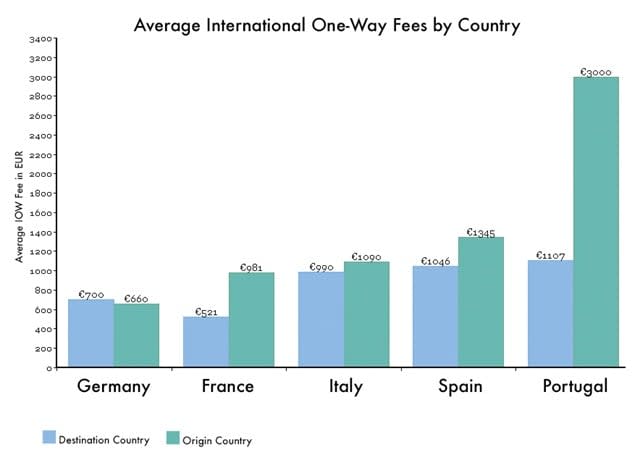
Certain countries are hot spots for international one-way travel, incurring steep fees for drivers who plan to cross borders. Italy, for example, is notoriously expensive when it comes to both incoming and outgoing transnational rental car traffic. This is mostly due to the fact that the country has statistically higher rates of theft and vandalism and national laws that make full insurance coverage on car rentals mandatory.
Any country in Eastern Europe also poses difficulties for one-way travel in a rental car. The area’s history with political instability (despite today’s milder political climate) yields one-way fees between Eastern and Western European countries, which can be higher than average.
In many cases, rental car companies won’t allow one-way rentals into Eastern Europe at all. Due to the popularity of smaller local suppliers with fewer international locations, one-way rentals into Western Europe and out of countries like the Czech Republic and Hungary can be tricky, too.
Drop fees also depend greatly on a traveler’s choice of supplier as each company determines their own fees independently. For the same given pick-up and drop-off location, one company may charge far less than another, while some companies might not be in a position to allow the desired travel at all. Every supplier has different offices and rental locations, enabling each provider to offer different options.
The bad news for consumers is there’s no exact science to estimating one-way fees as they are calculated on an individual basis by each respective rental car supplier — and determined by everything from car type to the time of year.
Great American Road Trip, Europe Edition
The complex realm of one-way car rental fees creates a tricky booking process for U.S. travelers to navigate. While similar domestic fees in the states are usually minimal (if applicable at all), driving just a few hundred miles through Europe can bring a driver across multiple borders, incurring significant additional fees.
Most Americans renting a car in Europe don’t expect to pay large fees to drop off a rental car a few hours away from its origin. As a result, many customers feel misled when hit with a charge far above what they anticipated.
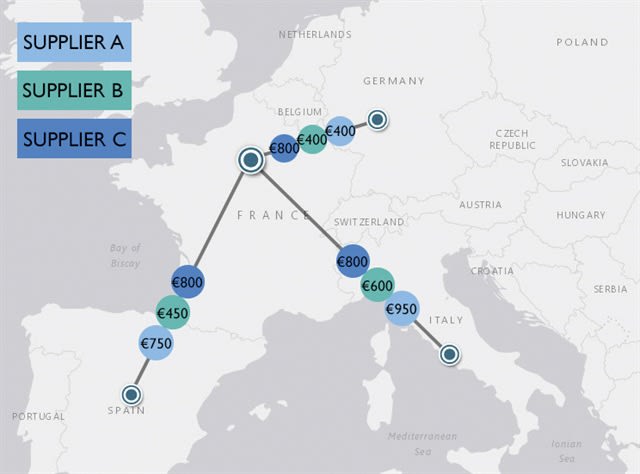
This graphic represents actual one-way fees from three car rental suppliers for otherwise identical one-way rentals.
Renters can mistakenly assume no additional fees will be incurred beyond a quoted rental price, even if one-way fees may be required upon pick up.
Alternately, if one-way fees are included in a quote or prepaid rate, a renter may not realize that a large portion of the total bill is made up of supplementary fees — opting to book with another company who doesn’t include the fee in the prepaid rate (but may, in fact, charge more at the rental desk).
The story of Mr. Smith details an unfortunate situation that can easily be avoided with some careful attention and awareness. Consumers should make a point to carefully read a contract’s terms and conditions. Not doing so can derail a vacation, and in many cases, high one-way fees are avoidable through alternatives — the consumer simply needs to be prepared to ask an expert for help.
If you are planning a road trip in Europe, simply traveling around Western European nations with a rental car is usually permitted for free or at a minimal cost, provided that the car is dropped back in its home country. It’s picking up a rental car in one country and dropping it off in another that can incur serious fees.
Domestic one-way fees (between two locations within the same country) can sometimes take effect depending upon rental specifics and supplier, but these charges are always far smaller than those applied to international one-ways.
Creating Transparency
It’s no secret that customers appreciate honesty, especially when it comes to information that can help them save money or, even more importantly, prevent their trip from being ruined by surprise fees.
One-way car rentals in Europe — and the significant fees associated with these rentals — give rise to many situations where transparency during the booking process should be a priority in the industry. Do right by the customer, and the customer will reward the company with brand loyalty.
“Maintaining repeat business is all about dependability and trust; things we achieve by being upfront with our customers regarding local and one-way fees,” says Brett Gould, vice president of Auto Europe. “This is why we work with the most trustworthy names in the industry and place special emphasis on transparency in the booking process.”
You can’t blame Mr. Smith or anyone else who gets upset about overlooking an additional charge of several hundred euros, especially when that fee is buried in a rental contract’s terms and conditions.
As an industry, we have a responsibility to be transparent about costs and allow travelers to make informed decisions. One-way car rental fees are an influential factor in the price of traveling in Europe — and that isn’t going to change anytime soon. It is up to the service providers, from brokers and consolidators to direct rental companies, to properly disclose all fees.
Subscribe to Our Newsletter
More Rental Operations

Palm Beach Airport Code Change Creates Car Rental Distribution Gap
A test of rental searches under the old PBI and new DJT airport codes returned largely different sets of brands and vehicles, highlighting a potential distribution problem for rental operators.
Read More →
U-Save Continues Dominican Republic Expansion with Launch in Punta Cana
The new franchise location builds on U-Save’s existing Santo Domingo operation and will begin taking reservations for October 2026.
Read More →
When AI Books the Rental Car, Who Controls the Sale?
As AI moves from comparing rental rates to completing transactions, operators need to understand how travelers find, interpret, rank, and ultimately see their offers. (Part 2 of 2.)
Read More →
European Booked Car Rental Rates Fell 5%, Results Varied by Country
Ireland, Cyprus, and the United Kingdom saw steep declines, while booked rates rose in Poland and Hungary.
Read More →
Is It Time to Rethink Rental Categories?
As traditional economy and compact cars disappear from the market, longtime rental operator Mike DeLorenzo asks whether the industry’s familiar vehicle categories still make sense — and what operators need to rethink along with them.
Read More →
Who Owns the Rate? AI Is Creating a New Distribution Problem for Car Rental
Generative Engine Optimization asks whether AI can find a rental company, but operators also need to know whether the agent inspected enough of the market, compared equivalent offers, and presented a rate the traveler can actually book. (Part 1 of 2)
Read More →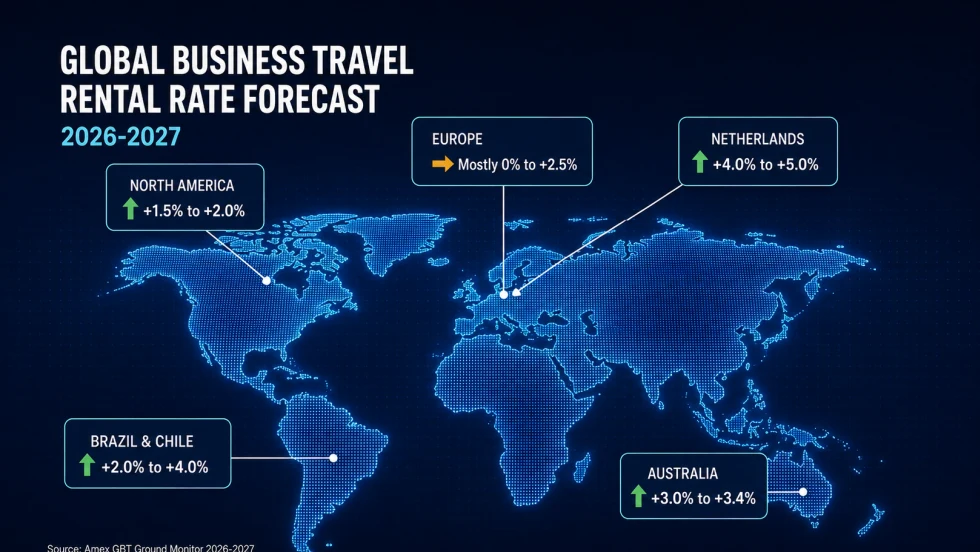
U.S. Business Travel Car Rental Rates Forecast to Rise Up to 2%
Improved fleet supply should limit pricing gains in 2026-27, while insurance, repair costs, and softer residual values continue to pressure rental operations, according to Amex GBT.
Read More →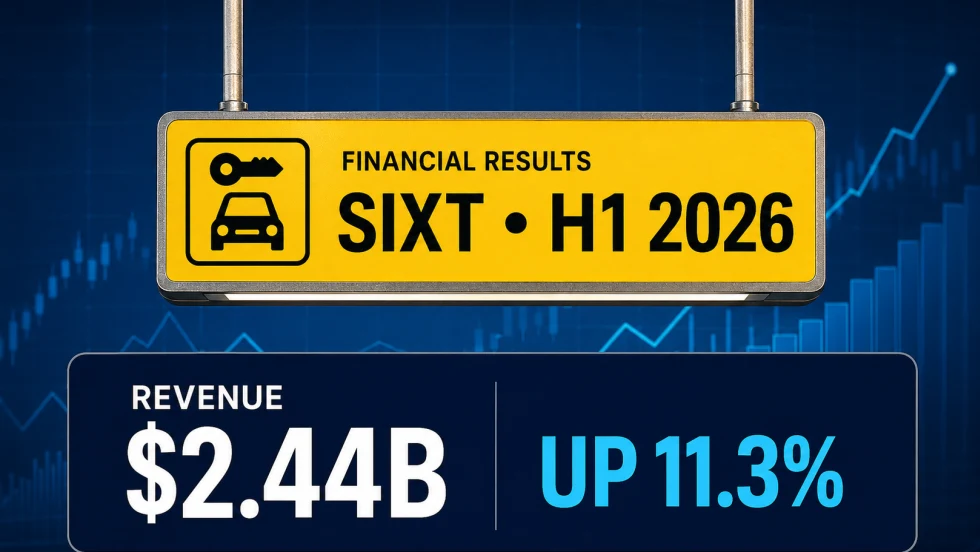
Sixt Revenue Tops $2.4 Billion in First Half of 2026
Sixt’s first-half revenue surpassed $2.4 billion for the first time as demand outpaced fleet growth, lifting utilization and earnings despite weaker consumer sentiment in North America.
Read More →
In Memoriam: Bobby Klyce, Avis Licensee Legend
The longtime Birmingham Avis operator and 2018 Auto Rental News Impact Award recipient was remembered as an advocate for independent licensees and the broader car rental industry.
Read More →
How to Build Custom Fleet Tools With AI and Vibe Coding [Webinar]
A new Automotive Fleet webinar explores how fleet managers are using AI and vibe coding to automate routine work and create simple operational tools without traditional programming skills.
Read More →