





More Travel Trends: Business Travel Growth Forecasted to Decline
Travel Industry Rebound: Leisure is Back, Business Spending Struggles
As the travel industry recovers, leisure is on track to see 2019 levels by 2023, while business spending lags behind. Here’s a look at overall trends and the shifting international inbound profile.
December 28, 2022

The travel industry is well on its way to recovery to 2019 levels, but business travel lags way behind leisure's comeback.
Photo: Canva
4 min to read
Many travel industry associations and experts project “cautious optimism” about the industry’s recovery post-pandemic, but economic conditions and geopolitical headwinds — including inflation, interest rates, global conflicts, and oil prices — may put a damper on this. The U.S. Travel Association’s latest forecast shows that the overall travel recovery, driven largely by domestic leisure travel, will remain relatively resilient to economic conditions due to pent-up demand and consumer savings.
Did Zoom Kill Business Travel?
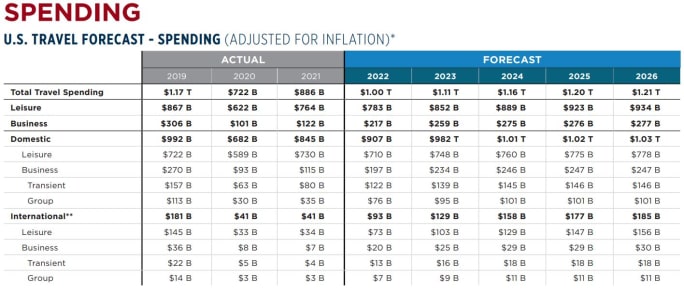
U.S. Travel estimates that $1 trillion will be spent on travel in the United States in 2022, which is 15% below 2019 levels and 16% below where it should have been in 2022 if not for the pandemic.
Overall, total travel spending in the U.S. is expected to almost return to pre-pandemic levels by 2024, but business travel’s recovery will see an even harder struggle than leisure with a long way to go.
U.S. Travel Forecast - Spending
Sources: Tourism Economics and U.S. Travel Association, fall 2022
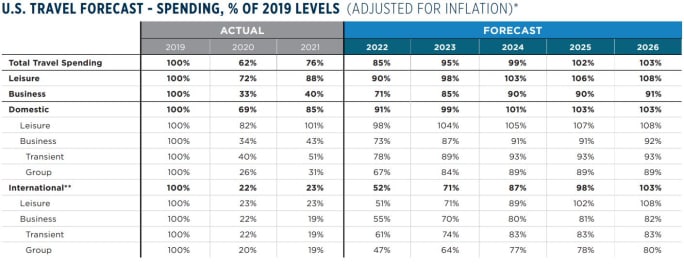
In 2019, $306 was spent billion on U.S. business travel, and 2022 spending is predicted to be just $217 billion, only incrementally increasing each year and not surpassing 2019 even through 2026. Yet the total leisure market, which was $867 billion in 2019, will more than recover by 2024 and be 108% over 2019 by 2026.
U.S. Travel Forecast – Spending % Change
Sources: Tourism Economics and U.S. Travel Association, fall 2022
International Inbound Profile Shifts: Where Did All the Renters Go?
To no one’s surprise, the pandemic greatly affected travel, and overseas arrivals data proves this point.
According to the U.S. Department of Commerce’s National Travel & Tourism Office (NTTO), historically, overseas arrivals accounted for nearly half of the total international arrivals through 2019. But with the dramatic decline in overseas travel to the U.S. in 2020, that declined to 40%. With the slow recovery in 2021, it accounted for 41.5% of all international arrivals to the country.
In 2021, the U.S. saw 22.1 million international arrivals. Of that, 9.2 million were overseas arrivals, which was up 21% from 2020 levels.
We’re headed in the right direction but still have so far to go.
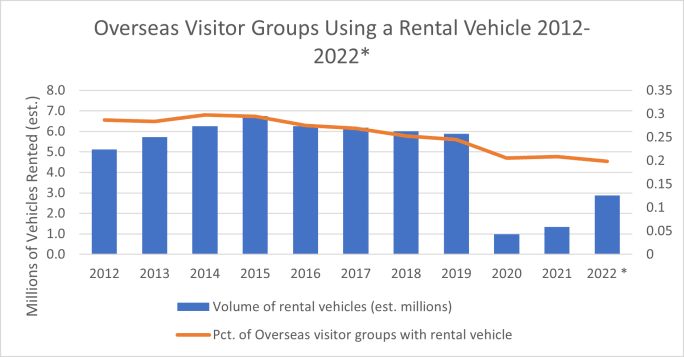
* All 2022 overseas visitation estimates are preliminary. Overseas includes all countries except Canada and Mexico. Overseas share of travelers renting cars is also a preliminary estimate based upon first six months of 2022 projected to year-end.
Source: U.S. Department of Commerce, National Travel & Tourism Office, October 2022
2015 was the peak year for car rentals by overseas travelers, with 13.7 million people renting a car. Since then, overseas use has declined for five straight years, dropping 83% in 2020 to just under 2 million. In 2021, we saw a slow recovery when 2.4 million overseas travelers rented a car.
Looking at the characteristics of overseas travelers who rented cars while in the country can provide insights rental car companies can use to develop further recovery plans and entice overseas travelers.
When focusing on which country’s visitors rented cars historically, the U.K. had been the top overseas market through 2019. Brazil and Germany generally followed, with some shifts from South Korea. Japan China generally took fifth place. Then, with the dramatic decline of 83% in the number of overseas car rentals in 2020, Brazil became the top market followed by South Korea, the U.K., Japan, and Germany. In 2021, it shifted again, and Colombia became the top market, followed by Argentina, Germany, the U.K., and Brazil. In 2015, the U.K. had 1.9 million travelers renting cars. That was followed by Brazil with 1.4 million and Germany with 1.3 million. By 2021, Colombia’s 376,000 visitors rented cars, followed by Argentina with 125,000.
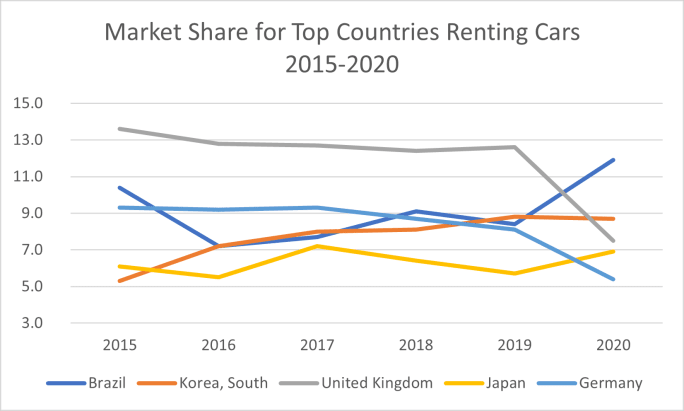
There was a dramatic decline in the number of overseas car rentals in 2020, with several shifts since.
Source: U.S. Department of Commerce, National Travel & Tourism Office, October 2022
According to the NTTO, 72% of visiting auto renters listed vacation as one of their purposes of trips, which is down only slightly from 77.7% in 2019. Visiting friends & relatives increased in 2021, which coincides with an increase in the usage of private/company autos while traveling — and with U.S. Travel Association data.
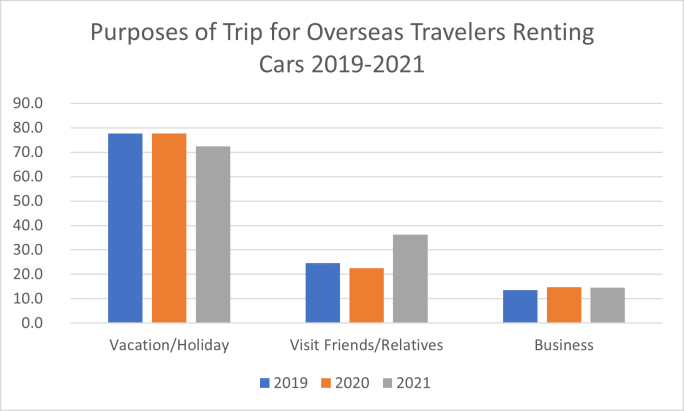
Source: U.S. Department of Commerce, National Travel & Tourism Office, October 2022
Other notable changes over the past few years were that the advance trip decision time fell from 116 days to 67 days in 2021. And the percent of first-time travelers to the U.S. dropped from 17.5% to 7.6% in 2021. In contrast, the length of stay of those who did travel in 2021 increased to 19 nights, up from 15 nights in 2019, showing a trend of quality over quantity. The number of travelers who only visited one state increased from 66% in 2019 to 75% in 2021, which could contribute to the decline in the need for a rental car.
The preliminary estimates for 2022 show growth in use of rental cars is growing just slightly slower than the 149% projected increase in overseas visitors. As the overseas visitor market continues to change, visit NTTO’s website for the latest data.
Subscribe to Our Newsletter
More Rental Operations

How Did This Independent Rental Operator Grow to 170 Vehicles in 4 Years?
With 170 vehicles across three Kentucky locations, Joel Price relies on an overseas team to handle reservations, payments, and after-hours customer service. It's one part of an unconventional approach to growing an independent rental operation.
Read More →
What Does It Take to Succeed in B2B Rentals?
The fundamentals may be familiar to daily car rental operators, but project-based truck rentals put different demands on the fleet and the business.
Read More →
NPR Builds on International Partnerships to Grow Rental Bookings
With Ana Laborde supporting broker development, NPR Auto Group is tailoring distribution strategies, rate packages, and partnerships to grow international reservations across its three brands.
Read More →
Advantage, Sixt Place Among Top Five in Annual Satisfaction Study
While Enterprise and National retain the top spots in JD Power’s 2026 rankings, the latest customer satisfaction results suggest renters can find competitive service beyond the biggest car rental names.
Read More →
The $100,000 Insurance Trap in Exotic Car Rentals
Exotic rental agencies often rely on customers’ personal auto policies to protect six-figure vehicles. But policy language can dramatically change the coverage for vehicles over $100,000 MSRP.
Read More →
The Booking Is Confirmed, But Is Your Customer Ready to Drive?
For international renters, a confirmed reservation doesn’t always mean they’re eligible to drive. Earlier checks can help operators catch documentation and payment issues before the customer reaches the counter.
Read More →
ICRS 2027 Opens Call for Papers
The International Car Rental Show seeks session proposals on the business, operational, and technology issues facing car rental operators. Submissions are due Jan. 15.
Read More →
Turo to Launch Vehicle Delivery Service
Turo Delivered will let travelers search for vehicles that hosts can deliver directly to hotels, homes, airports, train stations, and other locations.
Read More →
Palm Beach Airport Code Change Creates Car Rental Distribution Gap
A test of rental searches under the old PBI and new DJT airport codes returned largely different sets of brands and vehicles, highlighting a potential distribution problem for rental operators.
Read More →
U-Save Continues Dominican Republic Expansion with Launch in Punta Cana
The new franchise location builds on U-Save’s existing Santo Domingo operation and will begin taking reservations for October 2026.
Read More →