



Tweeting 4 Biz
Before you hash up your next Twitter promotion, check out this primer on the do's and don'ts of hashtagging.
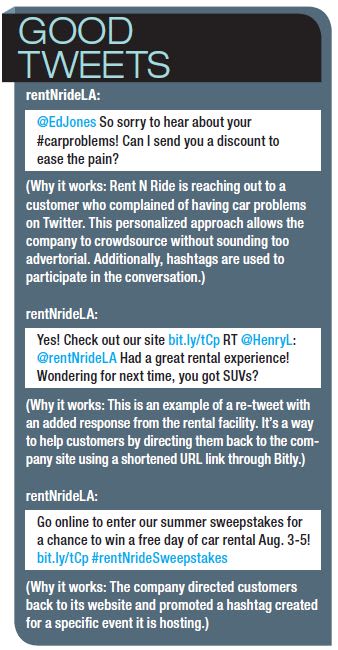
Examples of good tweets.
Twitter has become an essential part of any company’s marketing strategy, assisting with everything from increasing visibility to crowdsourcing.
Within the realm of Twitter, one of the most powerful tools is the hashtag, or “#” symbol, followed by one or more words — without spaces or punctuation — relevant to a specific topic.
Auto Rental News spoke with two social media experts about their experiences with Twitter and how they have seen it directly benefit automotive businesses across the country.
Paul Potratz is the CEO of Potratz Automotive Advertising and Jim Flint is the corporate director of interactive sales and marketing for John Eagle Dealerships, as well as president and founder of digital marketing firm Local Search Group. Here are a few of their Twitter do’s and don’ts.
Do Be Part Of The Conversation
One of the primary ways to achieve success through Twitter is to make sure each tweet — from the wording down to the tagging — is relevant. Twitter’s style is “conversational,” so participating in that conversation is key.
Flint likens appropriate Twitter dialogue to the way one would behave at a cocktail party. As attendees move in and out of conversations, they listen before interjecting.
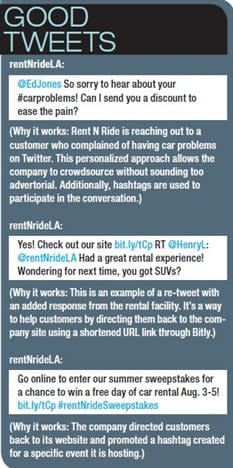
Examples of good tweets.
Do Create Your Own Hashtag
Some businesses are successful at creating their own hashtags, but doing so requires research. Start by using existing hashtags to create a community presence. Use Twitter’s hashtag search feature to find out which keywords and tags are the most popular.
Once you get a feel for hashtags, start creating your own. Monitor these hashtags using that same search feature on Twitter to determine which ones receive the most attention.
Integrate hashtags into the company’s marketing plan. Tell customers to follow a certain hashtag in marketing literature. Put the hashtag on your website and embed it into your email signature, for example.
Do Use Hashtags To Crowdsource
Hashtags can be engaging in smaller, more specific dialogues. “Most people who want to be involved in conversations about certain topics will hashtag it,” Potratz notes, adding that you will find more success reaching out to those already interested.
However, when reaching out, a proper response requires a personal touch. Address the user’s specific needs, and maybe attach a coupon, discount or rental car information. “It’s a chance to connect to them if we can fix their problem,” Potratz says.
Don’t Write A Novel
Twitter limits each tweet to 140 characters, but you probably don’t need that many. Use as few characters as possible, leaving more room for hashtags, which improves the tweet’s searchability.
Potratz advises to make sure tweets aren’t all about the “sale.” While it’s acceptable to link to your company’s site, you risk losing readers if you over-promote.
In addition, try to add pictures or videos relevant to your topic.
[PAGEBREAK]
Don’t Rely On Automation
Software or apps for social media management, such as HootSuite, can be useful tools if your goal is to simply maintain a presence. By doing this, however, you’re not actively engaged in the Twitter conversation. “Tweets are the easiest thing to deprioritize,” Flint says. “But that’s just a phase we go through.”
He adds that businesses typically go through three major phases when first familiarizing themselves with Twitter.
Phase 1: You say you’re going to start tweeting, but never get around to it.
Phase 2: You begin tweeting, but only generically, on your own terms and with predisposed and prepopulated components — usually via automated systems.
Phase 3: You realize Phase Two was ineffective, so you have to start participating in the conversation.
Flint advises businesses to aim for the third phase immediately. “Don’t do social, be social,” he says.
Don’t Over-Hashtag
Both Flint and Potratz agree that it’s important to not over-tag tweets. Overloading on them is advertorial and off-putting.
More importantly, search engines will actually disregard posts carrying too many hashtags and will treat them like spam, Potratz says. His rule of thumb is no more than two hashtags per tweet.
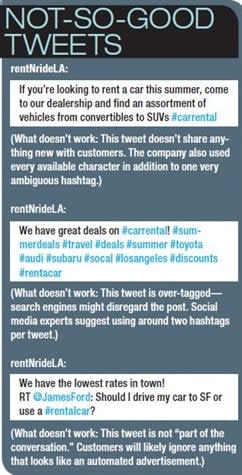
Examples of tweets that probably won't be as effective.
Don’t Treat Twitter Like Facebook
Each social media site offers customers a unique experience. Because Twitter operates in real time, the methods one would use to communicate with fans on Facebook don’t always apply.
Flint says that you shouldn’t just post tweets to Facebook or vice versa.
Don’t Just Re-Tweet
Re-tweeting via Twitter takes two forms: Companies can simply “re-tweet,” which takes another user’s tweet and posts it to their Twitter page verbatim, or they can post what’s called a “quote tweet,” which is a re-tweet that adds commentary to the user’s original post.
You can also reply to tweets, which gives you a fresh tweet slate and tags the original commenters so they can see the reply.
Potratz advises companies to reserve straight re-tweeting for interesting, standalone comments. For all other tweets, including customer feedback, companies should “quote-tweet” or reply to tweets to build a customer relationship.
More Rental Operations

Palm Beach Airport Code Change Creates Car Rental Distribution Gap
A test of rental searches under the old PBI and new DJT airport codes returned largely different sets of brands and vehicles, highlighting a potential distribution problem for rental operators.
Read More →
U-Save Continues Dominican Republic Expansion with Launch in Punta Cana
The new franchise location builds on U-Save’s existing Santo Domingo operation and will begin taking reservations for October 2026.
Read More →
When AI Books the Rental Car, Who Controls the Sale?
As AI moves from comparing rental rates to completing transactions, operators need to understand how travelers find, interpret, rank, and ultimately see their offers. (Part 2 of 2.)
Read More →
European Booked Car Rental Rates Fell 5%, Results Varied by Country
Ireland, Cyprus, and the United Kingdom saw steep declines, while booked rates rose in Poland and Hungary.
Read More →
Is It Time to Rethink Rental Categories?
As traditional economy and compact cars disappear from the market, longtime rental operator Mike DeLorenzo asks whether the industry’s familiar vehicle categories still make sense — and what operators need to rethink along with them.
Read More →
Who Owns the Rate? AI Is Creating a New Distribution Problem for Car Rental
Generative Engine Optimization asks whether AI can find a rental company, but operators also need to know whether the agent inspected enough of the market, compared equivalent offers, and presented a rate the traveler can actually book. (Part 1 of 2)
Read More →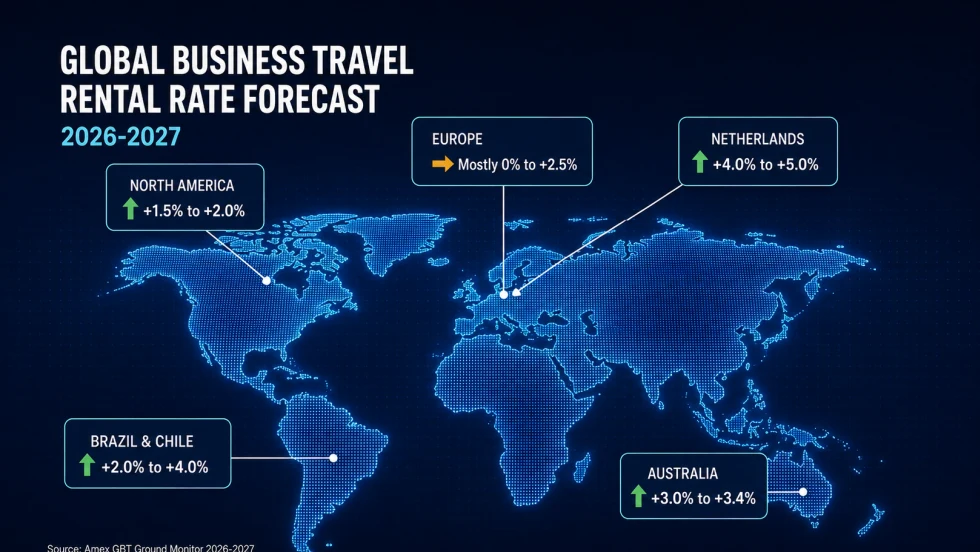
U.S. Business Travel Car Rental Rates Forecast to Rise Up to 2%
Improved fleet supply should limit pricing gains in 2026-27, while insurance, repair costs, and softer residual values continue to pressure rental operations, according to Amex GBT.
Read More →
Sixt Revenue Tops $2.4 Billion in First Half of 2026
Sixt’s first-half revenue surpassed $2.4 billion for the first time as demand outpaced fleet growth, lifting utilization and earnings despite weaker consumer sentiment in North America.
Read More →
In Memoriam: Bobby Klyce, Avis Licensee Legend
The longtime Birmingham Avis operator and 2018 Auto Rental News Impact Award recipient was remembered as an advocate for independent licensees and the broader car rental industry.
Read More →
How to Build Custom Fleet Tools With AI and Vibe Coding [Webinar]
A new Automotive Fleet webinar explores how fleet managers are using AI and vibe coding to automate routine work and create simple operational tools without traditional programming skills.
Read More →