




Calif., NY Rank Worst in Business Tax Climates
California, New Jersey and New York ranked worst in the Tax Foundation’s 2014 State Business Tax Climate Index.
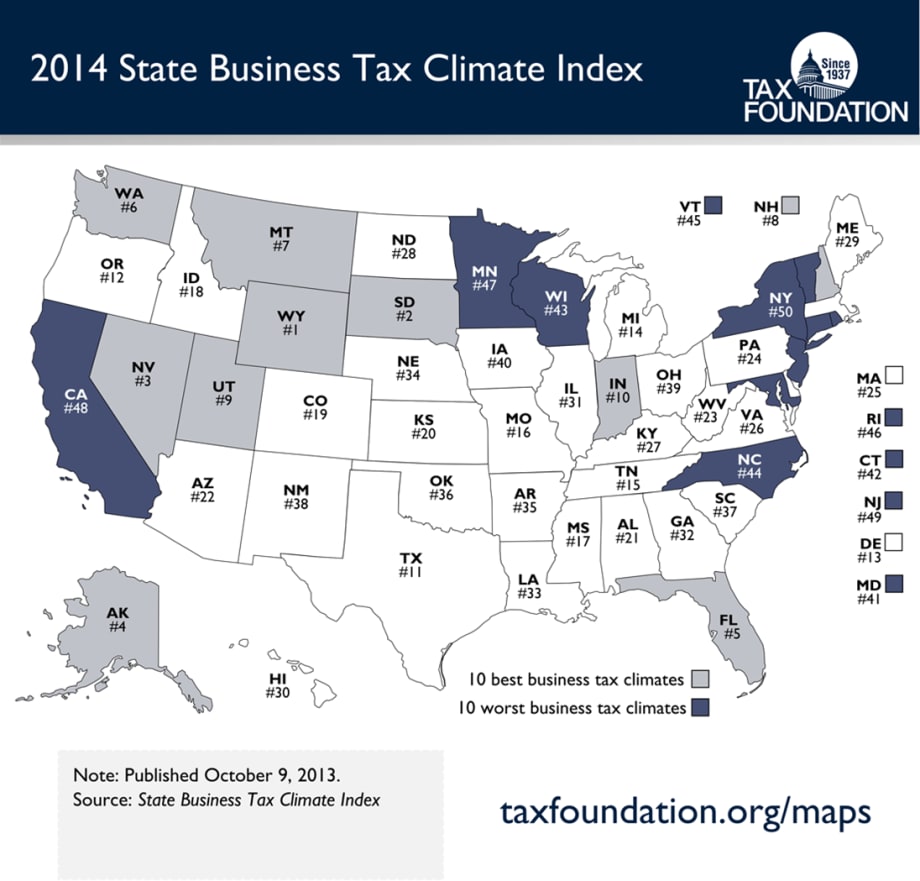
Source: State Business Tax Climate Index
The Tax Foundation has released its 2014 State Business Tax Climate Index.
Several states have moved in the rankings since last year. Texas dropped out of the top 10 for the first time, landing at No. 11, and Virginia and Kentucky both fell three places to #26 and #27, respectively. On the positive side, Arizona climbed five ranks to #22 and Kansas moved six spots to #20.
“The states that lost ground this year usually did so because they changed policy in a way that makes the tax code more complex, burdensome or economically harmful,” said Tax Foundation Economist Scott Drenkard. “By contrast, the states that improved did so because they are moving closer to a tax code that collects revenue without unnecessarily distorting business decisions. Their tax codes became more neutral.”
Now in its 10th edition, the State Business Tax Climate Index collects data on over a hundred tax provisions for each state and synthesizes them into a single, easy-to-use score. Then the states are compared against each other, so that each state’s ranking is relative to actual policies in place in other states around the country.
A state’s ranking can rise or fall significantly based not just on its own actions, but also on the changes or reforms made by other states, according to the Tax Foundation.
For 2014, the top 10 states are Wyoming (#1), South Dakota (#2), Nevada (#3), Alaska (#4), Florida (#5), Washington (#6), Montana (#7), New Hampshire (#8), Utah (#9) and Indiana (#10). And the 10 lowest ranked states are Maryland (#41), Connecticut (#42), Wisconsin (#43), North Carolina (#44), Vermont (#45), Rhode Island (#46), Minnesota (#47), California (#48), New Jersey (#49) and New York (#50).
“The goal of the State Business Tax Climate Index is to start a conversation with policymakers about how their states fare against the rest of the country,” said Drenkard. “With this report, we’re asking: ‘how well is your tax code structured? Are businesses in your state spending too much time complying with onerous tax provisions? Are you double taxing things you shouldn’t?’”
The Tax Foundation is a nonpartisan research organization that has monitored fiscal policy at the federal, state and local levels since 1937. For more information on the 2014 State Business Tax Climate Index, visit http://taxfoundation.org/article/2014-state-business-tax-climate-index.
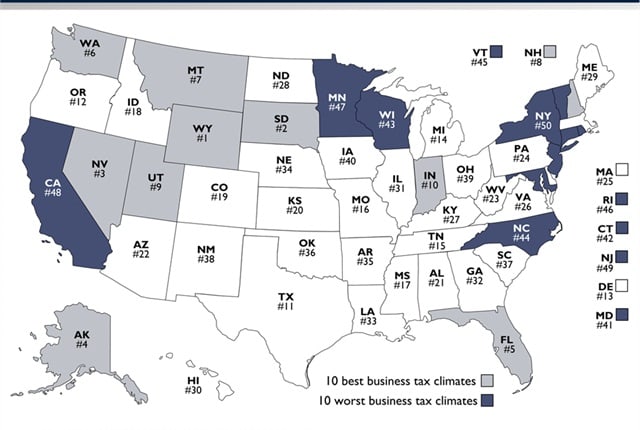
Source: State Business Tax Climate Index
More Rental Operations

Direct, Broker or Hybrid? How Travel Retailers Source Rental Cars
As travel retailers weigh direct supplier relationships against third-party distribution, rental operators need to understand how those decisions affect their business.
Read More →
How Did This Independent Rental Operator Grow to 170 Vehicles in 4 Years?
With 170 vehicles across three Kentucky locations, Joel Price relies on an overseas team to handle reservations, payments, and after-hours customer service. It's one part of an unconventional approach to growing an independent rental operation.
Read More →
What Does It Take to Succeed in B2B Rentals?
The fundamentals may be familiar to daily car rental operators, but project-based truck rentals put different demands on the fleet and the business.
Read More →
NPR Builds on International Partnerships to Grow Rental Bookings
With Ana Laborde supporting broker development, NPR Auto Group is tailoring distribution strategies, rate packages, and partnerships to grow international reservations across its three brands.
Read More →
Advantage, Sixt Place Among Top Five in Annual Satisfaction Study
While Enterprise and National retain the top spots in JD Power’s 2026 rankings, the latest customer satisfaction results suggest renters can find competitive service beyond the biggest car rental names.
Read More →
The $100,000 Insurance Trap in Exotic Car Rentals
Exotic rental agencies often rely on customers’ personal auto policies to protect six-figure vehicles. But policy language can dramatically change the coverage for vehicles over $100,000 MSRP.
Read More →
The Booking Is Confirmed, But Is Your Customer Ready to Drive?
For international renters, a confirmed reservation doesn’t always mean they’re eligible to drive. Earlier checks can help operators catch documentation and payment issues before the customer reaches the counter.
Read More →
ICRS 2027 Opens Call for Papers
The International Car Rental Show seeks session proposals on the business, operational, and technology issues facing car rental operators. Submissions are due Jan. 15.
Read More →
Turo to Launch Vehicle Delivery Service
Turo Delivered will let travelers search for vehicles that hosts can deliver directly to hotels, homes, airports, train stations, and other locations.
Read More →
Palm Beach Airport Code Change Creates Car Rental Distribution Gap
A test of rental searches under the old PBI and new DJT airport codes returned largely different sets of brands and vehicles, highlighting a potential distribution problem for rental operators.
Read More →