




Hertz Posts Positive EBITDA in Q1
Hertz Global Holding’s adjusted EBITDA in the U.S. of $24 million in the first quarter of 2021 is truly a remarkable achievement.

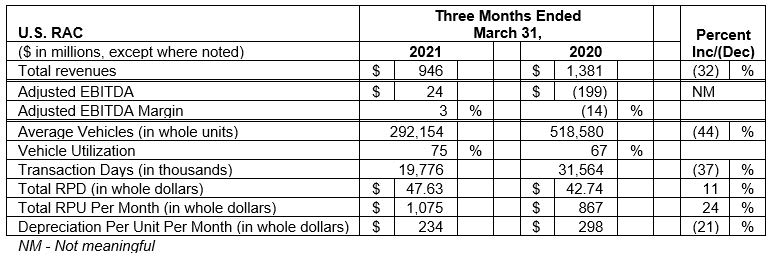
On lower fleet size, Hertz realized strong gains in the U.S. in revenue per day (RPD) and revenue per unit, per month (RPU).
"This quarter we realized the first effects of the leisure travel rebound and capitalized on strong demand-driven pricing in destination markets that exceeded 2019 levels," said Paul Stone, Hertz Global's president and CEO in a May 7 statement announcing first quarter 2021 results. "We're continuing to see improved demand and are optimistic about a sustained recovery.”
It’s okay to call this an understatement, owing to what Hertz has been through over the last 12 months: a bankruptcy, the accidental burning of 3,500 rental cars, senior management turnover, de-listing from the New York Stock Exchange, and a much-scrutinized Chapter 11 equity raise.
Hertz’s Q1 global revenues are no surprise: Total revenues of $1.289 billion are down a staggering — but expected — 39.5% compared to Q1 2020, the last “normal” quarter before the pandemic.
Yet Hertz still managed positive adjusted corporate EBITDA of $2 million, compared with minus $243 million in the same quarter last year. In the U.S., Hertz’s largest market and the one experiencing the biggest rebound, Hertz pulled in adjusted EBITDA of $24 million.
International dragged down the strong U.S. performance, as Europe and South America are still under the pandemic’s grip. That said, Hertz saw gains in international adjusted EBITDA over the previous year’s quarter.
Hertz’s performance is a testament to the ability of the car rental industry to engage in cost-cutting measures that other travel sectors can’t as easily. Certainly, being able to sell into the stratospherically high used car market is a primary factor in this recovery. Airlines, cruise operators, and hotels don’t have the same luxury.
Hertz’s performance is also remarkable when compared to Avis Budget Group. Avis posted a better overall adjusted EBITDA of $47 million in the first quarter on $1.37 billion in revenues, though it was able to avoid Hertz’s more severe fleet cuts and store closures. Both companies posted their best first quarter adjusted EBITDA since 2015.
Hertz’s per-unit metrics were solid too, befitting an environment of tight supply and returning demand last seen exiting the Great Recession. In the first quarter in the U.S., Hertz recorded per-unit gains in revenue per day (RPD) and revenue per unit, per month (RPU). In RPD, Hertz realized an 11% gain quarter over quarter ($47.63 per car in Q1 2021 compared to $42.74 in Q1 2020) and a 24% gain in RPU, from $867 in Q1 2020 to $1,075 in this year’s first quarter.
As a result of this strong performance and leaner, more efficient operations heading into strong demand, Hertz finds itself in a bidding war that includes shareholder recovery, unusual for a Chapter 11 exit. A Monday auction is scheduled.
During the quarter, Hertz also closed on the sale of its fleet leasing and management subsidiary Donlen to Athene Holding for $891 million. Liquidity at the end of the first quarter was $1.1 billion.
More Rental Operations

Advantage, Sixt Place Among Top Five in Annual Satisfaction Study
While Enterprise and National retain the top spots in JD Power’s 2026 rankings, the latest customer satisfaction results suggest renters can find competitive service beyond the biggest car rental names.
Read More →
The $100,000 Insurance Trap in Exotic Car Rentals
Exotic rental agencies often rely on customers’ personal auto policies to protect six-figure vehicles. But policy language can dramatically change the coverage for vehicles over $100,000 MSRP.
Read More →
The Booking Is Confirmed, But Is Your Customer Ready to Drive?
For international renters, a confirmed reservation doesn’t always mean they’re eligible to drive. Earlier checks can help operators catch documentation and payment issues before the customer reaches the counter.
Read More →
ICRS 2027 Opens Call for Papers
The International Car Rental Show seeks session proposals on the business, operational, and technology issues facing car rental operators. Submissions are due Jan. 15.
Read More →
Turo to Launch Vehicle Delivery Service
Turo Delivered will let travelers search for vehicles that hosts can deliver directly to hotels, homes, airports, train stations, and other locations.
Read More →
Palm Beach Airport Code Change Creates Car Rental Distribution Gap
A test of rental searches under the old PBI and new DJT airport codes returned largely different sets of brands and vehicles, highlighting a potential distribution problem for rental operators.
Read More →
U-Save Continues Dominican Republic Expansion with Launch in Punta Cana
The new franchise location builds on U-Save’s existing Santo Domingo operation and will begin taking reservations for October 2026.
Read More →
When AI Books the Rental Car, Who Controls the Sale?
As AI moves from comparing rental rates to completing transactions, operators need to understand how travelers find, interpret, rank, and ultimately see their offers. (Part 2 of 2.)
Read More →
European Booked Car Rental Rates Fell 5%, Results Varied by Country
Ireland, Cyprus, and the United Kingdom saw steep declines, while booked rates rose in Poland and Hungary.
Read More →
Is It Time to Rethink Rental Categories?
As traditional economy and compact cars disappear from the market, longtime rental operator Mike DeLorenzo asks whether the industry’s familiar vehicle categories still make sense — and what operators need to rethink along with them.
Read More →