




Toyota Motor Corp. Expands Car Sharing Tests in Japan
The newest car sharing pilot program is part of an urban transportation system called Ha:mo, which is supposed to represent a 'harmonious mobility' network between people and where they live. Ha:mo will first establish four, unmanned car sharing stations in Toyota City.
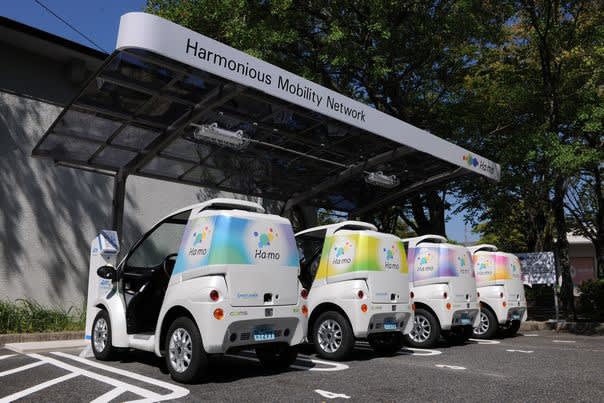
The Ha:mo Ride EV-sharing station. Starting this month, four unmanned stations will be established in Toyota City.
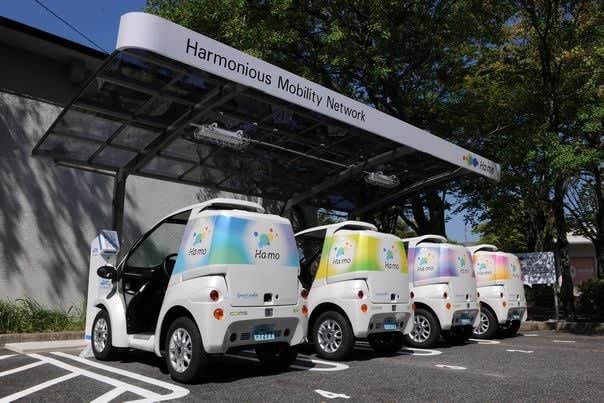
The Ha:mo Ride EV-sharing station. Starting this month, four unmanned stations will be established in Toyota City.
Toyota Motor Corp. (TMC), in cooperation with the Toyota City, Japan municipal government, transportation companies and others, announced on Oct. 1 that it began tests of an urban transportation system called “Ha:mo.”
The system will select optimal means of transport for users based on the operational status of public transport systems and traffic conditions, TMC said. In addition, car sharing stations are to be installed at four locations within Toyota City, providing a car sharing service using “COMS” ultra-compact single-occupant electric vehicles (EVs) manufactured by Toyota Auto Body Co. Ltd.
The system for the tests comprises two elements: “Ha:mo Navi,” which links transportation systems to enable a seamless search for transportation routes, and “Ha:mo Ride”, an ultra-compact EV sharing service designed to accommodate short-distance travel in urban areas.
Ha:mo Navi
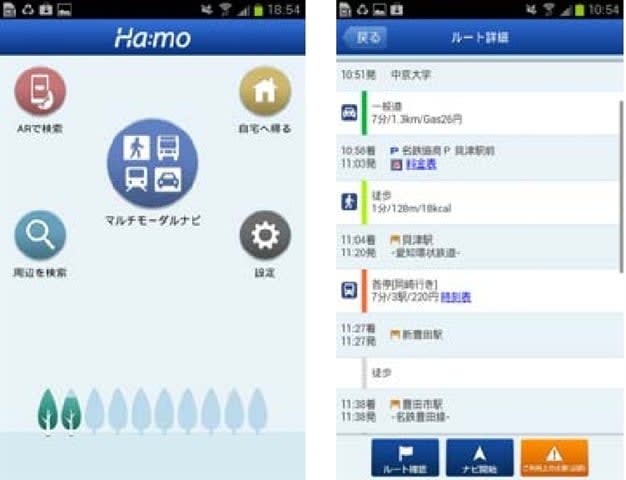
Ha:mo Navi smartphone application home screen (left) and suggested route screen (right).
Ha:mo Navi provides transportation alternatives based on forecasts of transportation supply and demand, and also links independently operated public transportation and cars, according to TMC.
Operation of the following Ha:mo Navi services will begin this month:
Multi-modal route guide for smartphones that searches for the optimal combination of multiple means of transport — such as trains, buses, cars and taxis — while taking into consideration traffic congestion.
Provision of park-and-ride facility information, such as parking space availability, when personal vehicle use is included in a search.
Provision of “eco-points” based on park-and-ride facility and public transportation use.
Integrating Ha:mo with Current TMC Car Sharing Initiatives
In June 2011, TMC announced a six-car pilot program also in Toyota City and in Aichi in partnership with Nomura Real Estate Development Co. Ltd., Daikyo Inc. and Toyota Housing Corp. The program provided six Prius Plug-in Hybrids to three condominiums and aims at testing an energy data management system (EDMS) to lower overall transportation system energy use.
The condominium pilot program is being managed by nearby Toyota vehicle rental and leasing locations.
The collaboration between the EDMS and new Ha:mo program will include transportation route calculations that consider the battery status of plug-in hybrid vehicles (PHEVs) of households participating in the project, as well as regional electric power demand.
Ha:mo Ride
Ha:mo Ride will seek to provide users vehicle and public transportation for short-distance travel from a train station to the user’s destination through the sharing of ultra-compact EVs. The initiative is also a part of the EDMS trials.
Starting in October 2012, unmanned vehicle-sharing stations will be established at four locations in Toyota City — two at Chukyo University and one each at Josui Station on the Nagoya Railroad and Kaizu Station on the Aichi Loop Line. A one-way travel car sharing service will run among the vehicle stations with ten COMS EVs.
The service will initially be available to approximately 100 members made up of Chukyo University students and employees, who will use smartphones for vehicle reservations and IC cards for vehicle access. To promote wide and regular use, there will be no charge for the first year of service.
Plans call for the service area to be extended throughout central Toyota City, with the number of stations to be increased to between 10 and 20, the number of vehicles to approximately 100 and the number of members to approximately 1,000. At that time, Ha:mo is planned to be changed to a fee-based service.
In the near future, the route information provided by Ha:mo Navi will be combined with the EV sharing information provided by Ha:mo Ride to give users access to integrated route information and travel history-based recommendations.
Inclusion of Yamaha Motor Co. Ltd. electric commuter bikes and electrically power-assisted bicycles in the system is also being considered. TMC also plans, within the EDMS framework, to promote off-peak power use through the management of vehicle charging.
The Ha:mo tests were selected as part of the Next-Generation Energy and Social System Demonstration Projects sponsored by Japan’s Ministry of Economy, Trade and Industry. The tests are being conducted under the Toyota City Low-Carbon Verification Project in cooperation with: Aichi Loop Line Co. Ltd.; Aichi Rapid Transit Co. Ltd.; Chukyo University; Hitachi Ltd.; Meitetsu Bus Co. Ltd.; Meitetsucom Co. Ltd.; Meitetsu Kyosho Ltd.; Nagoya Railroad Co. Ltd.; Toyota City; and Yamaha Motor Co. Ltd.
The term Ha:mo is being given to TMC-developed systems that seek to provide a “harmonious mobility” network among people and where they live.
More Rental Operations

How Did This Independent Rental Operator Grow to 170 Vehicles in 4 Years?
With 170 vehicles across three Kentucky locations, Joel Price relies on an overseas team to handle reservations, payments, and after-hours customer service. It's one part of an unconventional approach to growing an independent rental operation.
Read More →
What Does It Take to Succeed in B2B Rentals?
The fundamentals may be familiar to daily car rental operators, but project-based truck rentals put different demands on the fleet and the business.
Read More →
NPR Builds on International Partnerships to Grow Rental Bookings
With Ana Laborde supporting broker development, NPR Auto Group is tailoring distribution strategies, rate packages, and partnerships to grow international reservations across its three brands.
Read More →
Advantage, Sixt Place Among Top Five in Annual Satisfaction Study
While Enterprise and National retain the top spots in JD Power’s 2026 rankings, the latest customer satisfaction results suggest renters can find competitive service beyond the biggest car rental names.
Read More →
The $100,000 Insurance Trap in Exotic Car Rentals
Exotic rental agencies often rely on customers’ personal auto policies to protect six-figure vehicles. But policy language can dramatically change the coverage for vehicles over $100,000 MSRP.
Read More →
The Booking Is Confirmed, But Is Your Customer Ready to Drive?
For international renters, a confirmed reservation doesn’t always mean they’re eligible to drive. Earlier checks can help operators catch documentation and payment issues before the customer reaches the counter.
Read More →
ICRS 2027 Opens Call for Papers
The International Car Rental Show seeks session proposals on the business, operational, and technology issues facing car rental operators. Submissions are due Jan. 15.
Read More →
Turo to Launch Vehicle Delivery Service
Turo Delivered will let travelers search for vehicles that hosts can deliver directly to hotels, homes, airports, train stations, and other locations.
Read More →
Palm Beach Airport Code Change Creates Car Rental Distribution Gap
A test of rental searches under the old PBI and new DJT airport codes returned largely different sets of brands and vehicles, highlighting a potential distribution problem for rental operators.
Read More →
U-Save Continues Dominican Republic Expansion with Launch in Punta Cana
The new franchise location builds on U-Save’s existing Santo Domingo operation and will begin taking reservations for October 2026.
Read More →