




COVID-19 Survey: Rates, Revenues, Optimism Rebound in Q3
The latest Auto Rental News coronavirus survey tells the story of an industry that was initially devastated by the pandemic but is in an encouraging — if slow and uneven — process of recovery.


Auto Rental News has tabulated the results of its third survey deployed to assess the impacts of the coronavirus pandemic. The survey was sent to independent and franchised (non-corporate) U.S. car rental operators and garnered 87 responses. It was conducted beginning Oct. 9 and tabulated on Nov. 10.
The results of this survey, taken with the previous two (tabulated April 14 and May 19), tell the story of an industry that was initially devasted by the pandemic but is in an encouraging — if slow and uneven — process of recovery.
The respondents in this survey were 38% franchise and 51% independent (along with 8% dealership and 3% identifying as other). A plurality (30%) had fleet sizes of 100 to 499 units, with 23% from 50 to 99 units and 17% reporting greater than 500 units.
In terms of customer base, respondents were divided between 40% off-airport/neighborhood and 33% serving airport customers, with the remainder serving leisure destinations, dealerships, and exotic rental customers. The average full-time employee count was 19 and part-time was seven.
Staff Stabilization
As of April 14, the pandemic’s effect was clear. By the time the first survey was tabulated (April 14), 83% of respondents said they had reduced staff hours. Of that group, 57% reported reducing hours by 51% to 100%, with 14% of respondents reducing staff 100%, indicating they closed their businesses, at least temporarily.
Note that in that first survey, 15% of respondents said that their government had forced them to shut down their business as a part of COVID-19 safety measures. By the second survey, a 8% of respondents indicated a 100% reduction in hours.
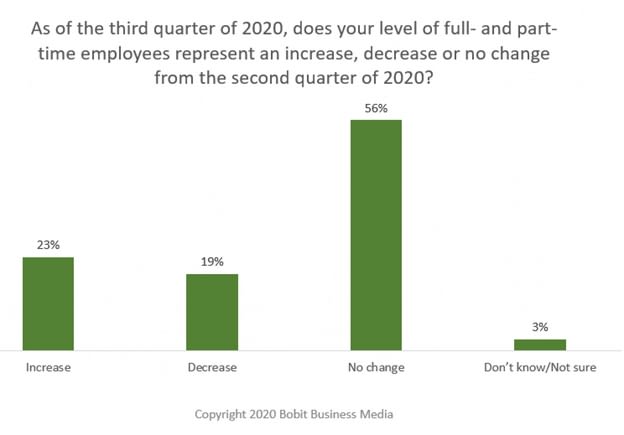
The final survey (tabulated Nov. 10) reveals a stabilization in staffing. In that survey, a majority of respondents reported that their staffing levels had at least stayed the same from the second into the third quarters, with more respondents increasing their staffing (23%) compared decreasing.
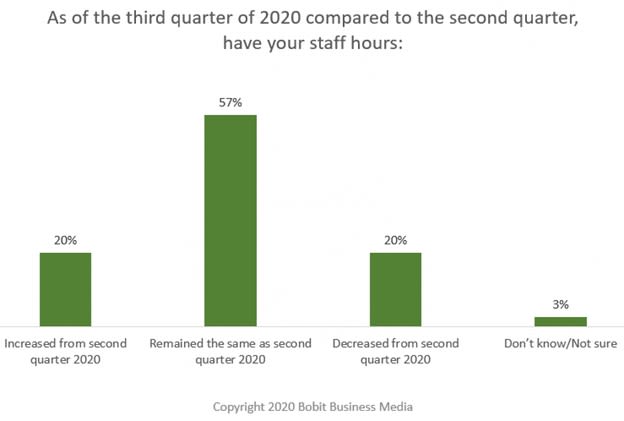
Mirroring the response on employee count, a majority of respondents said that they kept their staff hours the same from the second to the third quarters, while an even percentage of respondents either increased hours (20%) or decreased hours (20%). The key takeaway – operators are meeting the increase in third-quarter business with static staffing levels and hours.
Fleet Gains
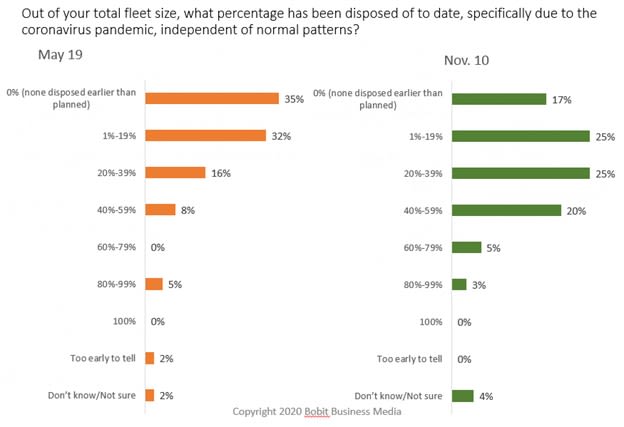
As business almost ground to a halt by mid-April, the great majority of respondents couldn’t shed fleet because the wholesale market’s infrastructure ground to a halt too. By the second quarter, operators were still faced with business losses, but the lack of new and used supply and constriction of auction lanes generated red hot prices. Car rental consignors took advantage.
By the third quarter — usually the busiest for car rental — operators were instead selling fleet. Note that 37% to 48% of respondents acquire all of their vehicles as risk units as opposed to through manufacturers’ repurchase programs.
Revenue Recovery
In the first survey, half of respondents said their first quarter revenue was down by 51% to 100%. (Note that the pandemic hit in the second half of the quarter.)
By the second survey, the revenue drop had accelerated, with 76% of respondents saying revenue had decreased 51% to 100%. The third quarter revealed the green shoots of recovery — compared to the third quarter of 2019, 45% said their revenue decreased to a lesser extent (0% to 50%).
Remarkably, 14% said revenue hadn’t declined in the period, while 14% said revenue had actually increased.

Pricing Shifts
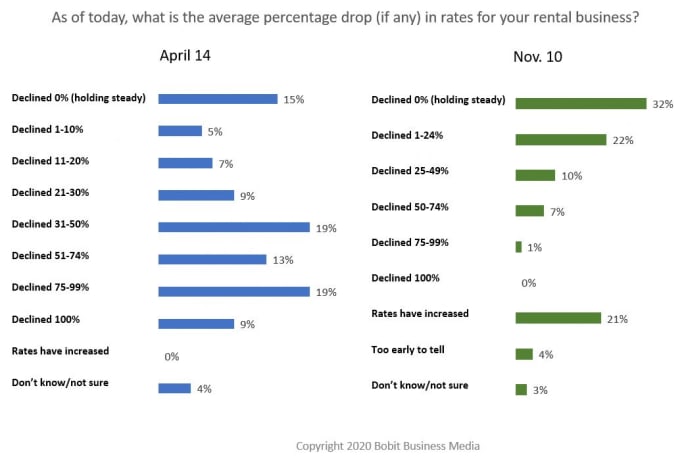
Car rental pricing shows a more dramatic recovery from the first to third surveys, for the specific reason that operators were able to shed fleet, allowing demand to outpace supply by the third quarter.
Year Ahead
The final questions in the third survey speak to the optimism (or lack thereof) of the car rental industry moving forward. While encouraging to see that the most selected response states that the respondent is on the road to recovery, it is not a majority, and 32% say “it’s too early to tell.”
And while respondents believe their company in particular will recover, it’s an almost even split between those that believe the industry in general will recover and those that won’t. (Note that these questions were not asked in the first two surveys.)

Similar to the previous question, more respondents identified as optimistic about the future than the other choices, and only 6% identified as pessimistic. However, the other two choices taken together reveal that 59% of respondents are still uncertain and are taking a “wait-and-see” approach.
More Rental Operations

What Does It Take to Succeed in B2B Rentals?
The fundamentals may be familiar to daily car rental operators, but project-based truck rentals put different demands on the fleet and the business.
Read More →
NPR Builds on International Partnerships to Grow Rental Bookings
With Ana Laborde supporting broker development, NPR Auto Group is tailoring distribution strategies, rate packages, and partnerships to grow international reservations across its three brands.
Read More →
Advantage, Sixt Place Among Top Five in Annual Satisfaction Study
While Enterprise and National retain the top spots in JD Power’s 2026 rankings, the latest customer satisfaction results suggest renters can find competitive service beyond the biggest car rental names.
Read More →
The $100,000 Insurance Trap in Exotic Car Rentals
Exotic rental agencies often rely on customers’ personal auto policies to protect six-figure vehicles. But policy language can dramatically change the coverage for vehicles over $100,000 MSRP.
Read More →
The Booking Is Confirmed, But Is Your Customer Ready to Drive?
For international renters, a confirmed reservation doesn’t always mean they’re eligible to drive. Earlier checks can help operators catch documentation and payment issues before the customer reaches the counter.
Read More →
ICRS 2027 Opens Call for Papers
The International Car Rental Show seeks session proposals on the business, operational, and technology issues facing car rental operators. Submissions are due Jan. 15.
Read More →
Turo to Launch Vehicle Delivery Service
Turo Delivered will let travelers search for vehicles that hosts can deliver directly to hotels, homes, airports, train stations, and other locations.
Read More →
Palm Beach Airport Code Change Creates Car Rental Distribution Gap
A test of rental searches under the old PBI and new DJT airport codes returned largely different sets of brands and vehicles, highlighting a potential distribution problem for rental operators.
Read More →
U-Save Continues Dominican Republic Expansion with Launch in Punta Cana
The new franchise location builds on U-Save’s existing Santo Domingo operation and will begin taking reservations for October 2026.
Read More →
When AI Books the Rental Car, Who Controls the Sale?
As AI moves from comparing rental rates to completing transactions, operators need to understand how travelers find, interpret, rank, and ultimately see their offers. (Part 2 of 2.)
Read More →