




Avis Rankles South Florida Limo Operators
Regulatory divide between chauffeured and rental car industries spurs calls for fairer playing field by limo operators.
Last year Avis Budget Group partnered with WeDriveU to create Avis Chauffeur Drive, which connects rental cars with drivers for customers who want chauffeured service. Now South Florida limo operators are contesting the rules that govern this business model.
Because Avis Budget is not classified as a limousine operator, it is not required to license its chauffeurs or meet the stricter safety requirements of the limousine and chauffeured transportation industry. One consequence is that Avis has to pay less for licensing and labor.
Such disparities prompted a meeting of South Florida limo operators and local regulators from Palm Beach, Broward and Miami-Dade counties in late September. The meeting, hosted and organized by the Florida Limousine Association, drew about 20 operators/association members along with various code compliance officers, airport law enforcement officers and consumer affairs officials.
“Our only concern is that as a new competitor Avis should be regulated as we are,” said NLA President Richard Kane, who attended the meeting. “Now, Avis goes around that public safety net of three or four decades. It uses a technical loophole by nature of its core business, rental car, to get into chauffeured transportation without registering as a chauffeured transportation operator.”
“What happened in the meeting has implications for the entire industry,” Kane said. “In the event local regulators allow them to do this, you’ll see chauffeured transportation companies no longer renewing their licenses, and they will create two separate companies. They will create and market a rental car company and they also will employ a chauffeur service. Therefore, they can be competitive.”
Under such an arrangement, a client would “rent” a limousine from a vehicle company, and then a chauffeur would be assigned from a chauffeur service company. Kane said some operators already have told him they would prefer the Avis business model since it’s simpler and more efficient.
That means limousine companies would no longer employ full-time chauffeurs and would deal with subcontracted chauffeurs only.
Avis (who declined an interview for this story) provides its own vehicles and hires chauffeurs from WeDriveU. This results in the need for two contracts to hire the car with chauffeur, said Ray Garcia, president of the Florida Limousine Association. Avis classifies its cars as private and not vehicles for hire. The WeDriveU chauffeurs are not required to complete the numerous and costly background checks, attend the classes or get the driver identification cards that are required of all chauffeurs in all counties, Garcia said.
Regulators told the operators they realize there is a problem and that they need time to research applicable ordinances and provisions.
Florida Ground Transportation Association President Carla Boroday has called for immediate action to make sure Avis complies. For South Florida operators, a quick resolution is critical since the Avis market intrusion already has hurt business. In one week alone, Avis provided 78 cars and 78 drivers for a convention at Miami’s Intercontinental Hotel, for an entire week, 24 hours a day, Garcia said.
Kane said the NLA opposes any measure or situation that compromises the safety of passengers. The NLA would prefer to maintain the current regulatory and safety structure, and make sure Avis complies. The regulatory disparities can only be addressed at the local level since there are no federal authorities, administrative rules or legislation that govern this issue. “Unfortunately, every one of these regulatory agencies has a different way of doing things,” he said.
The NLA plans to send letters to as many local officials as possible about the need for consistent regulations for chauffeured and rental vehicle services. The Avis issue in South Florida also has emerged in many major cities, including San Francisco, Houston and New York, in particular.
While Kane said he personally does not agree with the Avis business model and approach, there are chauffeured transportation owner-operators who believe Avis is leading the path to deregulation at a local level. “I’ve heard from 20 companies,” Kane said. “If Avis is allowed to do this, they will follow. It changes the whole game.”
Martin Romjue is the editor of LCT, Limousine & Chauffered Transportation Magazine.
To subscribe to Auto Rental News magazine, click here.
More Rental Operations

Palm Beach Airport Code Change Creates Car Rental Distribution Gap
A test of rental searches under the old PBI and new DJT airport codes returned largely different sets of brands and vehicles, highlighting a potential distribution problem for rental operators.
Read More →
U-Save Continues Dominican Republic Expansion with Launch in Punta Cana
The new franchise location builds on U-Save’s existing Santo Domingo operation and will begin taking reservations for October 2026.
Read More →
When AI Books the Rental Car, Who Controls the Sale?
As AI moves from comparing rental rates to completing transactions, operators need to understand how travelers find, interpret, rank, and ultimately see their offers. (Part 2 of 2.)
Read More →
European Booked Car Rental Rates Fell 5%, Results Varied by Country
Ireland, Cyprus, and the United Kingdom saw steep declines, while booked rates rose in Poland and Hungary.
Read More →
Is It Time to Rethink Rental Categories?
As traditional economy and compact cars disappear from the market, longtime rental operator Mike DeLorenzo asks whether the industry’s familiar vehicle categories still make sense — and what operators need to rethink along with them.
Read More →
Who Owns the Rate? AI Is Creating a New Distribution Problem for Car Rental
Generative Engine Optimization asks whether AI can find a rental company, but operators also need to know whether the agent inspected enough of the market, compared equivalent offers, and presented a rate the traveler can actually book. (Part 1 of 2)
Read More →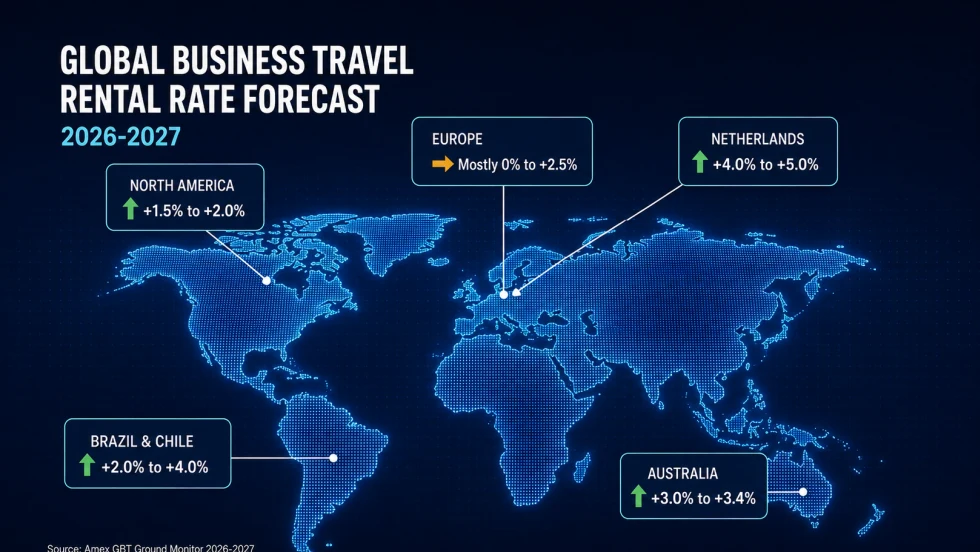
U.S. Business Travel Car Rental Rates Forecast to Rise Up to 2%
Improved fleet supply should limit pricing gains in 2026-27, while insurance, repair costs, and softer residual values continue to pressure rental operations, according to Amex GBT.
Read More →
Sixt Revenue Tops $2.4 Billion in First Half of 2026
Sixt’s first-half revenue surpassed $2.4 billion for the first time as demand outpaced fleet growth, lifting utilization and earnings despite weaker consumer sentiment in North America.
Read More →
In Memoriam: Bobby Klyce, Avis Licensee Legend
The longtime Birmingham Avis operator and 2018 Auto Rental News Impact Award recipient was remembered as an advocate for independent licensees and the broader car rental industry.
Read More →
How to Build Custom Fleet Tools With AI and Vibe Coding [Webinar]
A new Automotive Fleet webinar explores how fleet managers are using AI and vibe coding to automate routine work and create simple operational tools without traditional programming skills.
Read More →