





Related News: U.S. Car Rental Revenue Crosses $40 Billion
U.S. Length Of Rental (LOR) Declines Slightly in Q1 2026
LOR related to insurance claims overall continues to trend downward, but ongoing market and economic conditions could affect future results while the industry deals with staffing and productivity challenges.
May 7, 2026
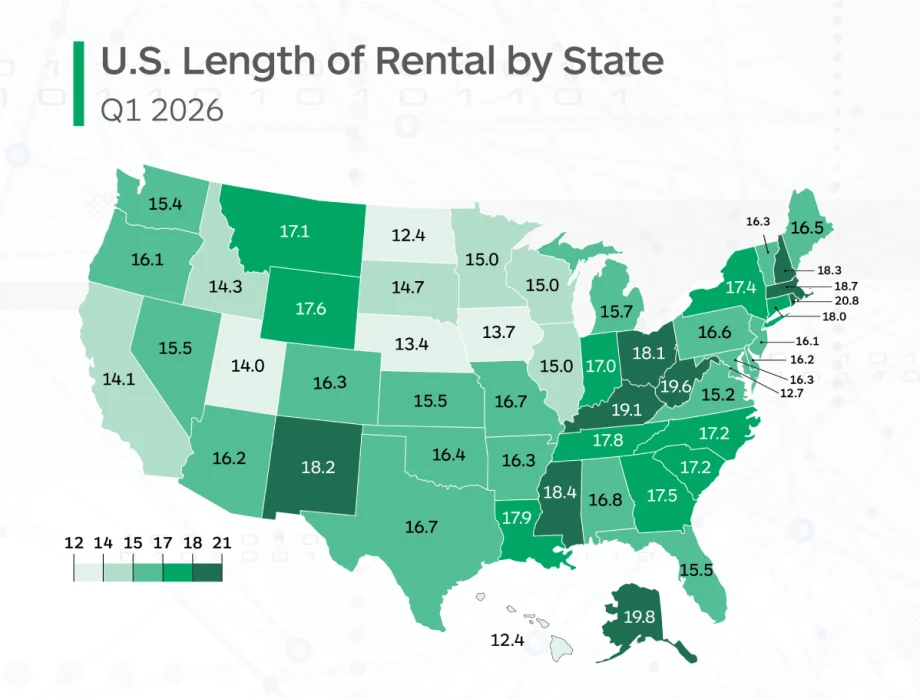
Despite recent decreases, rental length remains above pre-pandemic levels, compared with 13.2 days in Q1 2020 and 12.8 days in Q1 2019.
Credit:
Enterprise Mobility
3 min to read
The average length of rental (LOR) for collision-related insurance claims in the U.S. declined slightly in the first quarter of 2026, according to Enterprise.
Overall rental length averaged 16.3 days in Q1 2026, down 0.4 days from the same period a year earlier. The decline follows a 0.9-day drop in Q1 2025. Despite recent decreases, rental length remains above pre-pandemic levels, compared with 13.2 days in Q1 2020 and 12.8 days in Q1 2019.
John Yoswick of CRASH Network said shorter repair backlogs may be contributing to the decline. He noted average shop backlogs were about 1.8 weeks in January, down from 2.6 weeks a year earlier.
Fewer than 10% of shops reported backlogs of four weeks or more, while 18% said they had no backlog and could schedule work immediately. Backlogs varied by region, with the West reporting the shortest delays and the Northeast among the longest.
State results varied widely. Rhode Island recorded the highest overall LOR at 20.8 days, followed by Alaska at 19.8 days and West Virginia at 19.6 days. The lowest averages were in Hawaii and North Dakota at 12.4 days, and the District of Columbia at 12.7 days. Rhode Island and Wyoming posted the largest increases from a year earlier, while Oklahoma recorded the largest decline.
Parts availability continues to influence repair times.
Greg Horn of PartsTrader said delivery times showed mixed changes across states, confirming that parts delays remain a key driver of longer rental periods. He added that shortages of automotive-grade aluminum could increase delays in obtaining replacement panels.
Ryan Mandell of Mitchell International said the share of parts being repaired rose to 16.2% in Q1 2026 from 14.4% a year earlier, while the use of alternative parts increased to 41.6% from 39.5%. He said these trends can help reduce cycle times and contribute to shorter rental periods. He also noted average deductibles increased slightly but appear to be stabilizing.
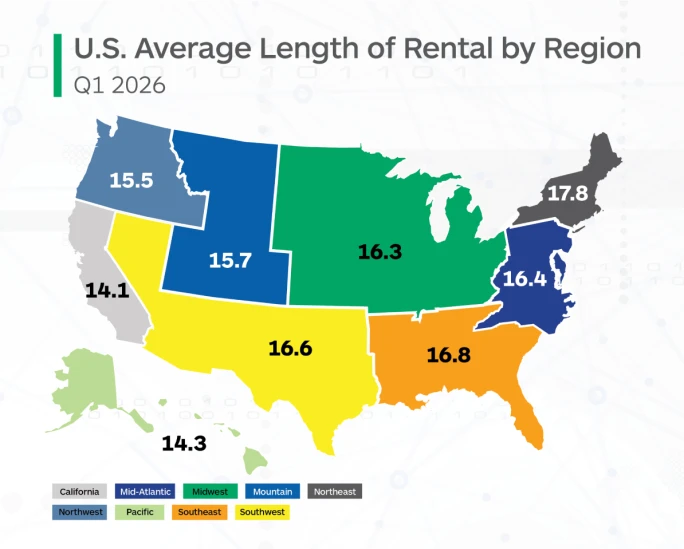
California showed the lowest regional LOR in Q1 2025 at 14.1 days.
Credit:
Enterprise Mobility
Drivable Claims
For drivable claims, LOR averaged 15 days, down 0.2 days from Q1 2025. Rhode Island had the highest drivable LOR at 19.4 days, followed by Alaska at 17.7 days, and Kentucky and Massachusetts at 17.4 days. North Dakota recorded the lowest at 10.6 days, followed by Hawaii at 11 days and the District of Columbia at 11.4 days.
Minnesota and Wyoming saw the largest increases, each rising by 1.1 days, while Ohio and Rhode Island each increased by about one day. Sixteen states and the District of Columbia reported increases. Oklahoma recorded the largest decline at 2.5 days, followed by Colorado at 2.3 days. Seven other states posted declines of more than one day.
Non-Drivable Claims
For non-drivable vehicles, LOR averaged 22.4 days, down 0.5 days year over year. Alaska had the highest LOR at 29.7 days, followed by West Virginia at 28.8 days and Vermont at 27.1 days. The District of Columbia recorded the lowest at 18.5 days, followed by Nebraska at 19.6 days and California at 19.8 days.
Wyoming posted the largest increase at 2.8 days. Vermont, Rhode Island, North Dakota, Montana and Iowa also recorded increases of more than one day. Thirteen additional states saw smaller increases. Sixteen states and the District of Columbia reported decreases, led by Oregon with a 2.8-day decline, followed by Nebraska and New Mexico.
Total Loss Claims
For total loss claims, LOR averaged 14.9 days, down 0.1 days from Q1 2025. West Virginia recorded the highest LOR at 19.4 days, followed by South Dakota at 18.8 days and New Hampshire at 17.8 days. Iowa had the lowest at 12.8 days, followed by North Dakota at 12.9 days and Florida at 13.2 days.
South Dakota posted the largest increase, up 5.7 days year over year. Rhode Island and Vermont also saw notable increases. Alaska recorded the largest decrease at 3.3 days, followed by Alabama and Hawaii.
More Rental Operations

Advantage, Sixt Place Among Top Five in Annual Satisfaction Study
While Enterprise and National retain the top spots in JD Power’s 2026 rankings, the latest customer satisfaction results suggest renters can find competitive service beyond the biggest car rental names.
Read More →
The $100,000 Insurance Trap in Exotic Car Rentals
Exotic rental agencies often rely on customers’ personal auto policies to protect six-figure vehicles. But policy language can dramatically change the coverage for vehicles over $100,000 MSRP.
Read More →
The Booking Is Confirmed, But Is Your Customer Ready to Drive?
For international renters, a confirmed reservation doesn’t always mean they’re eligible to drive. Earlier checks can help operators catch documentation and payment issues before the customer reaches the counter.
Read More →
ICRS 2027 Opens Call for Papers
The International Car Rental Show seeks session proposals on the business, operational, and technology issues facing car rental operators. Submissions are due Jan. 15.
Read More →
Turo to Launch Vehicle Delivery Service
Turo Delivered will let travelers search for vehicles that hosts can deliver directly to hotels, homes, airports, train stations, and other locations.
Read More →
Palm Beach Airport Code Change Creates Car Rental Distribution Gap
A test of rental searches under the old PBI and new DJT airport codes returned largely different sets of brands and vehicles, highlighting a potential distribution problem for rental operators.
Read More →
U-Save Continues Dominican Republic Expansion with Launch in Punta Cana
The new franchise location builds on U-Save’s existing Santo Domingo operation and will begin taking reservations for October 2026.
Read More →
When AI Books the Rental Car, Who Controls the Sale?
As AI moves from comparing rental rates to completing transactions, operators need to understand how travelers find, interpret, rank, and ultimately see their offers. (Part 2 of 2.)
Read More →
European Booked Car Rental Rates Fell 5%, Results Varied by Country
Ireland, Cyprus, and the United Kingdom saw steep declines, while booked rates rose in Poland and Hungary.
Read More →
Is It Time to Rethink Rental Categories?
As traditional economy and compact cars disappear from the market, longtime rental operator Mike DeLorenzo asks whether the industry’s familiar vehicle categories still make sense — and what operators need to rethink along with them.
Read More →