




Cover Story:Simplifying Car Rental Operations
How New Tech Can Quicken Car Rental Operations
AI’s use of data and smarter cars can enhance the business brainpower to spot problems, save time, and deliver superior service.
January 12, 2026
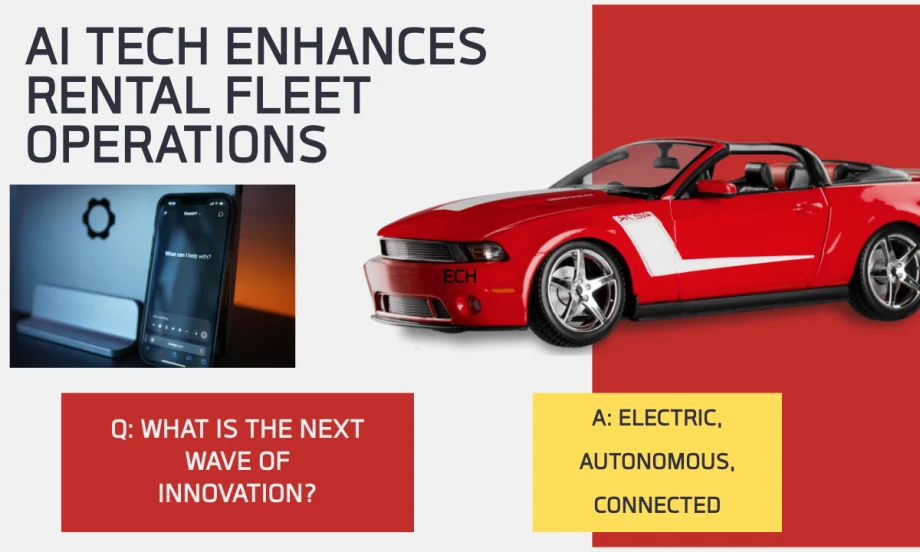
Fleets of all sizes can leverage AI and data to improve efficiency, reduce costs, and drive revenue growth.
Credit: Auto Rental News
8 min to read
- AI technology can analyze data to identify issues within car rental operations.
- Smarter cars integrate advanced systems to streamline processes and improve efficiency.
- Enhanced business intelligence through tech leads to time savings and better customer service.
*Summarized by AI
Artificial intelligence (AI) and connected vehicle technology are only starting to transform car rental operations as their potential grows.
When used in the right proportions, AI and connected-car innovations can engage customers, align pricing and revenue with real-time opportunities, and support safety and compliance while reducing risk.
AI enables smarter decision-making for rental fleets of all sizes, while connected vehicles provide real-time data and direct insights from the road. Meanwhile, car renters benefit from more personalized, seamless rental experiences.
It all points to a more precise, data-driven approach to business that frees up time to focus on customers more likely to return for repeat rentals.
These technological advances were leading topics at the 2025 International Car Rental Show in Las Vegas, where a range of experts and speakers took to the stage to educate rental car operators on how to adapt and manage their fleets.
This report details some of these insights and explains how new tools will deliver advances that yield smoother operations and greater profits.
AI Tools Boost Success
Integrating AI into car rental operations can automate processes, generate more accurate information, and increase efficiency. Fleets of all sizes can leverage AI and data to improve efficiency, reduce costs, and drive revenue growth.
AI has evolved from neural networks to GPT (generative pre-trained transformer) models, producing accurate data that avoids “hallucinations” while enabling practical applications such as live chat, automated phone systems that function like digital receptionists, and predictive maintenance.
Smaller rental fleet operators can use AI to handle customer inquiries, while larger ones may prefer to deploy it to predict and match rental car rates to customer demand.
AI will also play a deeper role in operations decision-making and anomaly detection, helping to save time and money.
Rising Interest in AI
This year, a training initiative in Brazil introduced AI concepts to over 3,000 participants from 300 rental companies across 14 cities.
Rental operators face challenges across sales, marketing, HR, operations, and rental fleet management. Their most common questions centered on marketing and sales.
Rental companies wanted to know how AI could strengthen advertising, generate promotional images, and enhance sales results. Operators proved eager to learn how AI can help attract and retain customers while reducing reliance on costly marketing methods.
The Evolution of AI
AI is not a brand-new concept. Some forms of AI have complemented computers since their early use. In the 1990s and 2000s, AI was often discussed in terms of neural networks and Bayesian models, while deep learning dominated the 2010s.
What has changed now is the power of hardware and algorithms like GPTs, which make AI accessible through tools such as ChatGPT. Smartphones now run faster and more powerfully than devices from five to 10 years ago.
With GPUs enabling massive data processing, AI can now generate text, images, and video in ways that were once purely theoretical. A GPU, or graphics processing unit, is a specialized processor designed to handle complex mathematical and graphical calculations rapidly.
AI is only as good as the data it receives. That means it needs consistent, accurate data to feed the AI platform, enabling it to generate relevant predictive insights.
Although AI can find patterns humans cannot, it still relies on incomplete or inaccurate datasets, such as using only one operator’s reservation history.
Incomplete data can lead to misleading results and AI hallucinations.
Real-World AI Applications in Car Rental
Among practical AI applications already delivering results, one of the most immediate is customer service automation. Live chat systems enable customers to check availability, view rates, and even complete bookings through conversational AI agents. These can operate both online and via phone IVR (interactive voice response) systems.
AI can empower agents to quickly create quotations, generate reports, and surface insights, much like an assistant that knows everything about a business.
Beyond customer service, predictive maintenance is gaining ground. By analyzing fault codes and maintenance history, AI can forecast breakdowns before they happen, reducing downtime
and costs.
Pinpointed rates are another use case, with AI helping operators adjust prices dynamically during peak periods to capture more revenue.
Scaling AI Adoption
Rental fleet operators should take a staged or phased approach to AI integration. CSV (comma-separated values) files may seem old-school, but they let operators dip their toes in before committing to costly custom projects. A CSV file is a plain text file that stores tabular data, with each line representing a row and values separated by commas.
As operators become more comfortable, they can connect AI systems directly to rental management software through APIs. This practice provides real-time access to both historical and live data, enabling deeper insights without manual uploads.
AI adoption can vary based on fleet size.
Small operators benefit most from chatbots and automated quoting, while large operators can leverage AI for demand forecasting and targeted pricing. Smaller fleet operations could apply AI to customer inquiries, while larger ones could use it to predict rates and customer demand. In multi-location, multi-thousand-car fleets, solving recurring problems with AI can deliver a sizable ROI.
Small rental fleet operators should not worry about fleet size; instead, they should leverage AI to improve safety and automate basic tasks.
AI Steers Decisions and Finds Anomalies
AI’s strength lies in spotting patterns humans miss, such as recommending when to retire cars, flagging revenue drops, and explaining spikes in damage incidents.
Detecting anomalies or mistakes is another likely future use case. AI can flag slight dips or blips and advise users to look more closely for costly or disruptive discrepancies.
Some examples where AI can boost value:
Dynamic rate adjustments during holidays generate
more revenuePredictive maintenance reduces breakdowns.
Marketing automation, such as AI-generated blog posts and images, helps operators save time while improving SEO and customer engagement.
Combining IVR systems with AI agents and API integrations with backend software can enable fully automated reservation workflows.
While AI is not a full-time panacea for operational problems, it’s rapidly becoming a vital new addition to the rental operator’s toolkit, changing weekly and monthly.
Used for a wide range of functions, such as marketing, predictive maintenance, dynamic pricing, or customer service, AI can find real opportunities to improve efficiency and profitability.
Connected Cars: The Neural Network for Car Rental
To complement AI tools, leveraging connected-car technology can enhance fleet management and the customer experience.
Telematics, for example, can predict vehicle breakdowns, streamline routes, and detect smoke in vehicles.
At ICRS, a session on connected cars brought together three major players in fleet mobility: Bosch, Geotab, and GM OnStar.
Together, they explored how connected-vehicle data can better predict maintenance needs, improve the customer experience, and leverage emerging technologies to transform rental-car operations.
Defining the Connected Dynamic
The connected car is more than a single technology — it spans an entire interconnected system. Various vendors can supply innovations beyond OEMs, embedding deeper levels of data into vehicles while bringing millions of cars onto a unified platform.
For starters, the advantages of OEM-embedded connectivity include fuel recovery data that helps rental companies recapture fractions of gallons left unfilled at return.
Remote commands such as lock, unlock, or disable can enhance security and aid vehicle recovery. In electric vehicles, connected data is essential for managing range and charging in real time.
Overall, the in-vehicle experience can increase customer satisfaction through features such as in-vehicle Wi-Fi, hands-free driving, and branded dashboard messaging, while also creating a revenue opportunity for rental companies.
Geotab, for example, accumulates and organizes billions of daily data points from its five million connected vehicles. Beyond GPS and odometer readings, Geotab uses data scientists to dig into fault codes, downtime, and usage patterns.
Predictive maintenance can generate alerts when vehicles are approaching failure or breakdown, thereby minimizing downtime and protecting operational performance. Instead of repair bills, downtime, and towing hassles, rental operators can use real-time information to keep vehicles on the road as much as possible.
Safety and Crash Reconstruction
Crash reconstruction has emerged as a vital application of connected data. Using accelerometer signals, harsh braking events, and G-force analysis, operators can receive time-stamped reports that reconstruct accidents. The information enables faster responses to renters, insurance support, and fraud detection.
Data-driven technology, for example, can capture a driver slamming the brakes at 75 mph before a crash in real time. Operators can immediately call the renter to check on their condition and see if they need a tow or a replacement vehicle.
Connected car technologies can also manage rental car problems and pain points. Bosch offers connected devices that detect smoking in vehicles using particle sensors that can distinguish between cigarettes, cigars, and vapes. By quantifying intensity, rental companies can apply fines in real time, reducing vehicle downtime. Such transparent data removes the “sniff test” guesswork and provides timely, fair enforcement.
Another feature, “battery in the cloud,” offers a digital twin that monitors EV battery health. The tool predicts degradation, recommends times to reduce fast-charging use, and issues certificates to strengthen residual value at resale.
Enhancing the Renter Experience
The future in-vehicle experience can, in many ways, resemble a high-end hotel check-in. Just as TVs greet loyalty members by name, rental cars could welcome renters with personalized screens that display weather, return tips, or loyalty offers. Such perks reinforce brand identity while boosting satisfaction scores.
GM’s Super Cruise, for example, serves both as a renter convenience and a potential revenue add-on. Hands-free driving on mapped roads offers long-distance comfort, while rental companies could charge for it as a premium feature.
Rental companies can charge renters who want that experience for the duration of their rental.
A Greater Role for Predictive Maintenance
One of the biggest opportunities in connected car advances lies in maintenance. By analyzing injector or fuel pump signals, Bosch can forecast failures 200 miles in advance. Geotab’s algorithms likewise identify high-risk fault codes that may lead to breakdowns. Together, these predictive tools allow rental companies to forecast and plan out fleet management. Rental operators can apply connected data to choose solutions and solve problems in real or faster timeframes.
Connected car technology, already shaping rental operations today, promises evermore progress, from predictive maintenance and crash reconstruction to personalized renter experiences and EV battery monitoring.
For rental operators, the problem-solving takeaways are clear: get connected, leverage data-driven insights, improve safety, satisfy customers, and achieve greater ROI across operations.
This article originally appeared in the print edition of the 2026 Auto Rental News Fact Book.
Subscribe to Our Newsletter
More Rental Operations

What Does It Take to Succeed in B2B Rentals?
The fundamentals may be familiar to daily car rental operators, but project-based truck rentals put different demands on the fleet and the business.
Read More →
NPR Builds on International Partnerships to Grow Rental Bookings
With Ana Laborde supporting broker development, NPR Auto Group is tailoring distribution strategies, rate packages, and partnerships to grow international reservations across its three brands.
Read More →
Advantage, Sixt Place Among Top Five in Annual Satisfaction Study
While Enterprise and National retain the top spots in JD Power’s 2026 rankings, the latest customer satisfaction results suggest renters can find competitive service beyond the biggest car rental names.
Read More →
The $100,000 Insurance Trap in Exotic Car Rentals
Exotic rental agencies often rely on customers’ personal auto policies to protect six-figure vehicles. But policy language can dramatically change the coverage for vehicles over $100,000 MSRP.
Read More →
The Booking Is Confirmed, But Is Your Customer Ready to Drive?
For international renters, a confirmed reservation doesn’t always mean they’re eligible to drive. Earlier checks can help operators catch documentation and payment issues before the customer reaches the counter.
Read More →
ICRS 2027 Opens Call for Papers
The International Car Rental Show seeks session proposals on the business, operational, and technology issues facing car rental operators. Submissions are due Jan. 15.
Read More →
Turo to Launch Vehicle Delivery Service
Turo Delivered will let travelers search for vehicles that hosts can deliver directly to hotels, homes, airports, train stations, and other locations.
Read More →
Palm Beach Airport Code Change Creates Car Rental Distribution Gap
A test of rental searches under the old PBI and new DJT airport codes returned largely different sets of brands and vehicles, highlighting a potential distribution problem for rental operators.
Read More →
U-Save Continues Dominican Republic Expansion with Launch in Punta Cana
The new franchise location builds on U-Save’s existing Santo Domingo operation and will begin taking reservations for October 2026.
Read More →
When AI Books the Rental Car, Who Controls the Sale?
As AI moves from comparing rental rates to completing transactions, operators need to understand how travelers find, interpret, rank, and ultimately see their offers. (Part 2 of 2.)
Read More →