


About The Author
Neil Abrams is president of Abrams Consulting Group Inc.
 MENU
MENU SEARCH
I see an uncanny ability of the rental industry to remake itself to fit the contour of the automotive and travel landscape, and even the culture of the times.

Few actively working in the auto rental industry today can look back over their shoulders at the evolution of our industry over the past 40 years and reflect on just how we arrived at the place the business exists today — and where we appear to be headed.
I have the dubious distinction of being one of those ancient souls. Sometimes nervous at the shaky platform upon which the auto rental model seems to be built, and at other times incredulous as to the ingenuity we find within ourselves to follow a ray of light through a darkened tunnel and come out the other side intact, stronger and smarter than ever.
What prompts me today to reflect on such high-minded concepts as the cyclicality of business?
It’s simple. The other day, the following headline crossed my screen: “Ride-hailing company Lyft partners with Hertz.” My first response was, “Say what?” My second response was, “What took them so long?”
Hertz’s agreement with Lyft — the No. 2 company behind Uber in this quickly expanding ride-hailing segment of the personal mobility industry — provides Hertz vehicles to Lyft drivers for a daily fee. Is it inevitable that Hertz acquires Lyft? Maybe cash-rich Uber, with its global aspirations and deep pockets, acquires Avis Budget Group? Think of the synergies.
Also, think of the mandate for the legacy rental brands to strive to be ahead of the curve — or left in the dust, like other large companies in major industries. Anyone remember American Motors?
When I went to work for Hertz Rent A Car in 1976, there were three companies controlling 90% of the domestic airport market: Hertz, Avis and National. Hertz was owned by RCA Corp. Avis’s parent was conglomerate Norton Simon and National’s owner was Household Finance.
Car rental was and still is a good cash flow business, which many of these holding companies needed. More importantly, the Investment Tax Credit provided significant tax benefits to investors in high-end capital goods such as automobiles — until the IRS modified it to the extent that it no longer provided that significant benefit. Subsequently, each of the brands went through a series of ownerships, structural changes and business combinations that have continued to this day.
Given the totality of these changes that have impacted auto rental for my four decades as an observer, I see an uncanny ability of the industry to slowly, strategically transform — if not remake itself to fit the contour of the automotive and travel landscape, and even the culture of the times.
Through recessions, quixotic thinking among the domestic manufacturers that led to acquisitions of the major rental brands, self-serving repurchase deals and then the manufacturers’ divestiture of the same rental company holdings, all the major players still stand — barely recognizable — but in a good way.
And ironically, similar to 1976, three corporations control 95% of the market.
This brings us back to where we started. Is the U.S. auto rental industry continuing to morph in subtle yet perceptible ways so that, if we look back 40 years from now, it will no longer be recognizable?
With the autonomous vehicle, the age of the Jetsons is upon us. Let’s layer on top new technologies that eliminate rental staff and facilities altogether. And car-hailing, which eliminates the stress of stepping out in a heavily-trafficked street, arm extended skyward, hoping to be acknowledged and blessed by a kindly, compassionate taxi driver.
Put all of these ingredients in a shaker and consider what the personal mobility industry might look like in 10 years: Hertz, Avis, or Enterprise managing fleets of hundreds of thousands of autonomous vehicles, each of which are summoned, dispatched and secured by virtual technologies, regardless of location — airport, urban, suburban, rural. Then renters are billed and vehicles are redeployed upon completion of the rental, whether it is 15 minutes or 15 days. Just imagine!
Alternatively, is the next stage in our evolution another Allegis Corp.? Don’t know what that is? Do the research. As they say, the only constant is change. If not before, I’ll check back with you in 10 years to see what the rental industry looks like. It should be interesting!
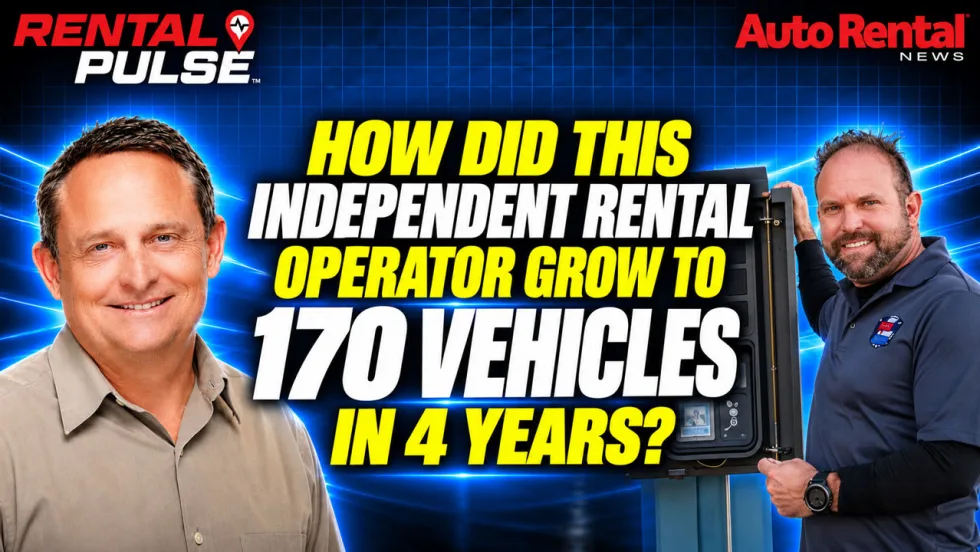
With 170 vehicles across three Kentucky locations, Joel Price relies on an overseas team to handle reservations, payments, and after-hours customer service. It's one part of an unconventional approach to growing an independent rental operation.
Read More →
The fundamentals may be familiar to daily car rental operators, but project-based truck rentals put different demands on the fleet and the business.
Read More →
With Ana Laborde supporting broker development, NPR Auto Group is tailoring distribution strategies, rate packages, and partnerships to grow international reservations across its three brands.
Read More →
While Enterprise and National retain the top spots in JD Power’s 2026 rankings, the latest customer satisfaction results suggest renters can find competitive service beyond the biggest car rental names.
Read More →
Exotic rental agencies often rely on customers’ personal auto policies to protect six-figure vehicles. But policy language can dramatically change the coverage for vehicles over $100,000 MSRP.
Read More →
For international renters, a confirmed reservation doesn’t always mean they’re eligible to drive. Earlier checks can help operators catch documentation and payment issues before the customer reaches the counter.
Read More →
The International Car Rental Show seeks session proposals on the business, operational, and technology issues facing car rental operators. Submissions are due Jan. 15.
Read More →
Turo Delivered will let travelers search for vehicles that hosts can deliver directly to hotels, homes, airports, train stations, and other locations.
Read More →
A test of rental searches under the old PBI and new DJT airport codes returned largely different sets of brands and vehicles, highlighting a potential distribution problem for rental operators.
Read More →
The new franchise location builds on U-Save’s existing Santo Domingo operation and will begin taking reservations for October 2026.
Read More →