





Related: $279 a Day to Rent a Car In NYC? There’s More to the Story
What the Lyft-Sixt Deal Could Mean to Car Rental and Mobility
Lyft gets a ready supply of vehicles while Sixt gets an alternative outlet for its fleet — yet this partnership’s potential long-term evolution could be the true art in this deal.
August 5, 2020

In this scenario, Lyft touches the rental customer first through the Lyft app, but doesn’t own the process, as the customer picks up and returns the car at Sixt locations.
Photo via Lyft.
4 min to read
When Lyft came out with its trial run daily rental service last year, two divergent thoughts sprang to mind: First, one of the world’s largest players in ride hailing is bringing its demand algorithms and consumer-engagement expertise to an industry that could use both. Why’d it take so long, and how fast will it penetrate?
Second, Lyft is only just learning about fleet, and fleet expertise is the backbone of any operation that churns hundreds of four-wheeled assets every six to 18 months. The car rental path is littered with great ideas that underestimated fleet’s steep learning curve. Would Lyft suffer the same fate?
With bikes, scooters, rideshare, transit, and now car rentals available through its app, Lyft is on a quest for mobility dominance. Yet the tech startup became a ride-hailing giant using someone else’s capital assets. Does it have the patience to grow an asset-heavy business the right way, through rounds of automaker negotiations, crunching lifecycle costs, developing used car sales relationships, managing oil stains, and jockeying for auction lanes?
Lyft can now leave much of that heavy lifting to Sixt, owing to a new partnership in which Sixt’s fleet will be available through the car rental tab in the Lyft app. When the Pet Shop Boys sang, “I've got the brains, you've got the looks, let's make lots of money,” they may have foretold this connection.
So who’s got the brains, and who’s got the looks? That’s split about evenly, in this symbiotic relationship.
Lyft gets a ready supply of vehicles from a company that knows how to manage them, which will allow Lyft to scale its daily car rental business a lot faster than by growing organically. On the other side, Sixt gets an alternative outlet for its fleet that will increase utilization with little customer acquisition cost and without high OTA fees.
In this new scenario, Lyft touches the rental customer first through the Lyft app, but doesn’t own the process. The customer picks up and returns the cars at Sixt locations, allowing Sixt to deliver that brand experience on which it rode into America in 2011.
Still, this type of innovative supply partnership provokes a few questions.
How is pricing managed? Should rates on both the Lyft app and Sixt’s channels mirror each other for an apples-to-apples rental from the same Sixt location? Would a pricing agreement constrain Sixt during high-demand season, leaving higher margins on the table? Will a large slice of Lyft users, those under 25, be allowed to rent?
And most importantly, how flexible is the agreement? In times of heavy demand, can Sixt turn off the Lyft faucet and redirect those cars to its own channels? Would Lyft ever be stuck without cars? These issues are exacerbated in the pandemic, particularly as Sixt just assumed those 10 Advantage locations. (Lyft is continuing its owned-fleet car rental operations in Los Angeles and the Bay Area.)
We’re not privy to these back-office permutations. Perhaps Sixt maintains a dedicated fleet for Lyft; perhaps Lyft retains its owned fleet in its existing operations and draws on Sixt when needed. Of course, the process may evolve with experience down the road — and the long-term evolution could be the true art in this deal.
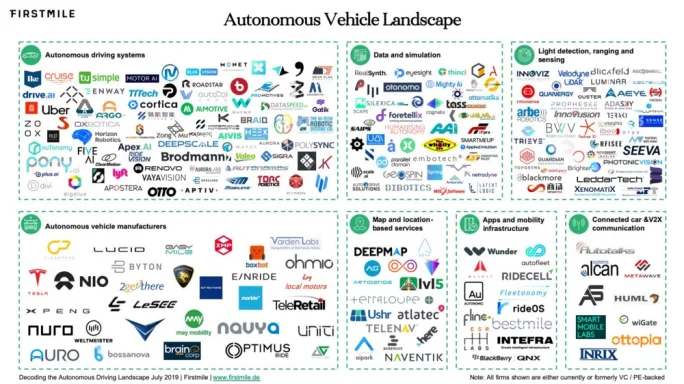
The autonomous vehicle landscape (as it stood in July 2019) is dependent on partnerships. When and how will car rental enter as a supplier or provider?
Image courtesy of First Mile VC.
We’ve been talking a lot about how transportation may look different after we emerge from the coronavirus pandemic, as mobility is reimagined with creative, efficient ways to put end users behind steering wheels. (Or we may just revert to our old habits, who knows.)
Looking longer term, one thought process has platform-based models such as Uber and Lyft taking the consumer-facing portion of the experience while car rental and other suppliers taking a fleet-management-as-a-service role behind the scenes. In this particular relationship, however, Sixt is a supplier and fleet manager, but is still very much involved with the customer.
Nevertheless, as we stare into an autonomous future, partnerships are essential. The emerging players in autonomy — from the manufacturers and the drive systems to the mobility service providers, data crunchers, and connected car platforms — realized this, which ushered in an era of high-profile acquisitions and tie ups.
Whatever that service looks like, the ones poised to win won’t be going it alone.
Subscribe to Our Newsletter
More Blog Posts

What Happens During a “Day on the Hill?”
Walking into a congressional office to discuss legislation certainly is outside the normal workday for most of us. But it’s a worthy, fun, and meaningful experience.
Read More →
What New Tariff Uncertainty Means for Rental Fleet Planning
Automakers won’t relocate production overnight, but uncertainty over Canadian tariffs could affect vehicle pricing, sourcing, and allocation well before the proposed Jan. 1 deadline.
Read More →
I'm Back
Life moves forward, as it inevitably does, but it sometimes seems to move in circles too. You end up in a different place, but you never close a door. Because you may walk back through it again.
Read More →
AI Can Supply The Damage Data, But Operators Must Apply The Judgments
The rental car industry held its first open discussion about the most controversial issue of the past year. Here are some key lessons, takeaways, and viewpoints.
Read More →
ICRS 2026 Countered The AI Drama, Thanks To These Panelists
One of my favorite sessions laid out the AI techno-optimism available to rental car operators ready to adapt their services for the decades ahead.
Read More →
Why Is JFK’s Grandson Interested In Your Rental Fleets?
Car rental operations should follow consistent practices when applying AI to vehicle damage assessments.
Read More →
‘Zero Friction’ Is The New Buzz Phrase for ICRS
This year’s International Car Rental Show hits the hot buttons on industry change and challenges.
Read More →
Rental EV Adoption Requires Local, Targeted Approach
The EV frenzy of the last few years has disillusioned the motoring public about going all-electric. Now it’s time to meet the market where it’s at.
Read More →
Why Car Rental Operations Must Use AI To Gain More Renters
A race has started between generations embracing AI and companies willing to adapt it to their operations.
Read More →
Speed Overtakes Car Rental Industry Practices
Technology, data, and digital advances are combining to create a business climate full of information, impatience, and instant results.
Read More →