



When Industry Groups Go to Capitol Hill
Walking into a representative’s or senator’s office to cogently deliver a message that will inspire change is an exhilarating, exhausting, and daunting task. Here’s an inside look on how these meetings go down.

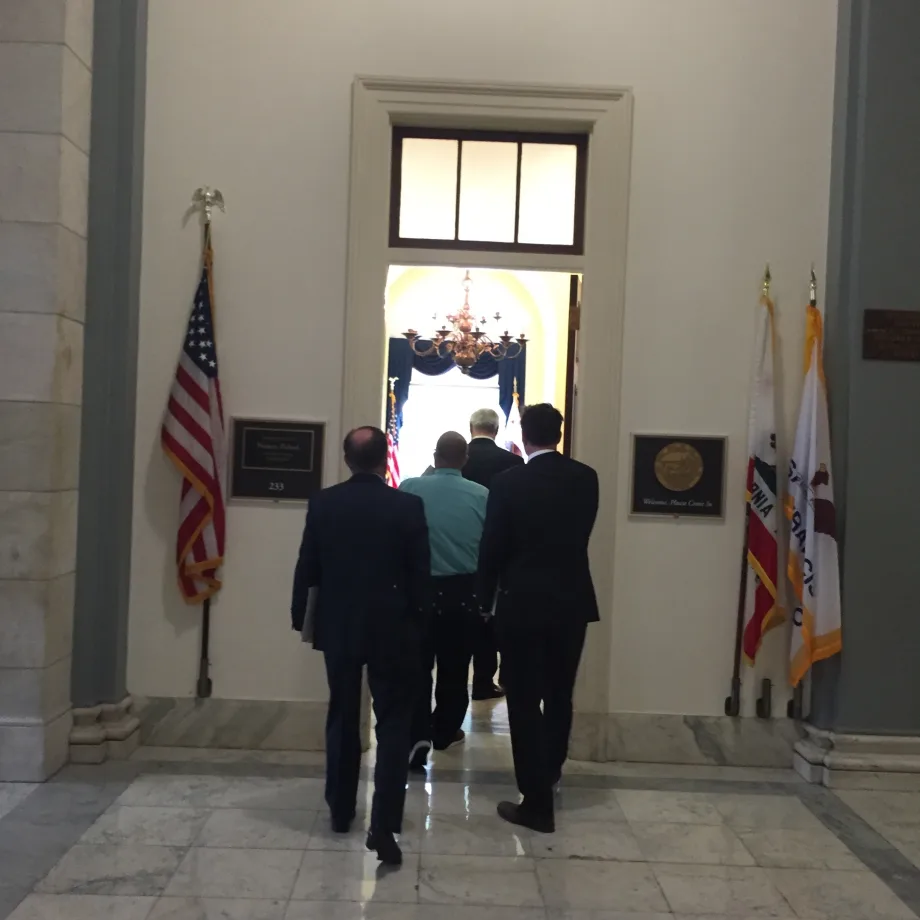
Photo by Chris Brown.
I just got back from the annual “Day on the Hill” meeting with the American Car Rental Association (ACRA). This is my fifth rodeo, so to me the proceedings have almost gotten perfunctory — but that shouldn’t blemish the importance of these meetings. More on that later.
Some with experience on The Hill will nod and smile at these insights; those who haven’t will have a better basis of understanding.
When Congress is in session, Capitol Hill is teeming with name-tagged and t-shirted industry and advocacy groups traversing the Capitol’s square-mile quad amongst protests, placards, speeches, and news crews setting up for remotes. It’s a lot of walking and short taxi rides. Yes, you’ll “get your steps in.” And D.C. is still pretty steamy in late September, especially in a dark suit.
These groups are making their way to meetings in eight office buildings, three for the Senate and five for the House. Getting inside any building entails a laborious security check — you could be removing belts and metal jewelry 10 times in a day.
Many of the office buildings are connected by tunnels, and the buildings themselves have endless halls and staircases. You run into the same industry and advocacy groups throughout the day, often rotating in and out of the same offices. There is a lot of hall loitering but no benches or places to sit whatsoever — you’re standing outside until you enter your meeting.
Meetings are generally set up to connect with legislators who chair the committees that are related to your issues. They’re also organized by legislators’ constituents in your group.
Groups are most often shepherded by a “squire,” who sets up the meetings, coordinates logistics, and knows the issues. The groups also generally include a second point person who is equally well-versed in the issues. This could be a third-party or in-house lobbyist or a legislative affairs rep who has relationships with the aides and legislators themselves.
The majority of the groups consists of businesspeople, association members, and folks that care enough about these issues to come to D.C. to speak to legislators.
As a constituent, you may know the issues as they affect your life and business, but you wouldn’t necessarily be expected to know who is sponsoring legislation and how it’s tracking — that’s the job of the lobbyist, squire, or legislative affairs rep. Everyone has a role in this age-old system. It works well.
Legislative aides take most of the meetings. They’re sharp, personable, and young. Your interactions with them will have you convinced they were tops in their graduating classes.
You often do get an audience with a Congressperson or Senator. Those meetings have a heightened air about them; they’re the rock stars in their native environments. Their job is to make you feel good, whatever your political stripe, and they succeed.
But they may have to bolt to the House or Senate chambers, reminded by the ubiquitous Congressional wall clock that uses a series of buzzes and lights around its face to count down to the vote.
Meetings last about 15 minutes. You may come in with one central issue or up to four issues; any more risks info fatigue for the allotted time. The idea is to succinctly deliver the importance of the issue for your group and how legislation would affect it positively or negatively. Legislation may be looking for a sponsor or awaiting a vote. Or there may be no legislation just yet, you’re there to get the issue on their radar.
After the point person speaks, it is important for the constituents to weigh in. After all, you’re their voting base, and as ineloquent or nervous as you might be in the room, your issues are their issues. They truly want to hear what you have to say.
Legislators and their staff will express genuine concern and ask good questions. They’ll be upfront (most of the time) on how they see the other side framing the issues. They’ll probe your group to understand if the issue or legislation is gaining momentum, and who else they need to talk to about it.
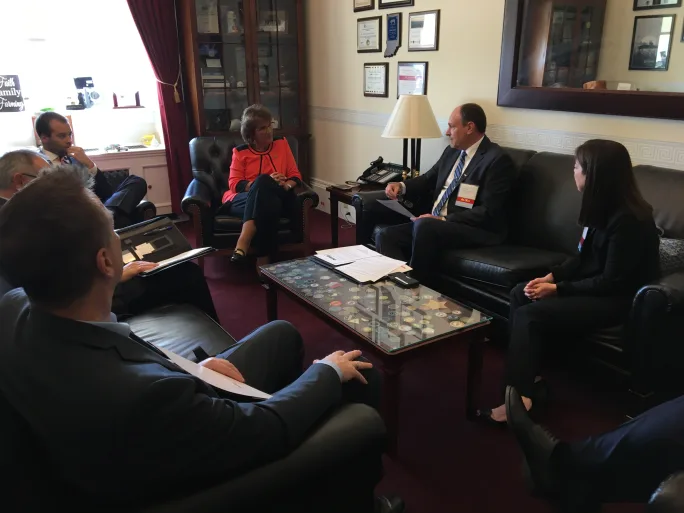
The ACRA Midwestern delegation meets with Representative Jackie Walorski (R-IN2).
Photo by Chris Brown.
Politics is as divisive as it may ever be in the history of our country. But these meetings always impress on me how most of the time D.C. is just another work environment. The explosive stuff on the news is often a distraction to the task at hand.
Many issues — say, discriminatory excise taxes, cybersecurity in motor vehicles, vehicle data access — aren’t easily divided by party lines. Take for instance H.R. 4311, which aims to prevent discriminatory excise taxes on car rental transactions. The bill is co-sponsored by Steve Cohen (D-TN9) and Steve Chabot (R-OH1), polar opposites politically who came together on this issue.
Others in the ACRA group have been to a few D.C. meetings as well. “We do this every year and they (the aides) take notes and smile but I wonder if any of it matters,” one member commented.
Yes, when the next group enters their offices those aides will listen intently, nod, and scribble notes just like they did for you.
But those meetings do make a difference. Who remembers when ACRA was “reborn” in 2006? Before then, there was a much smaller, much less unified voice heard in those Congressional office halls. The result was state and local governments marching onto a virtually empty battlefield to levy predatory excise taxes on car rental transactions.
Last year, through strong and constant industry education and support, national legislation was passed as part of the FAA reauthorization to ensure any new taxes on car rental airport transactions are assigned to airport use only. It was a major win, but challenges remain. The endeavor on Capitol Hill continues.
They do listen. Things in Washington do get done — though if you’re not participating in the discussion, perhaps not in your favor.
More Blog Posts
What Happens During a “Day on the Hill?”
Walking into a congressional office to discuss legislation certainly is outside the normal workday for most of us. But it’s a worthy, fun, and meaningful experience.
Read More →
What New Tariff Uncertainty Means for Rental Fleet Planning
Automakers won’t relocate production overnight, but uncertainty over Canadian tariffs could affect vehicle pricing, sourcing, and allocation well before the proposed Jan. 1 deadline.
Read More →
I'm Back
Life moves forward, as it inevitably does, but it sometimes seems to move in circles too. You end up in a different place, but you never close a door. Because you may walk back through it again.
Read More →
AI Can Supply The Damage Data, But Operators Must Apply The Judgments
The rental car industry held its first open discussion about the most controversial issue of the past year. Here are some key lessons, takeaways, and viewpoints.
Read More →
ICRS 2026 Countered The AI Drama, Thanks To These Panelists
One of my favorite sessions laid out the AI techno-optimism available to rental car operators ready to adapt their services for the decades ahead.
Read More →
Why Is JFK’s Grandson Interested In Your Rental Fleets?
Car rental operations should follow consistent practices when applying AI to vehicle damage assessments.
Read More →
‘Zero Friction’ Is The New Buzz Phrase for ICRS
This year’s International Car Rental Show hits the hot buttons on industry change and challenges.
Read More →
Rental EV Adoption Requires Local, Targeted Approach
The EV frenzy of the last few years has disillusioned the motoring public about going all-electric. Now it’s time to meet the market where it’s at.
Read More →
Why Car Rental Operations Must Use AI To Gain More Renters
A race has started between generations embracing AI and companies willing to adapt it to their operations.
Read More →
Speed Overtakes Car Rental Industry Practices
Technology, data, and digital advances are combining to create a business climate full of information, impatience, and instant results.
Read More →