




Hyre Launches Car Rental Spots at Norway’s Largest Airports
The company’s rental car 2.0 digital business model allows customers to go straight from planes to their reserved vehicles.

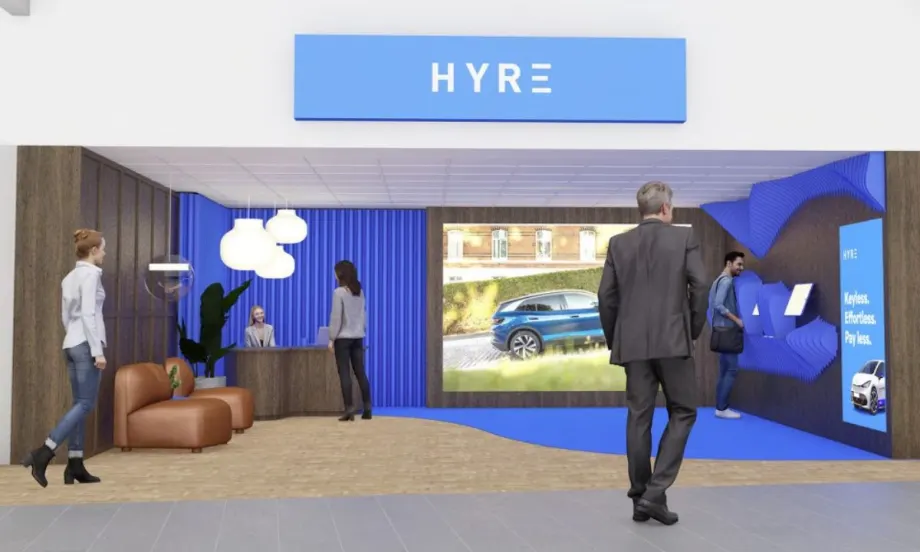
Hyre will not have traditional car rental desks at its locations, such as this kiosk-lounge style outlet at the Oslo airport in Norway.
Photo illustration: Hyre
Hyre, a car-sharing company serving the Nordic countries, is expanding into the airport market with a business model that saves car renters time waiting in line.
Already established as a downtown mobility player and a fast-growing force in the replacement car segment, Hyre will now bring its digital-first rental model to the busiest travel hubs in Norway. [Hyre is a separate company not connected to the U.S. carsharing platform, HyreCar].
On Oct. 1, Hyre will officially launch at Oslo, Bergen, and Trondheim airports after winning a tender earlier this year. [Winning a tender in business means being selected by a client to provide goods, services, or complete a project for a specified price].
The company will take over the rental counters and parking facilities previously held by Europcar, marking Hyre’s first major airport expansion.
“The car rental market at Norwegian airports has more than doubled since before the pandemic, now representing several hundred million euros annually,” said Hyre CEO Nils Petter Nordbø in a Sept. 22 news release. “Entering this market is a natural next step for us. Airports are where travelers expect efficiency, transparency, and reliability - and that’s exactly what Hyre delivers.”
Hyre will launch operations at Oslo, Bergen, and Trondheim airports and is ready to deploy a large fleet of vehicles as demand picks up. Unlike traditional rental companies, Hyre lets travelers head straight from the plane to their car saving the time spent waiting in line. Customers who haven’t pre-booked can use Hyre’s self-service kiosks, and on-site staff will be available for those who need help.
“Our customers won’t face long queues after landing,” Nordbø said. “You go straight to your car, and the vehicle you booked is the one you get, not a ‘similar model.’ All extra costs like charging, tolls, or ferry crossings are calculated in real time, so you avoid surprise bills and admin fees weeks later. And if you need support, our customer service typically answers in under a minute — available every day from early morning until midnight.”
Bookings can be made through Hyre’s app, website, and corporate portals, with the service also fully accessible to international tourists outside the Nordics. Cars are unlocked digitally via the app. No physical keys required.
“Car rental has, by and large, worked the same way for decades,” Nordbø said. “We are competing with the global rental giants head on but with a model built for today’s travelers.”
While Hyre eases the customer journey, the company keeps familiar standards in place. “Every car is cleaned between bookings, and we will have staff on site to help with practical needs, like arranging a child seat,” Nordbø said.
Hyre’s airport entry underscores the company’s ambition to disrupt the traditional rental market with a model built for today’s travelers.
“We see this as the future of car rental,” Nordbø concluded. “Digital, seamless, and customer-focused. This is Car Rental 2.0.”
More Rental Operations

How Did This Independent Rental Operator Grow to 170 Vehicles in 4 Years?
With 170 vehicles across three Kentucky locations, Joel Price relies on an overseas team to handle reservations, payments, and after-hours customer service. It's one part of an unconventional approach to growing an independent rental operation.
Read More →
What Does It Take to Succeed in B2B Rentals?
The fundamentals may be familiar to daily car rental operators, but project-based truck rentals put different demands on the fleet and the business.
Read More →
NPR Builds on International Partnerships to Grow Rental Bookings
With Ana Laborde supporting broker development, NPR Auto Group is tailoring distribution strategies, rate packages, and partnerships to grow international reservations across its three brands.
Read More →
Advantage, Sixt Place Among Top Five in Annual Satisfaction Study
While Enterprise and National retain the top spots in JD Power’s 2026 rankings, the latest customer satisfaction results suggest renters can find competitive service beyond the biggest car rental names.
Read More →
The $100,000 Insurance Trap in Exotic Car Rentals
Exotic rental agencies often rely on customers’ personal auto policies to protect six-figure vehicles. But policy language can dramatically change the coverage for vehicles over $100,000 MSRP.
Read More →
The Booking Is Confirmed, But Is Your Customer Ready to Drive?
For international renters, a confirmed reservation doesn’t always mean they’re eligible to drive. Earlier checks can help operators catch documentation and payment issues before the customer reaches the counter.
Read More →
ICRS 2027 Opens Call for Papers
The International Car Rental Show seeks session proposals on the business, operational, and technology issues facing car rental operators. Submissions are due Jan. 15.
Read More →
Turo to Launch Vehicle Delivery Service
Turo Delivered will let travelers search for vehicles that hosts can deliver directly to hotels, homes, airports, train stations, and other locations.
Read More →
Palm Beach Airport Code Change Creates Car Rental Distribution Gap
A test of rental searches under the old PBI and new DJT airport codes returned largely different sets of brands and vehicles, highlighting a potential distribution problem for rental operators.
Read More →
U-Save Continues Dominican Republic Expansion with Launch in Punta Cana
The new franchise location builds on U-Save’s existing Santo Domingo operation and will begin taking reservations for October 2026.
Read More →