




LOR Declines by a Day in Q4 2023 as Rental Vehicle Repair Backlog Eases
The trend of predictable seasonal length of rental continues, with the decrease as positive, and many repairers finding ways to anticipate and operate in the new normal.

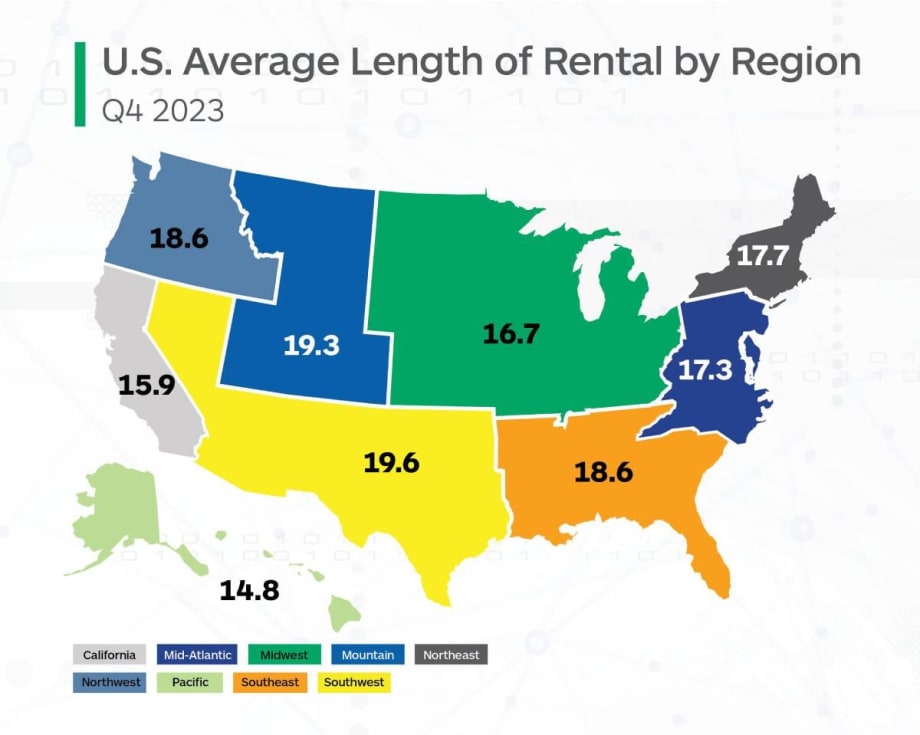
Despite regional variations, challenging market conditions remain, and overall LOR stands much higher than it was pre-pandemic.
Graphic: Enterprise Rent-A-Car
Overall length of rental (LOR) for collision-related rentals in Q4 2023 was 17.7 days, a one-day decline from Q4 2022, according to a report released Jan. 22 by Enterprise Rent-A-Car.
In Q4 2022, LOR (18.7 days) was up one-half day from Q4 2021, so the trend of declining year-over-year LOR tracked since Q2 2023 continues. Compared to Q4 2021, LOR is up 0.7 days.
Colorado had the highest LOR at 20.9 days, a 0.3-day increase from Q4 2022. West Virginia, Oklahoma, Rhode Island, New Mexico, and Kentucky were the next highest, respectively, all with an LOR of 20 days or higher.
Hawaii had the lowest LOR at 13.1 days, followed closely by North Dakota at 13.3 days. Iowa, Nebraska, and Washington D.C. had LOR under 15 days, with five other states (Vermont, Wisconsin, Maine, Illinois, and California) all coming in with an LOR under 16 days.
“Some decline in LOR in Q4 2023 lines up with some easing we saw in shops’ backlog of work during that period,” said John Yoswick, editor of the weekly CRASH Network newsletter in the Enterprise report. “The national average backlog in October dropped slightly to 4.1 weeks, down from 4.3 weeks in July. After drops the prior two quarters as well, shop backlog by last fall had fallen by a total of 1.7 weeks over nine months and was about 1.1 weeks lower in Q4 than the same period in 2022.”
PartsTrader’s chief innovation officer Greg Horn added, “While October delivery times were negatively impacted for the Big 3 because of the UAW strike, the fourth quarter saw median delivery days lower than the same quarter last year. This is congruent with the overall LOR reduction that Enterprise is seeing.”
Drivable Vehicles Days Down Slightly
For rentals associated with drivable claims, LOR was 16 in the fourth quarter, down 0.2 days from Q4 2022. Colorado had the highest drivable LOR at 19.2 days, followed by Rhode Island at 19 days and Oklahoma at 18.9 days.
North Dakota had the lowest LOR at 10.8 days, just above Hawaii at 11.6 days – the only two states under 12 days. Iowa, Vermont, and Nebraska all had LOR lower than 13 days. Colorado also had the highest increase, up 1.5 days, followed by Wyoming (+1.3) and New Mexico (+1.2).
Only 13 other states, plus D.C., had LOR increases. On the other end of the spectrum, Nebraska saw a decrease of 1.5 days, followed by Louisiana (-1.3) and Montana (-1.2). Eight additional states had decreases greater than one-half day, with Wisconsin, California, and Florida down 0.9 days each.
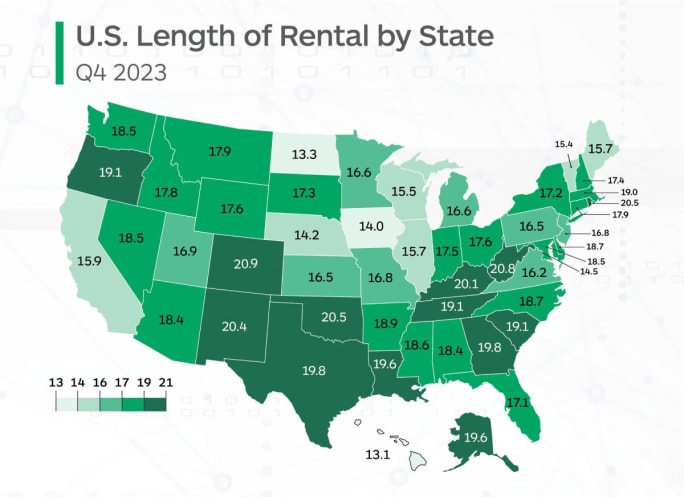
Colorado had the highest LOR at 20.9 days, a 0.3-day increase from Q4 2022. West Virginia, Oklahoma, Rhode Island, New Mexico, and Kentucky were the next highest, respectively, all with an LOR of 20 days or higher.
Graphic: Enterprise Rent-A-Car
Non-Drivable Vehicles Days See Big Drop
Non-drivable LOR in Q4 2023 was 24.7 days, a 2.4-day drop from Q4 2022. This is a sizable reduction, as Q4 2022’s LOR of 27.1 days was an equally significant rise (+2.8) from Q4 2021, when non-drivable LOR was 24.3 days.
West Virginia had the highest non-drivable LOR at 32.1 days, which was a 0.6-day increase over Q4 2022. New Mexico followed at 29.9 days, with Colorado (29.7) and Washington (29.4) just behind.
Iowa had the lowest non-drivable LOR at 21.2 days, just under Nebraska at 21.3 days. New York (21.8) and Virginia (21.9) were the other states under 22 days. Vermont also saw LOR go up 0.6 days, with Hawaii seeing an increase of 0.1 days.
Every other state, plus D.C., had a year-over-year decrease, with the largest being Louisiana – down a massive 5.5 days from Q4 2022, which follows what Enterprise observed in Q3 2023, when Louisiana’s non-drivable LOR declined 5.1 days. South Dakota (-4.3) and Arizona (-4) had the next-largest decreases.“Shops also may be processing more work more quickly as they gain the ability to do more ADAS calibration and related work in ways other than subletting it to new-car dealers, who also are often swamped with work,” Yoswick said. “The quarterly “Who Pays for What?” surveys we conduct with Mike Anderson of Collision Advice offer evidence of this change over time. In 2019, the surveys found that about one in three shops were sending virtually all their calibration work to dealers; this past fall, just 12% of shops said they were still doing that.”
Third party ADAS vendors have doubled their market share in that time, performing an estimated 40% of calibration work compared to 19% five years ago, he said. The percentage of calibration work conducted in-house at shops has also increased from an estimated 24% in 2019 to 32% today.
Total Loss Vehicles
LOR associated with total loss claims was 16.3 days in Q4 2023, a 1.9-day drop from Q4 2022. Total loss LOR in Q4 2021 was 17.6 days, so the current results are the lowest seen since before the pandemic.
Vermont had the highest total loss LOR at 20.2 days, with Wyoming, West Virginia, New Hampshire, Maine, and Washington all 19 days or higher.
Florida, Missouri, and North Dakota tied for the lowest total loss LOR at 14.7 days each. Only six states (Vermont, Wyoming, Alaska, Maine, Oklahoma, and Wisconsin) had total loss LOR increases in Q4 2023. All other states, plus D.C., saw decreases, with Hawaii’s (-7.1 days) decrease almost double that of the next-highest decreases in Tennessee and Oregon (both -3.8 days).
Overall LOR Outlook
As the numbers show, the trend of ‘predictable’ seasonal LOR continues. The LOR decrease is positive, and many repairers are finding ways to anticipate and operate in the new normal.
However, challenging market conditions remain, and overall LOR remains much higher than it was pre-pandemic.
Horn added: “We see a slight decrease in the average number of parts ordered per repair because of a mild fourth quarter winter compared to last year’s early and heavier winter. Parts are still a major factor in length of rental, but the decreases appear to be a result of a milder winter. Now that we are seeing significant weather in Q1 2024, we can expect a corresponding increase in non-drives with increased number of parts per repair.”
More Rental Operations

What Does It Take to Succeed in B2B Rentals?
The fundamentals may be familiar to daily car rental operators, but project-based truck rentals put different demands on the fleet and the business.
Read More →
NPR Builds on International Partnerships to Grow Rental Bookings
With Ana Laborde supporting broker development, NPR Auto Group is tailoring distribution strategies, rate packages, and partnerships to grow international reservations across its three brands.
Read More →
Advantage, Sixt Place Among Top Five in Annual Satisfaction Study
While Enterprise and National retain the top spots in JD Power’s 2026 rankings, the latest customer satisfaction results suggest renters can find competitive service beyond the biggest car rental names.
Read More →
The $100,000 Insurance Trap in Exotic Car Rentals
Exotic rental agencies often rely on customers’ personal auto policies to protect six-figure vehicles. But policy language can dramatically change the coverage for vehicles over $100,000 MSRP.
Read More →
The Booking Is Confirmed, But Is Your Customer Ready to Drive?
For international renters, a confirmed reservation doesn’t always mean they’re eligible to drive. Earlier checks can help operators catch documentation and payment issues before the customer reaches the counter.
Read More →
ICRS 2027 Opens Call for Papers
The International Car Rental Show seeks session proposals on the business, operational, and technology issues facing car rental operators. Submissions are due Jan. 15.
Read More →
Turo to Launch Vehicle Delivery Service
Turo Delivered will let travelers search for vehicles that hosts can deliver directly to hotels, homes, airports, train stations, and other locations.
Read More →
Palm Beach Airport Code Change Creates Car Rental Distribution Gap
A test of rental searches under the old PBI and new DJT airport codes returned largely different sets of brands and vehicles, highlighting a potential distribution problem for rental operators.
Read More →
U-Save Continues Dominican Republic Expansion with Launch in Punta Cana
The new franchise location builds on U-Save’s existing Santo Domingo operation and will begin taking reservations for October 2026.
Read More →
When AI Books the Rental Car, Who Controls the Sale?
As AI moves from comparing rental rates to completing transactions, operators need to understand how travelers find, interpret, rank, and ultimately see their offers. (Part 2 of 2.)
Read More →